
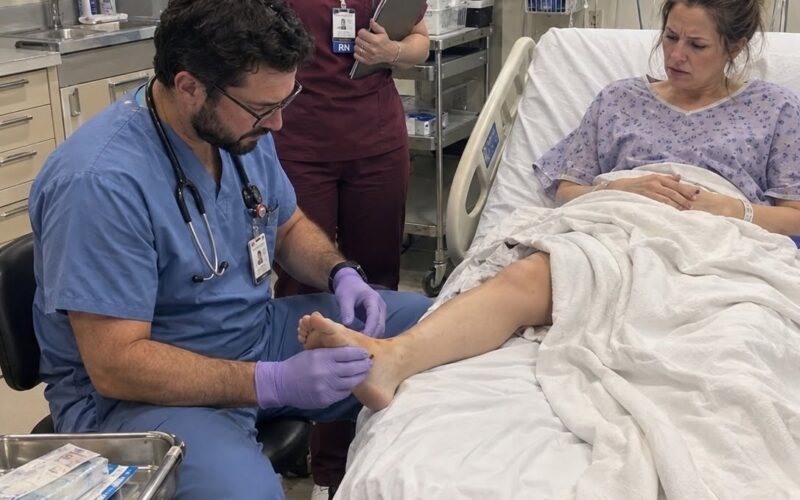

And she was beginning to wonder whether waiting was the worst decision she could make.
The Injury That Didn’t Seem Serious
The whole thing had started with an ordinary accident.
Jessi had been carrying laundry down the basement stairs when her heel caught against a rough edge. She stumbled and scraped the back of her ankle.
It hurt, but it didn’t initially seem like a major injury.
She cleaned it and put a dressing over the area.
When Luca came home later, he insisted on taking over.
“I’ll handle it,” he told her.
He had experience selling cleaning and sanitation products, and he often spoke confidently about first-aid supplies and household chemicals.
Jessi trusted him.
That first night, he cleaned the wound and replaced the dressing.
The next morning, however, the area was more painful.
By the following evening, the skin looked increasingly irritated.
Then came the fever.
At first, Jessi tried to convince herself that her body was simply reacting to the injury.
Luca wasn’t worried.
“It needs time,” he said.
When she suggested seeing a doctor, he gave her the same answer.
“Tomorrow.”
Seven Days of Waiting
The word slowly became part of their routine.
Tomorrow.
Tomorrow, they would visit a doctor.
Tomorrow, she would get the wound checked.
Tomorrow, she would feel better.
But tomorrow kept arriving without anything changing.
By the fourth day, Jessi was feeling increasingly unwell.
By the fifth, her fever had become severe.
She was sweating, shivering, and struggling to stay comfortable.
The skin around the wound looked different too.
It was warmer than the surrounding area, swollen, and increasingly red.
These are symptoms that can occur with skin infections such as cellulitis, which can become serious when treatment is delayed. Very high temperature, confusion, dizziness, rapid breathing, or other signs of severe illness require urgent medical attention.
But Jessi still hadn’t gone to the hospital.
She was listening to the person she trusted most.
And that was about to change.
The Moment She Finally Looked
On the seventh morning, Luca left the house for a meeting.
Jessi was alone.
For the first time in days, she decided to examine the injury herself.
She carefully removed the dressing.
What she saw frightened her.
The area was much more swollen and discolored than she remembered.
There were also red areas extending beyond the original scrape.
She sat on the edge of the bed.
Then she made a decision.
She wasn’t waiting anymore.
She called a taxi and went to the emergency department.
The Doctor’s Expression Changed
The triage nurse took one look at Jessi’s condition and moved her into an examination area.
A doctor came in shortly afterward.
He asked about the fever.
He asked when the injury happened.
Then he examined the ankle.
His expression changed.
“Who has been treating this wound?” he asked.
“My husband.”
“What has he been putting on it?”
Jessi hesitated.
“I don’t know exactly.”
The doctor looked at her.
“You don’t know?”
“He changes the dressing. He told me he was cleaning it.”
The doctor carefully examined the wound again.
He didn’t immediately tell Jessi what was happening.
Instead, he ordered tests and asked the nurses to document the appearance of the injury.
Then he asked another question.
“Do you have the dressing or anything your husband has been using on it?”
Jessi shook her head.
“I don’t know what he used.”
The doctor paused.
“Then let’s find out.”
A Different Kind of Concern
Over the next several hours, Jessi received medical treatment while the staff investigated the cause of her worsening condition.
Her fever and symptoms were concerning enough that the doctors needed to determine whether she had a serious infection or another complication.
A wound that becomes increasingly painful, hot, swollen, or discolored deserves medical attention. Serious infections can sometimes progress rapidly, and sepsis is a medical emergency that requires prompt evaluation and treatment.
But there was another issue.
Jessi couldn’t clearly explain what had been applied to her wound.
And that made the doctors cautious.
The hospital documented the materials that had come into contact with the injury and, where appropriate, preserved samples for examination.
Nobody accused Luca of anything.
At least, not yet.
Then Her Phone Started Ringing
Jessi’s phone vibrated.
Luca.
She watched the screen until the call stopped.
A few seconds later, another call came through.
Then a message.
Where are you?
Another appeared.
You should have told me before leaving.
Jessi stared at the screen.
She hadn’t told him where she was.
She hadn’t called him from the taxi.
And she hadn’t mentioned the hospital.
A few moments later, another message appeared.
Don’t tell them what I put on your leg.
Jessi felt the room become strangely quiet.
She showed the message to the nurse.
The nurse immediately contacted the appropriate hospital personnel.
The Question Nobody Expected
A hospital representative later asked Jessi whether she felt safe returning home.
She didn’t know how to answer.
She had never thought of Luca as someone she needed to fear.
He had been her husband.
He had been the person changing her dressing.
He had been telling her that everything would be fine.
But now there was a question she couldn’t ignore:
Why had he been so determined to keep her from getting medical attention?
The hospital followed its normal procedures for documenting the situation and, because there were concerns about possible harm, contacted the appropriate authorities.
That did not automatically prove that a crime had occurred.
It meant the situation needed to be investigated.
What the Investigation Found
Investigators later reviewed security footage from the couple’s home.
The recordings showed Luca repeatedly visiting a storage cabinet in the garage before attending to Jessi’s wound.
That detail alone didn’t establish wrongdoing.
But it gave investigators another question to answer.
What exactly had he been using?
They also examined the bottle recovered from the garage and compared it with information about the products Luca kept for work.
The investigation suggested that a product not intended for use on an open wound may have come into contact with Jessi’s injury.
The medical team could then consider whether chemical irritation or injury might have contributed to the worsening appearance of the wound.
Importantly, the doctors did not assume that every symptom had one explanation.
The fever still required its own medical evaluation.
The wound still needed treatment.
And the laboratory findings had to be interpreted in the context of the entire clinical picture.
Jessi Finally Understood Why the Doctor Had Been Concerned
Lying in the hospital bed, Jessi thought back to the previous seven days.
The repeated reassurances.
The dressing changes.
The requests not to touch the wound.
The promises that they would go to the doctor tomorrow.
She realized how easily a person can stop trusting their own instincts when someone they love repeatedly tells them that their concerns aren’t serious.
That realization frightened her almost as much as the medical problem itself.
Her Fever Finally Began to Improve
With appropriate hospital care, Jessi’s condition gradually stabilized.
Her doctors continued monitoring the infection and the injury while treating the problems they identified.
The fever eventually began to fall.
For the first time in a week, she woke up without feeling as though she were trapped inside a fog.
Her sister arrived at the hospital the following day.
She sat beside Jessi’s bed and took her hand.
“Why didn’t you call me?” she asked.
Jessi didn’t have a simple answer.
“I thought I was overreacting,” she finally said.
Her sister shook her head.
“You were sick.”
Those three words stayed with Jessi.
The Lesson She Couldn’t Forget
The investigation continued after Jessi left the hospital.
There were questions about the products used on the wound, the messages, the security footage, and Luca’s decisions during the week Jessi was ill.
The exact legal outcome would depend on evidence and the relevant authorities.
But Jessi no longer needed to wait for someone else to tell her whether her concerns were valid.
She had learned something much simpler.
If an injury is getting worse, if a fever becomes severe, or if you feel significantly more ill rather than better, medical advice shouldn’t be postponed simply because someone else thinks you should wait.
The CDC advises acting quickly when an infection is worsening or not improving, because sepsis can develop from infections and is a medical emergency.
And there was one final thought Jessi carried with her long after she left the hospital.
She had spent seven days waiting for tomorrow.
But sometimes, the most important decision is recognizing that today is the day you need help.