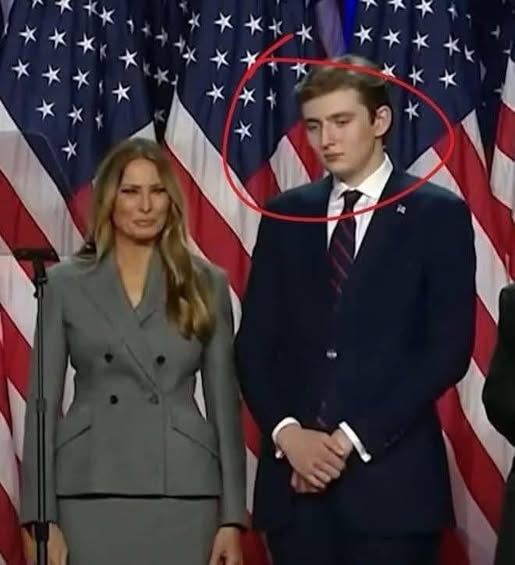
Then came loss.
When his grandmother was laid to rest, the world saw a headline. He felt the disappearance of one of the last places untouched by scrutiny. Suddenly, the boy long ignored was discovered again—this time measured and judged. Silence was interpreted. Stillness was analyzed. Even restraint became suspicious.
Grief was no longer private. It was projected onto him, repurposed to suggest strength or weakness, promise or threat. He was asked—without words—to represent something larger than himself. Anything but what he actually was.
His response was not defiance. It was withdrawal.
In a culture that treats visibility as currency, absence became his quiet form of control. He did not explain himself. He did not correct narratives. He did not perform resilience or rebellion. He simply withheld. Not as a statement, but as self-preservation.
There is power in that choice.
He carries grief without narrating it. Growth without broadcasting it. Curiosity without packaging it for consumption. He allows himself to remain unfinished, unbranded, and undefined in a world obsessed with early conclusions and inherited destinies.
That restraint is often misunderstood. Silence is mistaken for secrecy. Distance is read as arrogance. But silence can be a boundary, and distance can be care. Not everything withheld is hidden out of fear—sometimes it is protected out of respect.
He is not a political symbol. He is not a forecast of a legacy. He is not a metaphor waiting to be decoded. He is a young person moving through a moment shaped by forces far beyond his control, asking only for what should never be controversial: privacy.
There is a persistent belief that children in public families owe the world something simply by existing—a reaction, a narrative, a performance. But childhood is not a contract. Grief is not public property. Curiosity does not outweigh dignity.
By choosing quiet, he offers no speeches and issues no rebuttals. Yet the message is unmistakable: visibility is not obligation. Silence is not consent. Proximity to power does not erase humanity.
He stands—often awkwardly, often silently—in moments the world insists on magnifying. And by refusing the role assigned to him, he reminds us of something increasingly rare: it is still possible to exist without explanation.
He is not an heir-in-waiting. He is not a headline. He is a boy carrying loss in a world that struggles to look away. And if dignity still has a place in public life, it begins by granting him what he never offered to surrender—the space to grow, to grieve, and to become, on his own terms.
What are your thoughts on privacy for public families—especially their children? Share your perspective and join the conversation.