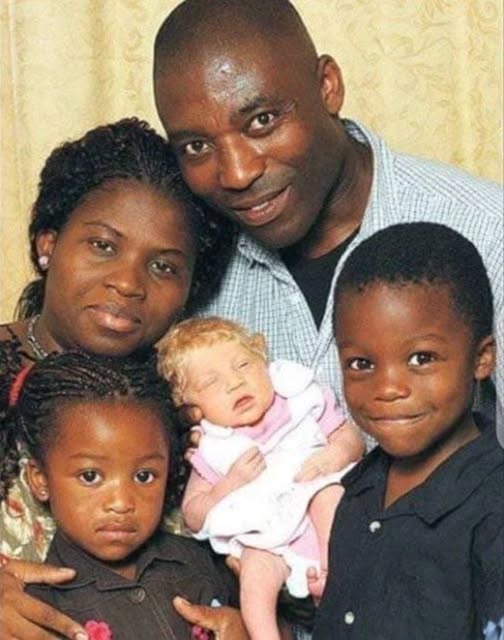
Before welcoming a new baby, many parents spend months wondering who their child will resemble. Will they inherit mom’s smile or dad’s eyes? Dark curls or straight, lighter hair? Imagining these details is part of the joy and anticipation that surrounds pregnancy.
Of course, appearance is secondary to what truly matters: a healthy child growing up in a safe and loving home. Still, it’s perfectly natural for families to form expectations based on familiar traits. Eye color, hair texture, and skin tone often seem to follow patterns we recognize within relatives.
Yet biology doesn’t always follow simple predictions.
That was the experience of Angela and Ben Ihegboro, a couple of Nigerian heritage living in London. In 2010, they welcomed their third child, a daughter named Nmachi. What drew widespread attention was that she was born with very light skin, blue eyes, and blonde hair—features that contrasted with both parents and her two older siblings.
The reaction was one of surprise, but also immediate love. While curiosity spread publicly, the family focused on their daughter’s well-being. Medical professionals later indicated that she did not show the defining characteristics of classic albinism, a genetic condition involving reduced melanin production and often associated with vision concerns. Instead, her case highlighted the complexity of inherited traits.
Understanding How Genetics Works
Many of us learn a simplified version of inheritance in school: dominant versus recessive genes. While useful as an introduction, human features such as skin tone, hair color, and eye color are influenced by multiple genes working together. This is known as polygenic inheritance.
Melanin—the pigment responsible for coloring skin, hair, and eyes—is regulated by several genes. Variations in these genes can produce a wide spectrum of appearances, even among children born to the same parents.
Because genetic variants can be carried silently for generations, two parents may each possess uncommon recessive traits without visibly expressing them. When those traits combine in a child, the outcome can be unexpected.
Possible Explanations
Although no detailed public genetic report was released in this case, experts often point to several scientifically grounded possibilities in similar situations:
1. Recessive ancestral traits
Genetic variations can persist quietly in family lines over long periods. Human populations have mixed and migrated throughout history, making genetic backgrounds more layered than they may appear.
2. Natural genetic variation
Spontaneous genetic changes occur regularly and contribute to human diversity. Most are harmless and simply expand the range of possible traits.
3. Variations in pigmentation
Not all differences in coloring are linked to well-known medical conditions. Some forms of pigmentation variation are mild and may change as a child grows. It’s also common for infants’ eye or hair color to shift during early childhood as melanin levels adjust.
Addressing Assumptions
Stories like this often generate speculation, especially online. However, from a biological standpoint, it is entirely possible for two parents with similar outward appearances to have a child who looks markedly different. Genetics does not operate on a strictly visible checklist.
Modern research also emphasizes that race is a social category more than a rigid biological division. Human genetic variation overlaps widely across populations, and outward appearance represents only a small portion of our overall DNA.
The Science of Pigmentation
Researchers have identified multiple genes involved in determining pigmentation. Variations in genes such as OCA2, MC1R, and SLC24A5 contribute to differences in eye color, hair shade, and skin tone.
For example:
- Eye color depends on interactions among several genes.
- Hair color results from differing amounts of eumelanin and pheomelanin.
- Skin tone reflects both the type and distribution of melanin.
Because these elements combine in complex ways, siblings can look strikingly different while sharing the same parents.
Beyond the Headlines
While scientific explanations are fascinating, the emotional dimension matters most. For Angela and Ben, the priority was their daughter’s health. Reports indicated she was born healthy, which is the greatest reassurance for any family.
Public attention often amplifies unusual cases, sometimes framing them as mysteries. In reality, they reflect the broad and natural spectrum of human genetics.
A Reminder About Diversity
Human biology is remarkably varied. Even when certain features appear consistent in a family line, unexpected combinations can emerge. Infants’ coloring may also evolve over time, reminding us that development is dynamic.
Accurate information is important when discussing topics like genetics and race. Clear scientific explanations help prevent misunderstanding and reinforce trust in biological research.
What Truly Matters
At its core, this story is about parents welcoming a child into their lives. Regardless of appearance, every child deserves love, stability, and belonging.
Genetics can surprise us. Family bonds, however, are not built on physical traits but on care and connection.
In the end, what stands out isn’t the unexpected coloring of a newborn—it’s the universal experience of parenthood: anticipation, astonishment, and unconditional love.
And sometimes, nature simply reminds us how wonderfully complex it can be.