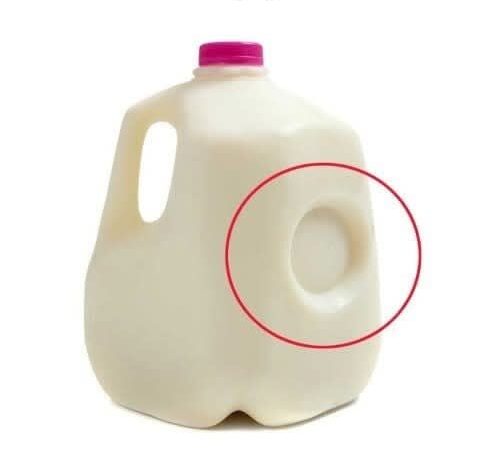
That little dent on your milk jug isn’t a flaw—it’s a tiny marvel of engineering working silently in your fridge. Most of us glance past it, assuming it’s a quirk of plastic molding. But in reality, that small circle is a built-in pressure valve, a shock absorber, and a hidden guardian designed to keep your milk safe and your kitchen mess-free.
Milk is more than just a drink—it’s a living, delicate liquid. Proteins, sugars, and fats make it a perfect environment for bacteria, especially when temperatures fluctuate or it nears its expiration. As microbes break down the milk, gases like carbon dioxide build up inside the jug. Without a way to release that pressure, the container could bulge, burst, or even leak, leaving a sticky disaster in your fridge.
Enter the dent. Known in packaging as a “vacuum button” or expansion joint, it’s designed to be the jug’s most flexible spot. When pressure rises, the concave dent pops outward, creating space for expanding gases and signaling that something might be off inside. If you notice the dent bulging, it’s your milk telling you to check its freshness before pouring.
The design doesn’t stop at spoilage prevention. During shipping, milk jugs face vibration, bumps, and impact from being stacked in crates and trucks. Liquids transmit force instantly, which could rupture a standard container. The dent acts like a mini “crumple zone,” flexing to absorb shocks and protecting the seams, handle, and cap. It also helps during manufacturing, ensuring even plastic thickness and reducing weak spots, which keeps the jug strong yet lightweight.
Continue reading on next page…