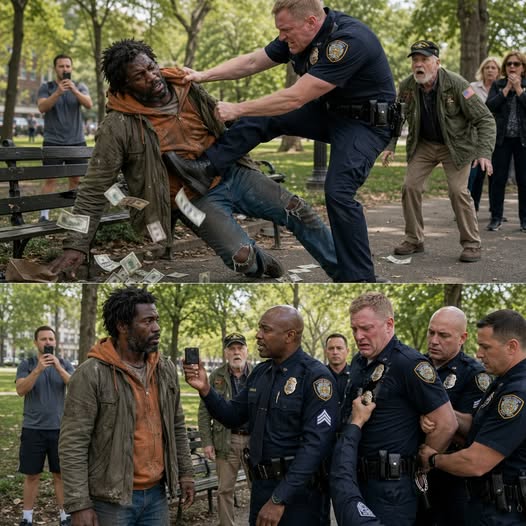
For six days, Morrison Park had been my world—cold benches, restless nights, and the kind of quiet that makes you feel erased from existence. To everyone passing by, I was just another homeless man wrapped in a worn blanket, blending into the background of a city that had long stopped noticing people like me.
That invisibility wasn’t accidental. It was part of the operation.
Officer Walsh didn’t realize that when he grabbed my collar that morning. His grip was tight, confident—like someone used to never being questioned. He leaned in close, expecting fear, expecting silence, expecting control. Instead, he got a calm voice telling him something he didn’t expect: Internal Affairs had been watching.
The shift was immediate. Two officers nearby froze. A jogger slowed down. The air itself seemed to change as uncertainty crept into a man who had built his authority on certainty.
Walsh tried to regain control the only way he knew how—force. He pushed me back and raised his voice, calling it “resisting,” already trying to shape the story in his favor. But this wasn’t a situation he could narrate anymore.
I stayed still.
Then I reached into my coat.
The moment I revealed my badge, everything stopped.
Captain Jonathan Rivers. Internal Affairs.
The reaction was exactly what you’d expect when the roles people assume are suddenly turned upside down. Walsh stared at the badge, then at me, trying to force reality to bend back into something familiar. But it didn’t. Not this time.
What he didn’t know was that the last six days had already been recorded in full detail. Every encounter, every escalation, every moment of abuse that had been dismissed or ignored—captured, documented, and streamed to a secure internal server.
Keep reading…