 Curious & Viral
That Tiny Hole in Nail Clippers Has a Purpose—But It May Not Be What You Think
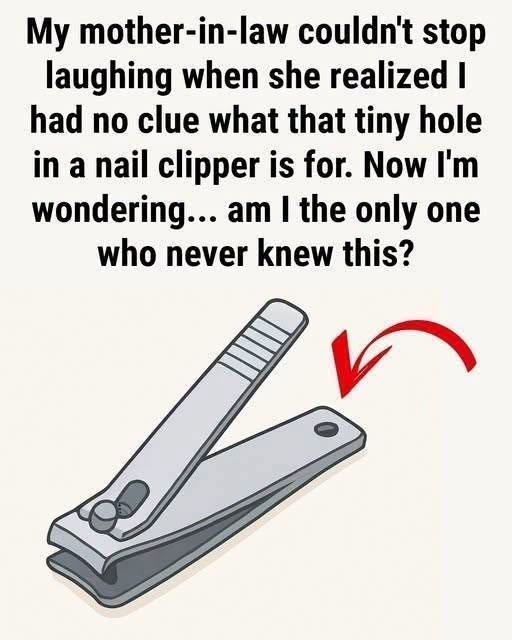
I was sitting at home one afternoon when my mother-in-law noticed me using a pair of nail clippers.
She suddenly laughed.
“You know what that little hole is for, right?”
I looked at the clippers in my hand.
Honestly, I had never thought about it.
The small round opening on the metal body had always been there, but I'd never questioned why. It seemed like one of those tiny design details that manufacturers added without much reason.
Apparently, I wasn't the only person who had ignored it.
The Obvious Explanation
One purpose of the small hole is surprisingly simple.
On some nail clippers, it can be used to attach the tool to a key ring, chain, or other small holder.
That's particularly useful for compact travel clippers, which are easy to lose in a toiletry bag, drawer, or suitcase.
But there's another part of the design that is easy to misunderstand.
It Works With the Clipper's Lever
If you look closely at a standard nail clipper, you'll notice that the upper lever isn't simply resting on top of the cutting mechanism.
It is connected to the clipper through a small pivot point.
The hole in the body is part of that mechanism on many traditional designs. A small pin or post on the lever fits into the opening, allowing the lever to pivot and transfer force to the cutting blades.
That's what makes the familiar squeezing action possible.
In other words, the hole isn't necessarily a random opening in the metal.
It's part of a simple mechanical system.
Why the Design Looks So Simple
Nail clippers rely on a basic principle of leverage.
When you press down on the lever, the force is transferred to the cutting jaws. The jaws then close against the nail.
 Up Next: Page 2 of 2
Because the mechanism is compact, the designers can create a surprisingly effective...
That's one reason the same general design has remained familiar for generations.
Continue Reading