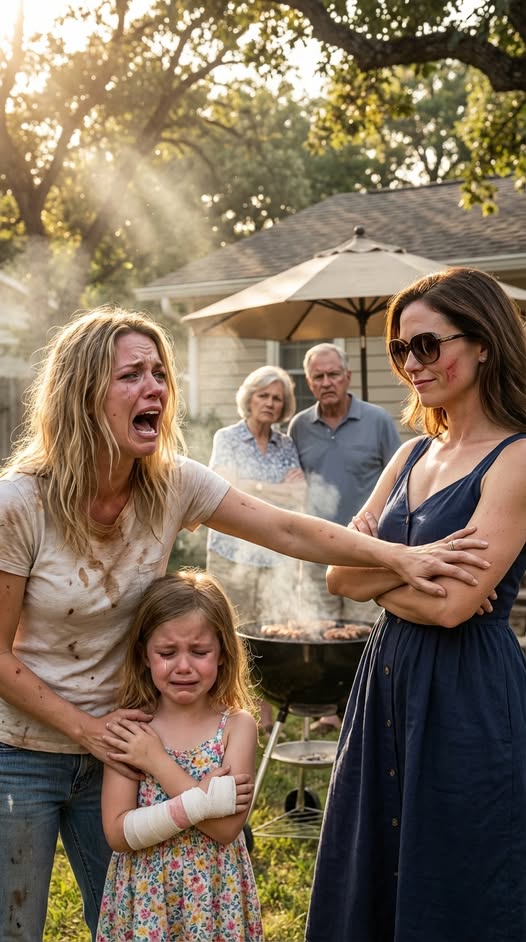
The scream that tore through the sticky summer air was nothing like the usual cry of a child who had tripped or scraped a knee. It was raw, instinctive, and filled with terror—the kind of sound that instantly tells you something has gone terribly wrong. It sliced straight through the chatter, the clatter of bottles, and the cheerful crackle of food on the grill at our family barbecue. Laughter died mid-sentence.
I was inside, helping my aunt carry glasses of iced tea, when that unmistakable pitch hit me. Every parent knows it. It bypasses logic and drills straight into your nervous system. My hands went numb, the tray slipped from my fingers, and glass exploded across the kitchen floor. I didn’t stop. I was already running, my heart pounding so hard it felt like it might break free from my chest.
I sprinted past the kiddie pool, past my brother flipping burgers, until I reached the far edge of the yard. That’s where time seemed to freeze. My four-year-old daughter, Ruby, was collapsed against the wooden fence, her small body shaking violently as she sobbed. But it was her arm that made my stomach lurch. Her left wrist hung at an angle that was horrifyingly wrong, twisted in a way no limb ever should be.
Standing above her was my older sister, Veronica. Her arms were folded, her face wearing an expression of bored irritation—as if Ruby were an inconvenience rather than a child in agony.
“What happened?” I shouted, dropping to the ground beside my daughter.
Ruby’s face was streaked with dirt and tears, her eyes locked onto mine, silently begging me to make it stop.
Veronica sighed dramatically and rolled her eyes. “Oh my God, calm down. It was just playing around. She fell. Kids fall all the time. She’s exaggerating.”
I reached for Ruby, my hands shaking so badly I could barely steady her. “Mommy’s here,” I murmured, trying to keep my voice calm. She whimpered as I touched her arm. The swelling had already begun, the skin turning dark and angry.
“This isn’t a fall,” I said, panic tightening my throat. “Her arm is broken.”
As I leaned in to lift Ruby, Veronica shoved me hard enough that I stumbled. “I didn’t do anything!” she snapped. “You’re always dramatic. Maybe if you didn’t coddle her, she wouldn’t cry over every little thing.”
The noise drew everyone else. My father, Robert, pushed forward, clearly annoyed rather than concerned. He glanced briefly at Ruby and frowned. “What’s going on? Why are you causing a scene? It’s just kids playing.”
My mother, Eleanor, followed with a wine glass still in hand. Her gaze landed on Ruby with cold disapproval. “Enough. Veronica said it was an accident. Put some ice on it and stop making such a fuss.”
I stared at them, stunned. The people who were supposed to protect us stood united—not around a crying child, but around my sister. Years of being dismissed, blamed, and minimized burned away in an instant. Something inside me finally broke.
I stood up, walked straight to Veronica, and slapped her. The sound echoed across the yard. Her smug expression vanished, replaced by shock.
“You’re insane!” she screamed.
I didn’t respond. I picked Ruby up, held her tight against me, and walked away. Behind us, my mother screamed that I was no longer welcome. As I reached the car, my father hurled his drink toward us. The glass shattered near my feet. I never turned around.
At the emergency room, everything moved quickly. One look at Ruby’s arm and the staff rushed us back. The doctor was gentle, but his face grew serious after reviewing the X-rays. He pulled me aside and pointed to the image.
“This is a spiral fracture,” he said quietly. “It’s caused by a twisting force. This type of injury doesn’t happen from a simple fall. I’m legally required to report this.”
The words settled heavily between us. This hadn’t been an accident. Someone had deliberately twisted my child’s arm.
The next day blurred into police reports and silence. I blocked my family’s messages without reading them. Early the following morning, there was pounding at my door. My mother stood outside, disheveled and frantic. To my disbelief, she dropped to her knees.
“They arrested your sister,” she sobbed. “Please, you have to tell them it was a mistake. You’re ruining her life.”
“She broke Ruby’s arm,” I said evenly. “The doctor confirmed it.”
“She didn’t mean it!” my mother cried, anger quickly replacing tears. “She was trying to discipline her. Family protects family!”
“I’m protecting my child,” I replied. “That’s my job.”
When she threatened disownment and money, I laughed as I closed the door. None of it mattered.
The hardest moment came later, in a child psychologist’s office. Ruby sat quietly, clutching her cast, before whispering what had happened.
“I spilled juice,” she said. “On Auntie’s shoes. I said sorry.”
“And then?” the therapist asked softly.
“She grabbed my hand and twisted it. She said I was bad. She said not to tell you.”
I had to step outside to breathe. My sister had hurt my child—and my parents had defended her.
That day, I understood something clearly for the first time. I had lost a family, but I had chosen the right side. I chose my daughter, her safety, and the truth. And I would choose her again, every single time.