Parental care is often discussed as a uniquely human trait, yet the animal kingdom offers countless examples that challenge this assumption. While we readily accept that highly social primates experience deep emotional bonds, large predators—especially lions—are frequently portrayed as distant, aggressive, and ruled solely by instinct. This narrow view was quietly dismantled by an extraordinary moment captured at the Denver Zoo: a gentle, first-time interaction between a lion father and his cub that revealed a surprisingly tender side of one of nature’s most formidable animals.
At the heart of the story are Tobias, a fully grown male African lion, and his son Tatu, a cub whose arrival carried significance far beyond the zoo’s boundaries. Born on July 25, 2019, Tatu quickly became a favorite among caretakers thanks to his oversized paws, soft coat, and alert, curious expression. But his importance went well beyond his charm. He was the third cub born to Neliah, a lioness known for her strong maternal instincts, and his birth represented a meaningful step forward for lion conservation efforts. The most anticipated moment, however, was introducing Tatu to his father—an encounter that would later captivate audiences worldwide.
The broader context makes this meeting especially meaningful. Lion populations in the wild have declined at an alarming rate, with conservation data showing that nearly half of Africa’s lions have disappeared over the past 25 years. Habitat destruction, poaching, and reduced prey availability have placed the species under constant pressure. Against this backdrop, Tatu’s birth was more than a joyful event—it was a critical success for the Lion Species Survival Plan (SSP), a program overseen by the Association of Zoos and Aquariums. The SSP aims to preserve genetic diversity and long-term viability for species threatened in the wild.
For Tobias, this moment was particularly significant. Despite being mature and dominant, he had never fathered a cub before. His genetic contribution was therefore extremely valuable, but it also introduced uncertainty. In natural settings, male lions may react unpredictably to cubs, especially when they are newly introduced. While lions are unique among big cats for their social pride structure, interactions between adult males and cubs can range from protective to dangerously hostile. Because of this, zoo professionals carefully planned and monitored the introduction to minimize stress and risk.
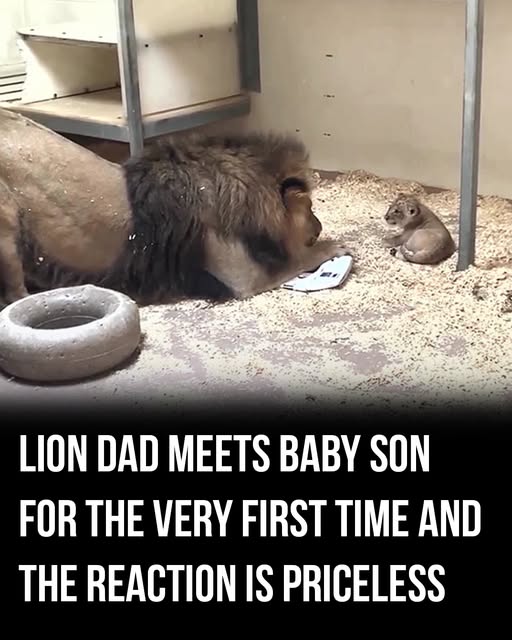
The footage of their first meeting quickly spread online, drawing attention not because of drama, but because of its calmness. Tobias, massive and powerful, approaches the tiny cub with measured caution. Instead of aggression, he lowers his head and gently investigates Tatu with slow movements and soft sniffs. The contrast between the father’s imposing presence and the cub’s small, unsteady body makes the moment especially striking.
Tatu’s response is equally telling. Rather than retreating, he behaves exactly as a healthy cub should—curious, bold, and playful. He swats clumsily at his father’s face, unaware of the sheer power standing before him. Tobias responds not with force, but with patience, offering a light nudge and maintaining a calm, watchful posture. The interaction suggests recognition, acceptance, and an early bond forming between father and son.
This brief exchange challenges long-held assumptions about predator behavior. It highlights that lion society is not defined solely by dominance and hunting, but also by social awareness and connection. For the Denver Zoo’s staff, the encounter confirmed that Tobias was not only genetically valuable, but socially capable of integrating into a healthy pride dynamic—a crucial factor in responsible animal management.
The widespread sharing of Tatu’s story served a larger purpose as well. Beyond being heartwarming, it helped bring attention to lion conservation in a way statistics alone cannot. Seeing a vulnerable cub and a gentle father allows people to emotionally connect with a species they might otherwise view as distant or abstract. It transforms conservation from an environmental issue into a relatable family story.
As Tatu grows and matures, that first meeting with his father remains an important milestone. It reflects the success of modern zoological care, which prioritizes emotional and social well-being alongside physical health. The careful handling of this introduction speaks to the zoo’s deep understanding of lion behavior and its commitment to long-term conservation goals.
In the end, the story of Tobias and Tatu is one of quiet optimism. It reminds us that even in an era of environmental uncertainty, moments of trust and connection still exist in the wild—and in the spaces dedicated to protecting it. The image of a powerful lion lowering himself to meet his cub is more than a touching scene; it is a symbol of continuity, resilience, and the enduring importance of family bonds—no matter the species.