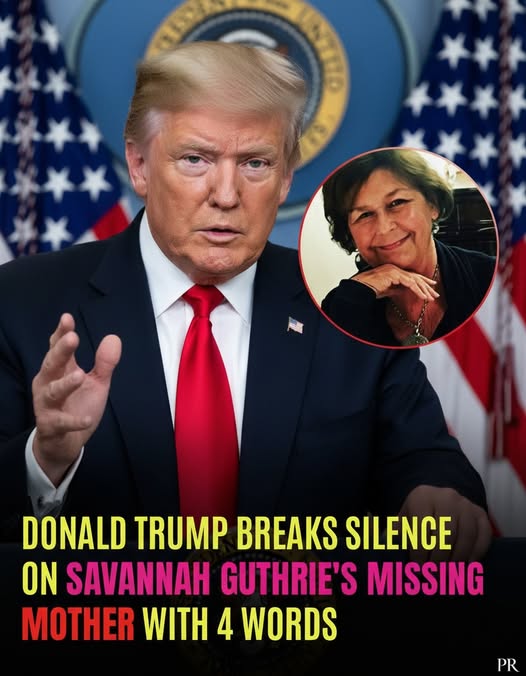
In today’s divided media landscape, where every comment becomes ammunition and restraint is almost nonexistent, genuine quiet moments stand out. For years, the dynamic between Donald Trump and journalist Savannah Guthrie played out in tense interviews, sharp exchanges, and headline-making confrontations. Their relationship symbolized the broader clash between political power and the press. But when the spotlight shifted from political conflict to a deeply personal crisis — the disappearance of Guthrie’s 84-year-old mother, Nancy — something unusual happened. The noise faded, and empathy took center stage.
When Trump was asked about the case unfolding in Tucson, he didn’t pivot to politics or deliver one of his trademark long remarks. Instead, he paused and offered a brief response: “Very sad. Very troubling.”
For a man known for expansive speeches and constant commentary, the simplicity of those words carried weight. There was no hidden jab, no attempt to redirect attention, and no rhetorical flourish. The short statement felt like recognition that the moment called for compassion rather than commentary. It marked a rare shift from public figure to fellow human witnessing a family’s nightmare.
Nancy Guthrie’s disappearance quickly grew from a local concern into a nationwide investigation. Friends described her as steady, routine-oriented, and deeply rooted in her community. When she vanished from her Tucson-area home, authorities immediately sensed something was wrong. The surrounding desert was searched extensively with volunteers, search dogs, and advanced technology, yet no trace suggested she had wandered away on her own. Investigators soon concluded that foul play was likely involved.
As days stretched into weeks, federal authorities joined the case, announcing a significant reward for information connected to her recovery. Reports of ransom messages complicated the search — some were exposed as cruel scams, while others remain under serious forensic review. Through it all, Savannah Guthrie has approached the public with quiet resolve, using her visibility not for attention, but to appeal for truth and answers.
Trump’s restrained response stood out largely because of the history between them. Many remembered their tense 2020 town hall, where Guthrie’s direct questioning sparked national debate. Given that backdrop, some expected silence or a pointed remark. Instead, what emerged was a moment of shared humanity — an acknowledgment that some situations rise above political rivalry.
Online reactions mirrored the country’s usual divisions. Some praised the comment as respectful and appropriate. Others speculated about motive. But those discussions quickly faded against the gravity of the ongoing search. Regardless of interpretation, the focus remained where it belonged — on a missing woman and a family trapped in uncertainty.
Authorities have repeatedly cautioned against internet speculation, stressing that amateur theories often hurt investigations more than help them. Tip lines can become flooded with rumors, and innocent people can be wrongly targeted. Law enforcement continues to follow verified evidence, emphasizing patience in what has become a slow and meticulous pursuit of truth.
Beyond press conferences and updates lies a family living through unimaginable limbo — waking each day hoping for news, yet bracing for heartbreak. Savannah Guthrie’s rare public remarks reveal not a television personality, but a daughter enduring a painful unknown. Trump’s brief words echoed what many across the country have felt watching the case unfold: sorrow mixed with deep unease.
There’s a quiet lesson in that moment. In an era where tragedy is often politicized or exploited for attention, sometimes the most meaningful response is restraint. Not every crisis requires analysis or debate. Sometimes acknowledging pain is enough.
As the investigation intensifies — now focused on tracking a primary suspect — hope remains for answers and, above all, for Nancy’s safe return. The desert search has become a high-stakes effort combining forensic work, surveillance, and coordinated manhunts.
Trump’s four words didn’t solve the case. They didn’t offer strategy or closure. But they created a brief pause in a culture usually driven by conflict — a reminder that beyond politics, loss is something everyone understands.
And until the silence surrounding Nancy Guthrie’s disappearance is finally broken, the nation waits, united not by ideology, but by concern.