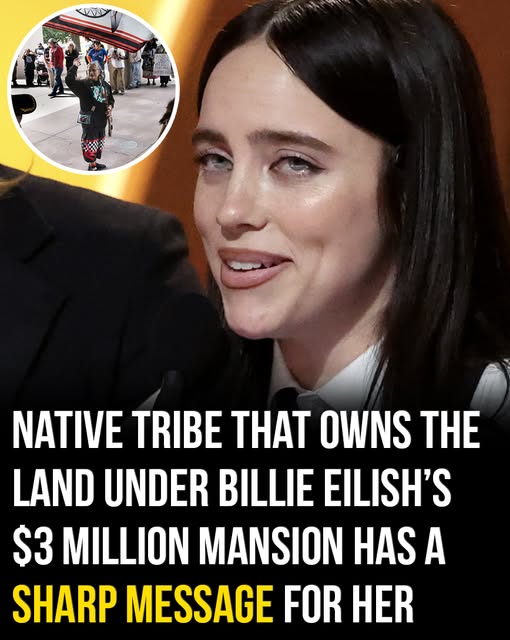
The intersection of celebrity influence and historical accountability came sharply into focus during the 68th Annual Grammy Awards, when Billie Eilish used her acceptance speech for Song of the Year to make a pointed political statement. On February 1, 2026, at the Crypto.com Arena, Eilish and her brother FINNEAS sparked intense public discussion that quickly extended far beyond the music world. “I’m grateful, of course, but I want to say this: no one is illegal on stolen land,” she announced, before adding a blunt critique of Immigration and Customs Enforcement (ICE).
The comments, which invoked centuries of European colonization and the forced displacement of Indigenous peoples, immediately divided audiences. Supporters praised the 24-year-old for using her platform to highlight systemic injustices surrounding sovereignty and immigration. Critics, however, highlighted a seeming contradiction, noting Eilish’s own high-value real estate in Los Angeles—reportedly between $3 million and $14 million—situated on the ancestral territory of the Tongva people.
Response from the Gabrieleno Tongva Nation
As online debate swelled, the Gabrieleno Tongva, the Indigenous people of the greater Los Angeles area, issued a cautious, clarifying statement. A spokesperson acknowledged Eilish’s role in drawing attention to the history of “stolen land” but emphasized that she had not engaged directly with the tribe regarding her property.
“We appreciate the attention Ms. Eilish has brought to these issues,” the statement read. “Her residence sits on our ancestral land. While she has not yet consulted with the tribe directly, we recognize the importance of public figures shedding light on this history.”
The tribe encouraged more precise acknowledgment in future discussions, noting that broad references to “stolen land” can obscure the living histories of specific nations. They welcomed the sentiment but urged explicit recognition of Gabrieleno Tongva territory. “It is our hope that future mentions make clear that the greater Los Angeles basin is Gabrieleno Tongva territory,” the statement concluded.
Criticism Intensifies
While the Tongva sought constructive engagement, political commentary quickly escalated. Many voices demanded that Eilish move beyond symbolic statements, sparking broader debates over the effectiveness of “land acknowledgments” and whether such gestures carry weight without concrete action.
Some conservatives were particularly vocal, framing her comments as hypocritical due to her status as a wealthy property owner. Utah Senator Mike Lee suggested that public acknowledgment should be paired with tangible restitution: “Anyone who publicly declares land ‘stolen’ should return it to Indigenous communities,” he wrote online.
Florida Governor Ron DeSantis dismissed the remarks as “empty rhetoric” and argued Eilish should relinquish her mansion. Even Elon Musk chimed in on social media, agreeing with the sentiment. The common critique emphasized a “put up or shut up” approach, questioning whether her activism is meaningful if she remains on land she acknowledges as taken.
Immigration and Broader Controversy
Eilish’s linking of “stolen land” with ICE drew further scrutiny. Her expletive-laced condemnation comes amid ongoing tensions over federal immigration enforcement, including controversial operations in Minneapolis that resulted in the deaths of U.S. citizens Renee Good and Alex Pretti.
Long an outspoken critic of ICE, Eilish has accused the agency of violence and unlawful detentions. By framing immigration enforcement in the context of Indigenous sovereignty, she argued that the concept of “illegal” status is a construct imposed on land that was originally inhabited by others.
Critics, however, challenged her to put her beliefs into action. Social media users suggested she use her estate to shelter asylum seekers, portraying her existing property and security as conflicting with her moral position.
The Challenge of Modern Restitution
The debate around Eilish highlights the tension between symbolic acknowledgment and material action. For some, statements about Indigenous land serve as a necessary first step in educating the public. For others, they risk being performative gestures that do not alter real-world conditions.
The Tongva response points to a middle ground: visibility is valuable, but specificity and relationship-building are crucial. Naming the Gabrieleno Tongva territory underscores that the land is not abstract but home to a community actively seeking recognition and sovereignty.
As of early February 2026, Eilish’s team has not publicly responded to the tribe or to political criticism. Whether she will pursue a formal partnership with the Gabrieleno Tongva—through property restitution, funding programs, or other forms of support—remains uncertain. One thing is clear: in today’s hyper-connected world, public statements are now expected to be accompanied by meaningful, documented action.