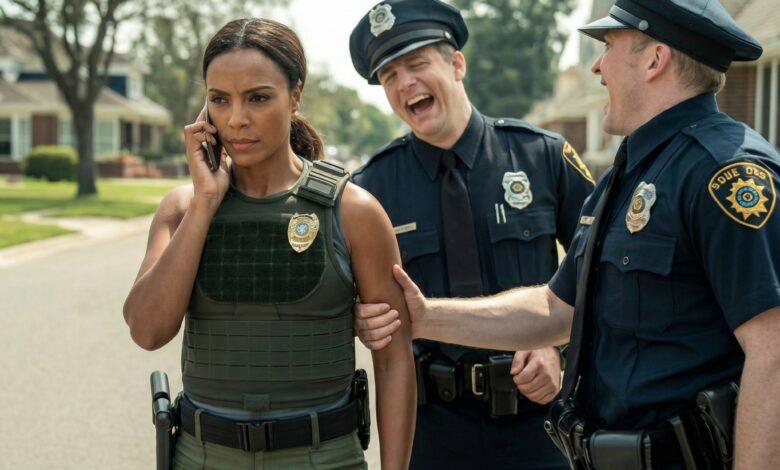
Lieutenant Jasmine Carter had faced life-or-death situations overseas, earning a Purple Heart and Bronze Star during two combat deployments. She understood the weight of silence and the value of composure. But on a humid Friday night outside Charleston, South Carolina, she confronted a different kind of danger—one where authority came with bias instead of honor.
Fresh from a memorial service for a fallen comrade, Jasmine was pulled over in her rental car. She followed protocol: hazards on, engine off, hands visible. But the officers who approached her weren’t conducting a routine traffic stop—they moved with aggression. Officer Grant Malloy shone a flashlight into her eyes while Officer Dane Rucker circled the car, sneering. When Jasmine presented her military ID, it was tossed back at her as if it were worthless.
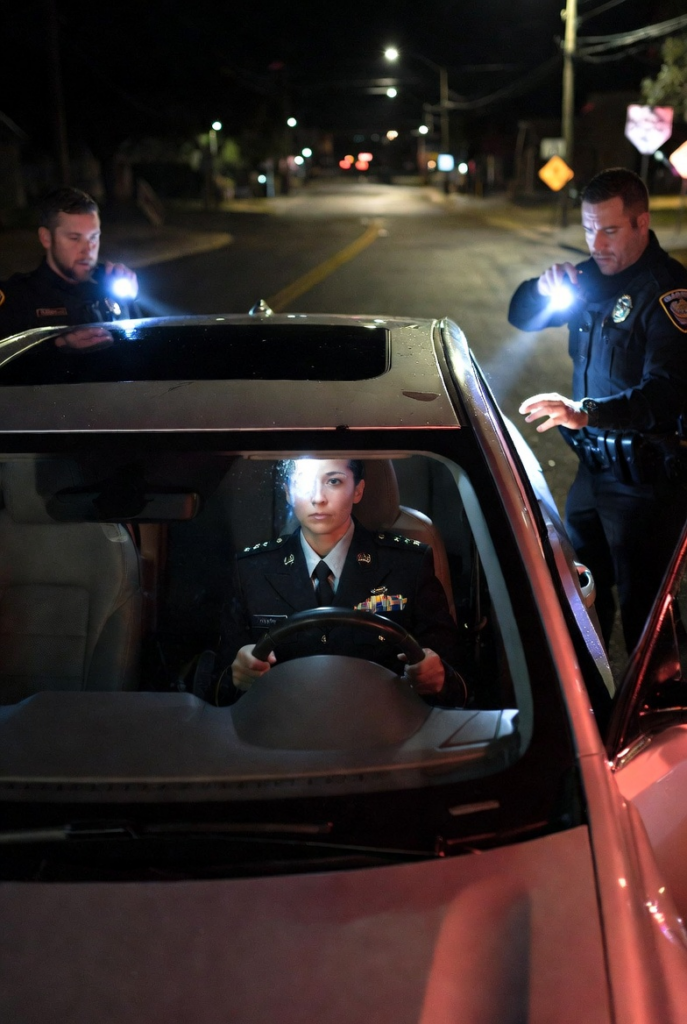
“What’s this costume supposed to do?” Malloy demanded.
“It’s not a costume,” Jasmine replied calmly. “I am active-duty Army. Contact my command.”
Despite her compliance, she was physically assaulted. Shoved against the hood, handcuffed too tightly, and mocked on camera, she remained steady. With her cuffed fingers, she activated a secured, encrypted device and whispered, “I’m invoking Contingency Seven.”
Within moments, the night transformed. Blackhawk helicopters roared overhead, searchlights blinding the patrol car, while unmarked SUVs and tactical teams surrounded the scene. FBI agents and military police moved with precision. Malloy and Rucker’s power evaporated as Special Agent Lyle Bennett ordered, “Remove her cuffs. Now.”
One routine traffic stop became a test of courage, a secret contingency, and a reckoning no one expected…