I should have refused.
I had paid for the seat through my daughter's miles, and I had every right to remain there.
But I was exhausted, embarrassed, and raised to believe that making a fuss was worse than accepting an inconvenience.
So I agreed.
Kayla carried my purse, and I followed her toward the rear of the aircraft.
We passed the curtain separating first class from the main cabin.
I could feel passengers looking at me.
By the time we reached row 32, I wished I could disappear.
The seats were uncomfortable and didn't recline. The bathrooms were directly behind them, and every few minutes their doors opened and closed.
I sat beside the window.
Kayla brought me a small cup of water and a packet of pretzels.
Then she returned to the front.
I folded Walt's ruler and placed it on the tray table.
Outside, the landscape stretched beneath us.
I thought about the years we had traveled together.
Fifty-three years of Walt taking the middle seat.
Fifty-three years of making sure I was comfortable.
And now, on my first flight without him, I was sitting alone in the last row.
I began crying again.
The Flight Attendant Who Remembered
A little later, another flight attendant approached with the beverage cart.
Her name tag read Denise.
She was older than Kayla, with short gray hair and reading glasses hanging around her neck.
She stopped when she saw me.
Then she looked more closely.
"Honey, why are you sitting back here?"
I tried to smile.
"Someone needed the seat."
Denise frowned.
"I remember you. You were in 3D when we boarded."
She glanced at the ruler on my tray table.
"Kayla told me you're going to a funeral."
"My husband's," I replied. "He's being buried Saturday in Suffolk. He was a Navy chief."
Denise's expression softened.
"My father was a Navy chief too," she said.
She pulled out the aisle seat and sat beside me.
"What's your husband's name?"
"Walter Pruitt. Everyone called him Walt."
She asked about his Navy service, and I began telling her.
I told her about the ships he had served on, his years at the Norfolk Naval Shipyard, and the twenty-one years he spent teaching woodshop.
I told her about the students who visited our home on weekends to use his tools.
I told her about the birdhouses he made for our neighbors.
And then I remembered something that still made me emotional.
One summer, Walt had secretly built a wheelchair ramp for a student's father who had been paralyzed in a car accident.
The family couldn't afford one.
Walt spent weekends working on it, never asking for money or recognition.
I only discovered what he had done when the boy's mother sent us a thank-you card.
Her husband could finally sit on the porch and watch the sunset.
When I confronted Walt about the project, he simply shrugged.
"Well, Evvie, it's kind of a deck."
Denise listened without interrupting.
When I finished, she gently squeezed my hand.
"Your husband sounds like a wonderful man," she said.
"He was," I replied.
She stood up.
"Stay right here. I'll be back."
I didn't think much of it.
But Denise had decided that something needed to change.
A Familiar Name in the Cockpit
Denise returned to the front of the plane and spoke with Kayla.
She later told me she had been very direct.
In more than thirty years of flying, she had never believed that a grieving passenger should be moved simply because another passenger wanted a quieter place to work.
She also contacted the captain.
She explained that a passenger named Evelyn Pruitt was traveling to Virginia to bury her husband, a retired Navy chief.
When the captain heard the name Walter Pruitt, he asked her to repeat it.
Then he requested the passenger manifest.
He looked at the passenger information for a long moment.
Evelyn M. Pruitt.
Seat 3D.
Phoenix to Norfolk.
He turned toward his first officer.
"Your airplane," he said.
The first officer acknowledged him.
And the captain left the cockpit.
I knew nothing about this.
I was still sitting in row 32, watching the land pass beneath the window.
Then I noticed something unusual.
The cabin had become quieter.
People were turning around and looking toward the back.
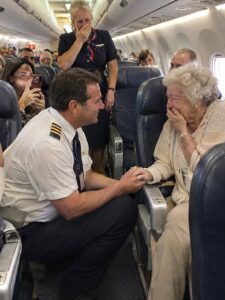
A man in a pilot's uniform was walking down the aisle.
When he reached my row, he stopped.
He removed his hat and held it against his chest.
Then he knelt beside my seat.
"Mrs. Pruitt?"
I looked up.
"Yes?"
He took my hand.
"Do you remember Hickory Ridge High School? Around 1997?"
I shook my head.
"My name is Marcus Hale," he said. "Your husband was my shop teacher."
He paused, struggling to speak.
"Mr. Pruitt saved my life."
The Boy Who Slept Beneath the Workbench
Marcus explained that when he was sixteen, he had been thrown out of his home following a violent argument with his stepfather.
It was January 1997.
He had nowhere to go, only a backpack, an inadequate jacket, and eleven dollars.
He walked through the snow to Hickory Ridge High School.
He knew the back door near the loading dock didn't lock properly. He managed to open it and entered the woodshop.
That night, he slept beneath a workbench on a pile of sawdust, using a canvas drop cloth as a blanket.
The next morning, Walt arrived at his usual time.
He noticed the boy's shoes sticking out from beneath the workbench.
According to Marcus, Walt didn't call the police or immediately contact the school administration.
Instead, he crouched down and looked at him.
Then he said:
"Son, that drop cloth has linseed oil all over it. You're going to smell like a cutting board all day."
Marcus laughed as he remembered it.
Walt went to his truck and returned with an old sleeping bag.
I knew exactly which one he meant.
It was an army-surplus sleeping bag Walt had kept in his truck for years.
He had told me it was there for emergencies.
I remembered asking him about it in February 1997.
He said he had lent it to someone.
I never asked who.
Marcus continued.
Walt arranged for him to stay in a small supply room behind the lumber rack. He brought in an old cot, arranged a space heater, and gave him a key to the back entrance.
He told the school janitor that Marcus was helping him with projects.
For several months, Walt quietly made sure the boy had somewhere safe to sleep.
But there was something else.
Every morning, Walt arrived with two brown paper lunch bags.
One was for himself.
The other was for Marcus.
They contained ham and Swiss sandwiches on rye bread, an apple, and two oatmeal cookies wrapped in wax paper.
 Up Next: Page 3 of 5
There was always a handwritten note.
"Eat the apple first. Do your algebra. Stand up straight, sailor."
Continue Reading