Once you recognize the animal, it may become difficult to return to your original interpretation. The picture itself has not changed; you have simply found a new way to connect its visual details.
Why Does the Illusion Fool Our Eyes?
Our brains constantly organize visual information into recognizable patterns.
When we encounter an unfamiliar or complicated image, we often use familiar objects and previous experiences to make sense of what we see. This process is usually helpful, but it can also lead us to interpret ambiguous shapes in unexpected ways.
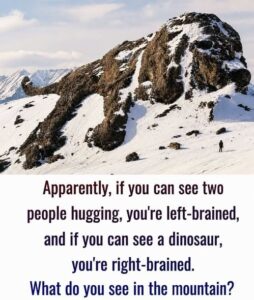
In this picture, the snowy background and overlapping contours make the dog's outline less obvious. Some areas resemble shadows or hills, while others can suggest entirely different objects.
Once someone points out the hidden animal, those same shapes may suddenly seem much easier to understand.
Does Your First Answer Reveal Whether You Are Left-Brained or Right-Brained?
Online captions sometimes claim that seeing one shape rather than another reveals whether a person is “left-brained” or “right-brained.”
That claim should be treated as entertainment, not a scientific test.
The popular idea that people are either predominantly left-brained and logical or right-brained and creative oversimplifies how the brain works. Different brain regions do have specialized functions, but complex tasks generally involve networks across both hemispheres.
Research has not established that choosing one interpretation of a viral optical illusion can reliably identify a person's thinking style, intelligence, or personality.
So if you saw the dog first, that does not prove you are more creative or observant than someone who saw something else.
Why Do Different People See Different Things?
Several factors can influence what someone notices first, including the shapes they recognize, their expectations, and the clues that attract their attention.
 Up Next: Page 3 of 3
If a person is told to search for a dinosaur, they may...
Neither response necessarily reveals anything deep about the viewer. It simply demonstrates how expectations can influence the interpretation of an ambiguous image.
Continue Reading