 Curious & Viral
That “Upside-Down” Outlet in Your Home Might Have a Reason—Do You Know Why?
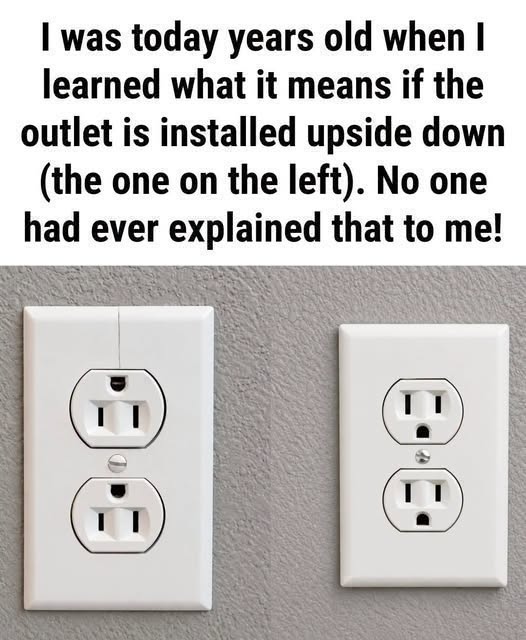
Have you ever walked into a room and noticed that one electrical outlet looks different from all the others?
Instead of having the grounding opening at the bottom, the outlet appears to be installed the other way around.
At first glance, it can look like someone simply mounted it incorrectly.
But an unusual-looking receptacle isn't necessarily evidence of a mistake.
There Isn't Just One Orientation
In many homes, standard wall outlets are installed with the grounding opening facing downward.
However, you may also encounter receptacles installed with the grounding opening facing upward.
The orientation itself doesn't automatically tell you whether the outlet is wired correctly or incorrectly.
Electrical requirements focus on how a receptacle is installed, grounded, protected, and used. The National Electrical Code contains detailed requirements for receptacle installation and grounding, but the orientation people notice on an ordinary wall isn't by itself proof of an electrical problem.
Why Would Someone Install It That Way?
There are several possible explanations.
In some installations, an electrician or property owner may choose an orientation for practical reasons related to the equipment being plugged in or the surrounding space.
One commonly discussed reason involves plugs and cords.
If a heavy plug or cord is positioned in a particular direction, changing the receptacle's orientation may sometimes make the arrangement more convenient.
However, this shouldn't be treated as a universal rule. Different electricians and jurisdictions may follow different conventions.
What About Safety?
The important issue isn't whether the outlet looks upside down.
What matters is whether the receptacle and its wiring are properly installed and meet the applicable electrical requirements.
Modern electrical standards include detailed provisions concerning grounding, receptacle protection, and installation. Certain locations also have additional requirements designed to reduce electrical hazards.
For example, the NEC places restrictions on receptacles installed face-up in certain countertops, work surfaces, and areas beneath sinks because of concerns such as liquid entering the receptacle.
 Up Next: Page 2 of 2
That's very different from simply mounting a wall receptacle with the grounding...
If you live in an older property, you may also encounter electrical outlets that don't match what you see in newer homes.
Continue Reading