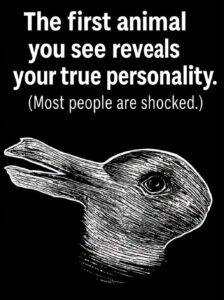
Your first impression can depend on many ordinary factors, including what part of the image caught your attention, how quickly you looked at it, your viewing angle, and what you were expecting to see.
In other words, seeing the duck first doesn't automatically tell you what kind of person you are.
If You Saw the Rabbit First
The same is true if the rabbit immediately stood out.
Some versions of this puzzle describe rabbit-first viewers as imaginative, intuitive, or emotionally sensitive.
Those descriptions can be entertaining to consider, but they aren't scientifically established personality categories based on this particular illusion.
You may simply have noticed a particular combination of lines and shapes before your brain interpreted the alternative.
The Most Interesting Part Comes Next
Here's where the puzzle gets really fascinating.
After someone tells you that a second animal is hidden in the image, you may suddenly notice it.
The picture hasn't changed.
Your eyes haven't received new information.
Instead, your interpretation has changed.
This is one reason ambiguous images can be so satisfying. They demonstrate how dramatically a different interpretation can alter what we think we're seeing.
Can Stress or Mood Change What You Notice?
Your attention can certainly be influenced by factors such as fatigue, distraction, expectations, and emotional state.
However, that doesn't mean this particular image can accurately measure your mood or personality.
Human perception is complicated, and a single visual puzzle isn't enough to draw meaningful psychological conclusions about someone.
That's an important distinction between an entertaining optical illusion and a genuine psychological assessment.
 Up Next: Page 3 of 3
What If You See Both Animals?
If you can eventually see both animals, you've solved the central trick of the picture.
Continue Reading