In a town like Ridgewood, Ohio, that detail carried more weight than my name. Ridgewood liked to see itself as wholesome and welcoming—quiet streets, Friday night games, signs about kindness posted on church lawns. But beneath the surface, people measured worth carefully, often silently.
Everyone knew my mother.
Some people remember childhood by the smell of breakfast or perfume. I remember the sound of a garbage truck idling before sunrise and the faint scent of industrial soap that never quite left my mother’s hands.
Every weekday morning, before the sky lightened, I heard that truck outside our small rental home. It was my alarm clock. I’d see my mother moving quietly through the hallway, already dressed for work—reflective stripes, sturdy boots, hair neatly tucked away like armor.
Before leaving, she always came into my room.
She’d sit beside me, kiss my forehead, and whisper the same words every morning.
“Study hard today, Ev. You’re going somewhere better than this.”
Back then, I thought she meant a nicer house or more money. I didn’t realize she meant dignity.
My mother, Laura Miller, hadn’t always worked sanitation. She once studied public health at a nearby community college. She believed in prevention, in systems that kept people safe before problems began. Our refrigerator used to be covered with handwritten plans—class schedules, budgets, dreams outlined in careful ink.
Once, she had those dreams.
Once, she had a husband.
My father worked in road construction. He believed effort mattered more than talent and that showing up every day counted. When I was small, he carried me on his shoulders and told me roads weren’t just concrete—they were connections.
When I was five, a worksite accident changed everything.
It made the local paper briefly. Then life moved on.
My father didn’t come home.
What did come home were bills, sympathy meals, and a version of my mother who learned to carry grief quietly because she had no choice. She left school, sold her wedding ring, and took the first job that promised stability. Sanitation work paid on time. It kept the lights on.
To Ridgewood, she became “the trash woman.”
To me, she became everything.
School taught me how quickly people judge what they don’t understand. At first, it was whispers. Later, it became jokes and nicknames. Someone once left a soda can on my desk with a note meant to mock.
Teachers heard it. Some frowned. Most stayed silent.
I learned early that silence can be powerful—and painful.
I started eating lunch alone. I volunteered for solo projects. Every afternoon, I went home and answered the same question the same way.
“How was school?” my mom asked, unlacing her boots.
“Fine,” I said.
She believed me. Or chose to.
In high school, everything intensified. Online jokes lasted longer than whispers ever did. One video of me walking behind my mother’s truck circulated briefly, then vanished—but the comments stayed with me.
So I focused on what I could control. My grades. Books. Staying late after class to clean chalkboards. Reading about people who built systems others depended on but rarely noticed.
Graduation arrived faster than I expected.
When the principal announced the valedictorian, I didn’t expect to hear my name. When I did, the auditorium went quiet.
That evening, I told my mother while she prepared her lunch for the next day.
“They asked me to speak,” I said.
She froze, then smiled wider than I’d ever seen.
“I’m proud of you,” she said, pulling me into a hug that smelled like detergent and long days.
I didn’t tell her what I planned to say.
The night before graduation, I sat at the kitchen table, staring at my speech. It wasn’t clever or dramatic. It was honest—and honesty felt risky.
She noticed my worry and sat beside me.
“You don’t have to prove anything,” she said softly. “You already did.”
“I don’t want to make things harder for you,” I admitted.
She smiled, calm and steady. “I’ve survived worse.”
Graduation day was bright and hot. Families gathered in neat rows. I saw my mother standing apart, hands tight around her purse.
When my name was called, the applause was polite.
I stepped to the podium, unfolded my paper, then set it aside.
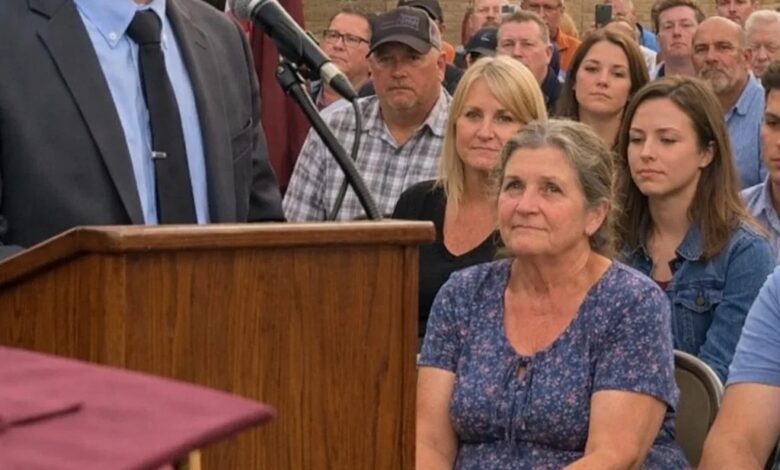
“My mother has been collecting this town’s waste for years,” I began.
The room shifted.
“So today, I want to return something that was often overlooked,” I continued. “Respect.”
I spoke about dignity. About work that keeps communities running even when no one notices. About a woman who showed up before sunrise every day so others could live comfortably.
I turned toward her.
“She taught me that strength isn’t about status,” I said. “It’s about showing up when no one is watching.”
The silence was heavy.
“The people who do the work we ignore are often the ones holding everything together.”
Then I stepped back.
At first, nothing happened. Then someone stood. Then another. Applause followed—slow at first, then sincere.
I saw my mother, eyes filled with tears, looking stunned—not embarrassed, but seen.
Afterward, people approached her with quiet thanks and awkward apologies. She accepted them with grace.
That night, she held my face gently.
“I was afraid I failed you,” she whispered.
“You taught me how to stand,” I replied.
Life moved forward. Scholarships came. College followed. I studied environmental systems—work most people only notice when it breaks.
Years later, I returned to Ridgewood as a consultant on a waste management project. People shook my hand in buildings where they once looked past my mother.
She watched from beside her truck, smiling.
“You look important,” she joked.
“You always were,” I said.
The town didn’t change overnight. But it learned to look more closely.
My mother retired with a small plaque marking her years of service. She stared at it like it belonged to someone else.
“I never needed this,” she said.
“I know,” I replied. “You earned it anyway.”
Years later, I brought my child past the sanitation depot.
“What’s that?” she asked.
“That’s where your grandmother worked,” I said. “She helped keep the town running.”
“That sounds important,” my daughter said.
It was.
Some people overlook others. But dignity doesn’t disappear when ignored.
It waits.
And once you finally recognize who’s been holding everything together, you don’t forget.