Then one evening, driven more by restlessness than hope, he downloaded a dating app.
That’s when he met Hannah Brooks.
From their first conversations, something felt different. Hannah didn’t ask about money or status. She asked about architecture, how spaces influence emotion, and why certain cities feel alive while others don’t. She talked about old films, used bookstores, and novels filled with handwritten notes in the margins.
Their conversations stretched late into the night. Messages turned into phone calls, and laughter replaced the quiet Evan had grown used to. Slowly, something unfamiliar returned: optimism.
Evan was honest with Hannah—but not entirely. He hadn’t yet told her about the wheelchair. Fear lingered in every conversation. What would happen when she saw him in person?
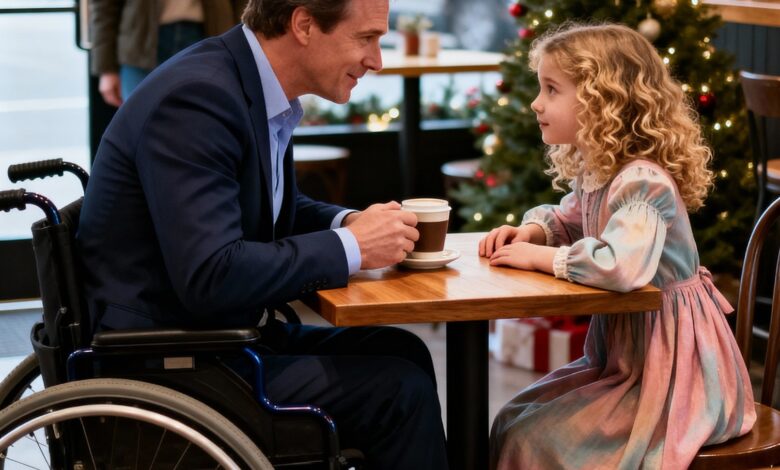
When Hannah suggested meeting, Evan hesitated. He chose a café near his apartment with wide entrances and open space, arriving early so he could leave easily if things became uncomfortable. As he waited, his anxiety grew. He imagined the moment she would notice, the subtle shift in expression, the polite but distant response.
Then the door opened.
But it wasn’t Hannah who entered first.
A small girl, no more than five years old, walked in carrying a coloring book nearly as large as her. She spotted Evan, smiled, and confidently sat across from him.
“Hi, you’re Evan,” she said cheerfully. “My mom’s coming. She showed me your picture.”
Before Evan could respond, she leaned forward and studied his face. “She says you have kind eyes,” the girl added.
“I’m Penny,” she announced. “Mom thought this would help you feel less nervous.”
Evan was stunned.
Moments later, Hannah arrived, apologizing with a smile. She explained that Penny had insisted on going in first. Evan barely heard the explanation. He was watching Hannah closely. Her eyes didn’t linger on the wheelchair. They didn’t soften with discomfort or pity. She simply smiled and sat down.
“It’s really nice to finally meet you,” she said.
The conversation flowed easily. They talked about books, design, and everyday life. Penny colored nearby, occasionally offering comments that made them laugh. Evan realized he wasn’t tense anymore. He wasn’t bracing for rejection. He was simply enjoying the moment.
The weeks that followed felt natural and steady. Dinners became longer conversations. Outings moved at a slower pace but felt more meaningful. Penny became part of Evan’s life without effort or hesitation.
One afternoon, she handed him a drawing of a house with ramps, wide doors, and a playground visible through every window.
“So everyone can go everywhere,” she explained.
For Penny, the wheelchair wasn’t something to question. It was just part of who Evan was.
Still, doubt crept in. One night, Evan came across an old photo online—Hannah and her late husband. He, too, had used a wheelchair. The realization unsettled him. Was he simply familiar? Was he replacing someone rather than being chosen?
He pulled away. Cancelled plans. Let silence return. Until Penny quietly asked one day, “Did I do something wrong? You don’t come anymore.”
That was the moment Evan understood what he was risking.
He stopped running from uncertainty. He chose honesty, presence, and trust.
Years later, Evan, Hannah, and Penny built a life together—not perfect, but genuine. When asked how he found love again, Evan would smile and say, “I thought the date was a mistake. Then someone reminded me how to see differently.”
Love doesn’t focus on limitations. It recognizes connection, patience, and what people still have to offer. And sometimes, the bravest choice is staying when fear tells you to step back.