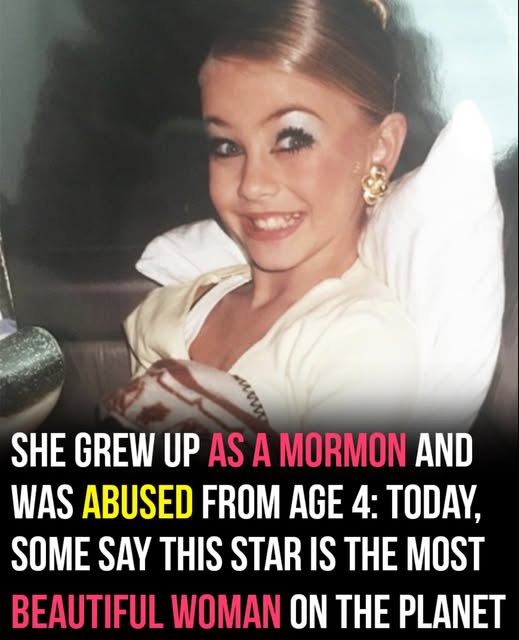
From the outside, Julianne Hough’s rise to fame can seem effortless—a life filled with bright lights, applause, and the charm of a naturally charismatic performer. Fans see the sparkling persona she has maintained through decades on Dancing with the Stars and her three Primetime Emmy nominations, but beneath that glossy exterior lies a childhood marked by profound trauma and experiences no child should endure. To fully understand the 37-year-old entertainer and survivor, one has to look back at the “tormented little girl” forced to swap innocence for a premature “grown-up facade” long before her teens.
Julianne was born in Orem, Utah, the youngest of five children in a prominent Mormon family. Her father, Bruce, was a figure in Utah politics, while her mother, Marianne, navigated the strict social rules of a community where perfection was not optional but expected. In this environment of appearance over reality, a devastating secret was hidden: at just four years old, Julianne was abused by a neighbor in their quiet neighborhood.
For years, the memory remained private. In a 2024 interview on The Jamie Kern Lima Show, Julianne recounted coming home with her clothes inside out—a detail that alarmed her mother. Yet, rather than confronting the crime, the family moved. There were no consequences, no conversations of reckoning, just a relocation. For a young Julianne, this taught an early and painful lesson: silence is safer than truth.
As she entered adolescence, the stage shifted to the international dance world. At ten, while her parents finalized a bitter divorce, she was sent to London to train at the prestigious Italia Conti Academy of Theatre Arts, living with family friends. While her peers were still in elementary school, Julianne navigated the London Underground alone, often lost, under enormous pressure to perform like an adult.
Abuse followed her into this new setting, but it was systemic and psychological rather than physical. The competitive dance world demanded a level of sophistication and sensuality inappropriate for a child. Julianne was transformed into a performer who appeared far older than her years, applying heavy makeup and mastering routines far beyond her age. Looking back, she laments the absence of photographs capturing her natural, ten-year-old self—only the “sexy facade” remains.
Returning to the U.S. for high school in Las Vegas and Utah brought new challenges. Her peers, dazzled by her polished professionalism, misread it as arrogance, leading to social isolation and bullying. One particularly cruel moment involved a prom invitation that ended in public humiliation orchestrated by other students.
Yet Julianne’s resilience persisted. By fifteen, she was excelling in international dance competitions, and soon Hollywood took notice. Her brief appearance in the first Harry Potter film was just the beginning. She went on to become a household name on Dancing with the Stars, transitioned to judging, and starred in films such as Footloose, Rock of Ages, and Safe Haven. Despite outward success, she privately struggled with anxiety, depression, and chronic endometriosis.
Her public life brought its own trials: high-profile relationships, media scrutiny, and the occasional backlash over body image or public missteps. Yet Julianne consistently embraced accountability. She used her platform to raise awareness of women’s health, openly discussing endometriosis and taking steps to protect her future, like freezing her eggs—an act that helped her shed shame and reclaim agency.
A particularly transformative period came after her divorce. Stripped of the glamorous lifestyle she had once inhabited, Julianne reconnected with her parents. For the first time, she allowed herself to be vulnerable, to “be the kid” again. These honest conversations helped her family confront past regrets and allowed Julianne to process the trauma that had shadowed her since childhood.
By 2026, Julianne Hough embodies resilience and self-possession. She is no longer the child forced into adult roles, but an adult who has reclaimed her right to vulnerability. Dance provided confidence when she felt adrift, but her voice—unafraid and authentic—is what truly defines her today. Her journey from a Utah cul-de-sac to Hollywood stardom is a testament not only to talent but to the courage to pivot toward healing and light.
As she embraces future opportunities in love, career, and advocacy, Julianne continues to inspire those who have endured trauma. She proves that the most dazzling element of her life is not awards or costumes, but the strength she discovered in speaking her truth.