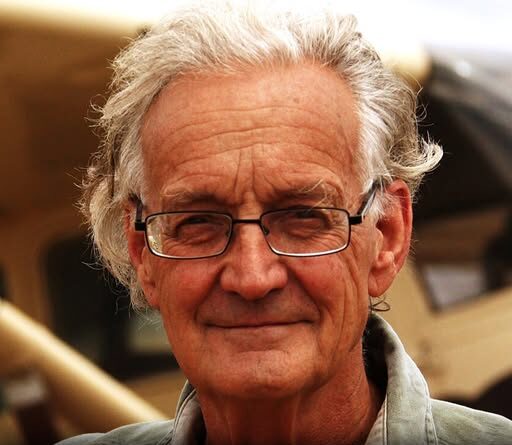
At Lake Manyara, he did something radical for the time: he treated elephants as individuals. He learned to recognize them by the shape of their ears, the curve of their tusks, the scars of their lives, and even their personalities. He documented family bonds, leadership roles, mourning rituals, and long-term memory. That approach laid the foundation for modern elephant behavioral science.
But alongside understanding came alarm. As he followed elephant families, he also recorded their disappearance. Poaching was not occasional—it was systematic. Through dangerous aerial surveys, Douglas-Hamilton exposed the true scale of the ivory trade’s devastation. Entire herds were vanishing. Landscapes once alive with movement were falling silent.
His work put him in constant danger. He was charged by elephants, stung by swarms of bees, and targeted by armed poachers. Still, he persisted. His data was undeniable, and it forced the world to confront reality. Those findings played a critical role in securing the 1989 global ban on the international ivory trade—a turning point in conservation history. He later described the crisis plainly, calling it an “elephant holocaust.”
Renowned primatologist Jane Goodall later said Douglas-Hamilton helped the world understand that elephants are capable of feeling much like humans do. That shift—from seeing animals as resources to recognizing them as sentient beings—may be his most enduring legacy.
In 1993, he founded Save the Elephants, now one of the most influential wildlife conservation organizations in the world. Long before GPS tracking was common, he pioneered its use, revealing vast migration routes and demonstrating how elephants rely on memory and environmental knowledge to survive in an increasingly human-dominated world.
His influence reached the highest levels of global leadership. Collaborations with world leaders helped pave the way for landmark agreements, including international efforts that dramatically restricted ivory markets and weakened illegal wildlife trade networks.
Over more than six decades, Douglas-Hamilton received numerous honors, including international conservation awards and national recognition in the UK. Yet those close to him say accolades never motivated him. His focus was always on balance—between people and wildlife, progress and preservation.
“I think my greatest hope for the future is that there will be an ethic developed of human-elephant coexistence,” he once said. He understood that conservation could not succeed without addressing the realities faced by communities living alongside wildlife.
Douglas-Hamilton is survived by his wife Oria, his daughters Saba and Dudu, and six grandchildren. But his legacy lives far beyond his family—across Africa’s protected migration corridors, in reduced poaching rates, informed global policy, and in the countless elephants still walking the land because of his work.
In a world grappling with environmental loss and climate uncertainty, his vision feels more urgent than ever. Thanks to Iain Douglas-Hamilton, humanity is closer to understanding what coexistence truly means. And because of him, the elephants endure.
What do you think is the most important step humanity can take to protect wildlife? Share your thoughts and keep the conversation alive.