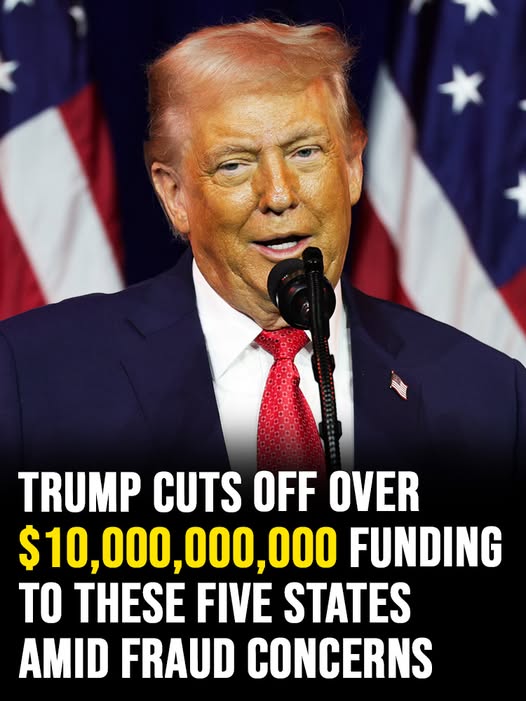
In a decision that has stirred intense debate across Washington and state capitals, the Trump administration has announced a pause on more than $10 billion in federal funding directed to five Democrat-led states: California, Colorado, Illinois, Minnesota, and New York. The freeze affects major social service programs that support low-income families, including Temporary Assistance for Needy Families (TANF), the Child Care Development Fund (CCDF), and the Social Services Block Grant (SSBG).
Officials at the Department of Health and Human Services (HHS) say the move is aimed at addressing what they describe as widespread misuse of federal resources. According to the agency, the action is meant to ensure taxpayer money is spent as intended and to prevent fraud within state-run programs.
Andrew Nixon, an HHS spokesperson, stated that the administration believes some Democrat-governed states have failed to adequately prevent improper use of federal funds. “For too long, massive fraud has occurred under state leadership,” Nixon said. “This administration is committed to making sure taxpayer dollars are protected and used for legitimate purposes.”
Scope of the Freeze
The financial impact is significant. TANF, which provides direct assistance to struggling families, faces a reduction of more than $7.3 billion. The CCDF, which helps parents afford safe child care so they can work or attend school, will lose approximately $2.4 billion. An additional $869 million from the SSBG—used to fund community services such as foster care, mental health programs, and adult protective services—is also on hold.
Altogether, the freeze places over $10 billion in federal support in limbo, potentially affecting millions of Americans who depend on these programs for basic needs such as housing assistance, food security, and child care.
In letters sent to the governors of the affected states, ACF Assistant Secretary Alex Adams cited “recent federal prosecutions and additional allegations” suggesting that large portions of federal resources were diverted away from their intended recipients. The administration says the pause is necessary while these concerns are reviewed.
Political Fallout
The announcement drew swift condemnation from Democratic leaders, who argue the decision is driven by politics rather than evidence. New York Senator Kirsten Gillibrand called the freeze “immoral and indefensible,” accusing the administration of punishing children and low-income families for political reasons.
“Trump is threatening to freeze child care funding in New York and targeting our children for political retribution,” Gillibrand wrote on X. “This has nothing to do with fraud and everything to do with politics.”
Governors echoed that sentiment. California’s Gavin Newsom described the move as “a direct attack on vulnerable families.” Illinois Governor J.B. Pritzker labeled it “reckless and harmful,” while Minnesota’s Tim Walz warned of “devastating consequences” for those most in need. Colorado Governor Jared Polis argued that these programs already operate under strict oversight and that the accusations appear politically motivated.
Legal analysts say court challenges are likely, noting that broad funding freezes affecting essential services are often subject to judicial review.
Impact on Families
TANF provides temporary financial support for food, housing, and utilities. A freeze of over $7.3 billion could result in reduced benefits or delays, pushing families deeper into hardship. Experts warn that interruptions may increase poverty levels, especially in high-cost urban areas.
The CCDF is critical for working parents. With $2.4 billion withheld, fewer child care slots may be available, forcing some parents to cut back work hours or leave the workforce entirely—impacting household income and children’s development.
SSBG funds support services for seniors, foster children, and people with disabilities. Cuts could lead to program closures, staff reductions, and fewer resources for domestic violence survivors, mental health patients, and elderly residents.
Broader Concerns
While fraud does occur in large federal programs, past audits have generally found it to be limited. A 2022 federal review of TANF programs showed isolated errors but overall compliance in most states. Critics argue that sweeping freezes punish millions for the actions of a few and depart from the usual approach of targeted audits or penalties.
Policy groups like the Center for Budget and Policy Priorities warn that withholding funds will have immediate consequences for children’s health, education, and stability. Child advocacy organizations say disruptions to care services could push families toward unsafe alternatives.
The freeze also raises broader questions about federal power and state autonomy. Programs like TANF and CCDF are designed to combine federal oversight with local flexibility. Using funding as political leverage, critics argue, risks setting a precedent that could destabilize social services nationwide.
As governors prepare legal challenges and advocacy groups mobilize, the coming weeks may determine whether the freeze stands, is modified, or is overturned in court. Regardless of the outcome, the decision has ignited a national debate over accountability, political authority, and the real-world impact of policy on America’s most vulnerable families.