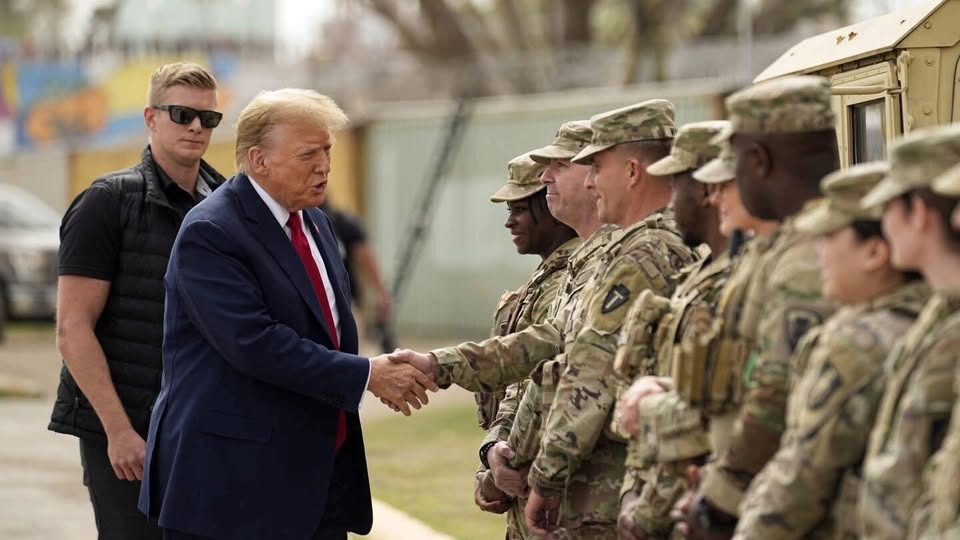
The decision to deploy active-duty U.S. Marines in support of Immigration and Customs Enforcement marks a turning point in modern American governance, one that reshapes long-standing boundaries between civilian administration and military power. With 200 Marines already operating in Florida and additional deployments planned for Louisiana and Texas, the federal government has taken an extraordinary step: embedding uniformed military personnel deep within the infrastructure of domestic immigration enforcement. The move arrives amid an already volatile national debate over immigration policy, executive authority, and the appropriate role of the armed forces within the country’s own borders.
Pentagon officials have been careful to frame the mission in strictly limited terms. According to military briefings, the Marines are not conducting arrests, patrolling neighborhoods, or engaging in enforcement actions. Instead, they are assigned to internal support roles inside detention centers—handling logistics, facility operations, inventory management, and administrative processing. These tasks, officials argue, fall within legal boundaries established by the Posse Comitatus Act, which restricts federal troops from acting as domestic law enforcement. By keeping Marines “behind the fence,” policymakers maintain that the deployment respects the letter of the law while alleviating severe staffing shortages within ICE.
From the administration’s perspective, the move is a calculated response to institutional overload. Detention facilities and processing centers have struggled to manage growing caseloads, forcing trained ICE agents into clerical roles far removed from fieldwork. By shifting logistical burdens to the military, officials contend, enforcement personnel can return to operational duties, accelerating case processing and reducing prolonged detention. Supporters of the plan describe it as a temporary stabilization effort—an infusion of organizational capacity drawn from one of the most disciplined logistical systems in the world.
Yet for many Americans, the legal nuance offers little reassurance. The visual reality of Marines in uniform operating inside civilian detention centers has triggered widespread unease. Civil liberties advocates and immigrant-rights organizations argue that the presence of the military—regardless of its official function—fundamentally alters the nature of these facilities. To them, camouflage uniforms in an immigration context are not symbols of efficiency but of coercion, reinforcing the idea that migrants are being treated as security threats rather than individuals navigating a civil legal process. Protests near facilities in Florida and along the Gulf Coast reflect a growing belief that this deployment represents not administrative support, but normalization of military involvement in domestic governance.
The reaction is especially intense in southern states where military installations and border enforcement already shape daily life. In parts of Texas and Louisiana, residents describe a creeping sense that their communities are becoming permanent zones of heightened security. Surveillance infrastructure, armored vehicles, and now active-duty Marines contribute to an environment where the distinction between foreign defense and internal control feels increasingly blurred. For locals, the official claim that Marines are merely “support staff” does little to counter the symbolic weight of their presence.
Legal scholars warn that symbolism matters. While National Guard deployments under state authority are a familiar tool during emergencies, the use of federal active-duty forces—particularly the Marine Corps—carries a different constitutional and cultural significance. Experts note that once the military becomes an accepted solution for administrative shortfalls, the threshold for future deployments may steadily erode. If logistical assistance is permissible today, critics ask, what prevents expanded roles tomorrow under the same rationale of “support”?
Inside Washington, the deployment is defended as a pragmatic necessity rather than a philosophical shift. Officials emphasize that the Marines’ involvement is finite, task-specific, and subject to strict oversight. They argue that better-run facilities improve safety, food distribution, medical logistics, and overall conditions for detainees—outcomes they describe as inherently humanitarian. In this view, military efficiency is being borrowed not to punish migrants, but to fix a system straining under its own dysfunction.
Still, the broader implications remain unresolved. As additional units prepare to deploy to border states, the nation is left to measure success through competing lenses. The administration will likely cite metrics—processing times reduced, backlogs cleared, resources stabilized. Opponents will focus on costs that defy quantification: fear within immigrant communities, stress on military readiness, and the long-term consequences of embedding soldiers into civil institutions.
What is unfolding is more than a staffing solution; it is a reflection of an era in which extraordinary measures have become politically viable with remarkable speed. The deployment illustrates a governing philosophy that prioritizes decisiveness and security presence, even at the risk of redefining traditional norms. Whether this moment proves to be a short-term intervention or the opening chapter of a more militarized domestic policy remains uncertain.
What is clear is that the boundary between civilian administration and national defense has shifted. For those living near these facilities—and for the migrants inside them—the difference between a government clerk and a Marine in uniform is not theoretical. It reshapes the experience of the state itself. And as the Marines move deeper into the American interior, the country—and the world—is watching closely to see whether this is an emergency measure or a new model of governance taking hold.