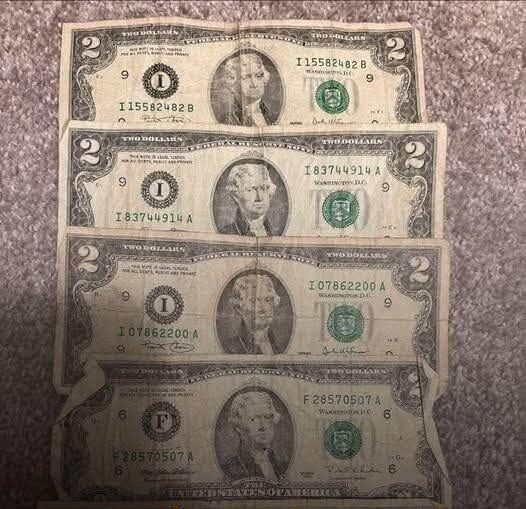
Older bills? Even more enticing. Early 20th-century $2 bills with red or brown seals can fetch hundreds. Nineteenth-century oversized “horse blanket” notes? Museum-level collectibles. Printing errors or rare short-run series can send value skyrocketing. What seems ordinary to one person could be a goldmine to a collector.
Contrary to popular belief, the $2 bill is still produced. Millions exist today. The scarcity is in circulation, not production. Because they’re requested less frequently, many bank tellers keep them tucked away. That invisibility feeds the myth of rarity—but collectors care about bills preserved in perfect condition, and $2 bills tend to survive because people save them.
Stories abound of small fortunes discovered in forgotten drawers, old wallets, or attic stashes. A bill worth $20 a decade ago might now fetch $100 or more simply because collector interest has spiked. And beyond the money, the $2 bill carries historical significance. The back features John Trumbull’s iconic painting of the Declaration of Independence—a visual reminder of America’s history on every note.
Recently, the $2 bill has even enjoyed a quiet resurgence. Businesses use them to spark conversation. Tourists love them as keepsakes. And once someone receives one, it’s often tucked away, continuing the cycle that keeps these notes rare in circulation.
The lesson is clear: never underestimate a $2 bill. Check the year, the seal color, and the serial number. Even a bill that seems ordinary could be worth far more than $2. What many overlook as a strange, outdated note is actually a small treasure waiting to be discovered.
Have a $2 bill tucked away? Take a closer look—you might just be sitting on a collector’s gem! Share this with friends and family so they can check theirs too.