
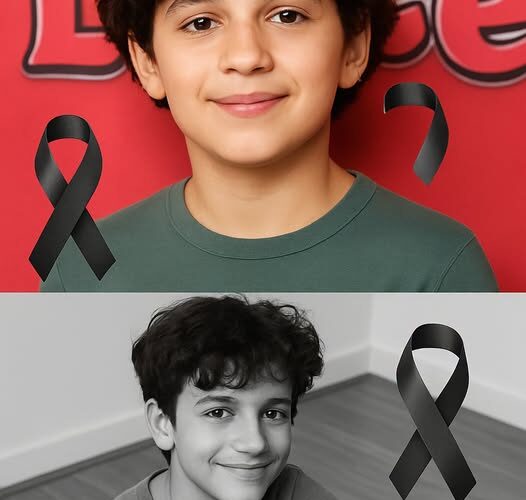

Those closest to the family understand that no interview could adequately capture the depth of such a loss. There is no perfect statement capable of explaining what it means for a parent to lose a child. There is no photograph that can communicate the silence left behind.
Instead, there are memories.
A familiar voice.
A favorite photograph.
A childhood story repeated quietly.
A piece of clothing left exactly where it was.
A song that suddenly carries an entirely different meaning.
An ordinary place that becomes impossible to visit without remembering who once stood there.
For grieving families, memories can be painful and comforting at the same time. The same photograph that brings tears can also preserve a moment that might otherwise exist only in memory. The same story that feels unbearable to tell can eventually become something a family repeats because keeping that person’s presence alive matters.
Those who knew her son have their own memories.
They remember his personality, his kindness, his sense of humor, the small gestures that may have seemed ordinary at the time but now feel priceless. Friends, classmates, teachers, relatives, and family acquaintances may each carry a different piece of his story.
Some memories will be shared publicly.
Others will remain private.
Some may be written in letters that are never immediately opened. Others may exist only in conversations between people who knew him best.
Together, those memories form something larger than a public tribute. They become a quiet circle of remembrance around a family trying to navigate an unimaginable absence.
There is also an important difference between remembering someone and moving on without them.
People often use the phrase “move on” when speaking about grief, but profound loss does not necessarily follow such a simple path. A person may learn to live with grief without leaving the person they lost behind.
The goal is not to forget.
It is to find a way to continue living while carrying the memory forward.
For a mother mourning her child, that process may take forms the public never sees. It might be lighting a candle on a birthday, visiting a favorite place, keeping a photograph nearby, speaking his name at home, supporting a cause connected to his interests, or simply remembering the smallest details that made him who he was.
There is no timetable for any of it.
Some days may feel manageable. Others may bring the grief back with unexpected force. A familiar date, photograph, smell, song, or place can reopen emotions that seemed quieter only hours earlier.
That does not mean healing has failed.
Grief is not a straight road.
It can be quiet one morning and overwhelming by evening. It can coexist with laughter, gratitude, exhaustion, anger, love, and even moments of ordinary happiness. None of those emotions erase the loss.
And none of them diminish the love that remains.
For the family, the most meaningful support may therefore be the simplest: patience, privacy, practical help, and the understanding that there is no performance required.
She does not need to prove that she is strong.
She does not need to appear on camera to reassure strangers.
She does not need to turn her grief into a public message simply because people are waiting for one.
Sometimes strength looks like accepting help.
Sometimes it looks like saying nothing.
Sometimes it means making it through a day that once seemed impossible.
The world may eventually see her return to public life. There may be another interview, another appearance, another photograph in which she smiles again.
If that happens, it should not be interpreted as evidence that the grief has disappeared.
People can smile while carrying profound sorrow.
They can return to work while still missing someone desperately.
They can laugh at a memory and cry moments later.
Life does not necessarily replace grief. Instead, people gradually learn how to carry both.
For now, perhaps the most compassionate thing the outside world can offer is space.
Space for the family to remember.
Space to mourn.
Space to be surrounded by people who knew and loved the child beyond the headlines.
And space for a mother to take whatever time she needs before stepping back into a world that is watching.
Her son’s life will always be more than the circumstances of his death.
He was a child with his own personality, relationships, memories, hopes, and place in the lives of the people who loved him. Those are the things that deserve to remain at the center of his story.
And while the public may never see most of what happens behind closed doors, that does not make the healing any less real.
Sometimes recovery begins quietly.
Not with a grand announcement, but with getting out of bed.
Not with a perfect speech, but with accepting a friend’s hand.
Not with forgetting, but with remembering.
One day at a time, one memory at a time, one fragile breath at a time.