
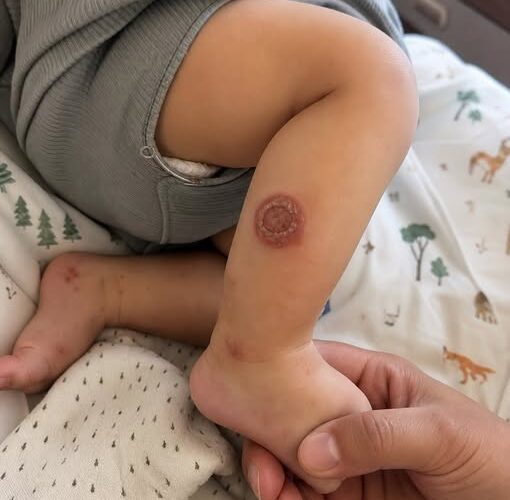

A rash that looks relatively minor can change considerably over several hours or days. It may become itchy, develop scaling or crusting, become warm or painful, or begin appearing in additional areas. In some cases, a child may also develop a fever or seem generally unwell.
Those changes are important information for a healthcare professional.
Parents can help by documenting what they see. Take a clear photograph when the rash first appears and another if it changes. Make a note of when you first noticed it, whether it has grown, whether your child is scratching it, and whether there have been any other symptoms.
Think about recent exposures, too.
Has your child recently played outdoors? Been around animals? Shared sports equipment, towels, clothing, or bedding? Started using a new soap, lotion, detergent, or medication? Had contact with another child who developed a rash?
These details can help a pediatrician or dermatologist work toward the correct diagnosis.
It is also important to pay attention to the child’s overall condition rather than focusing exclusively on the appearance of the skin.
A rash that is rapidly spreading, increasingly painful, warm, swollen, or producing pus or significant drainage deserves medical attention. Fever, unusual tiredness, significant discomfort, facial swelling, or a child who appears seriously ill can also be warning signs that should not be ignored.
Some situations require more urgent assessment. If your child has difficulty breathing, swelling of the lips or tongue, fainting, severe illness, or a rapidly developing rash accompanied by concerning systemic symptoms, seek emergency medical care.
For less urgent but persistent skin changes, contacting your child’s pediatrician or another qualified healthcare professional is often the safest next step.
Treatment depends entirely on the cause.
A fungal infection may require an antifungal medicine. A bacterial infection may require different treatment. An inflammatory or allergic condition may call for another approach altogether. Using the wrong product can sometimes irritate the skin further or delay appropriate treatment.
That is why repeatedly applying different over-the-counter creams without knowing what you are treating may not be the best strategy.
Instead, observe carefully, document changes, and seek professional advice when the rash is persistent, worsening, or accompanied by other symptoms.
Most childhood skin conditions are treatable, and many resolve completely with appropriate care. The frightening part for parents is often the uncertainty — seeing a strange mark appear and not knowing what it means.
The key is not to panic, but not to ignore significant changes either.
A red ring on your child’s skin is a reason to pay attention, not automatically a reason to assume the worst. With careful observation and timely medical guidance, the cause can usually be investigated and the appropriate treatment chosen.
What looks like a mysterious and frightening rash today may ultimately become nothing more than a short chapter in your child’s medical history.
But when a child’s skin changes rapidly, spreads, becomes painful, or appears alongside fever or other concerning symptoms, getting the right medical advice is far safer than trying to solve the mystery alone.