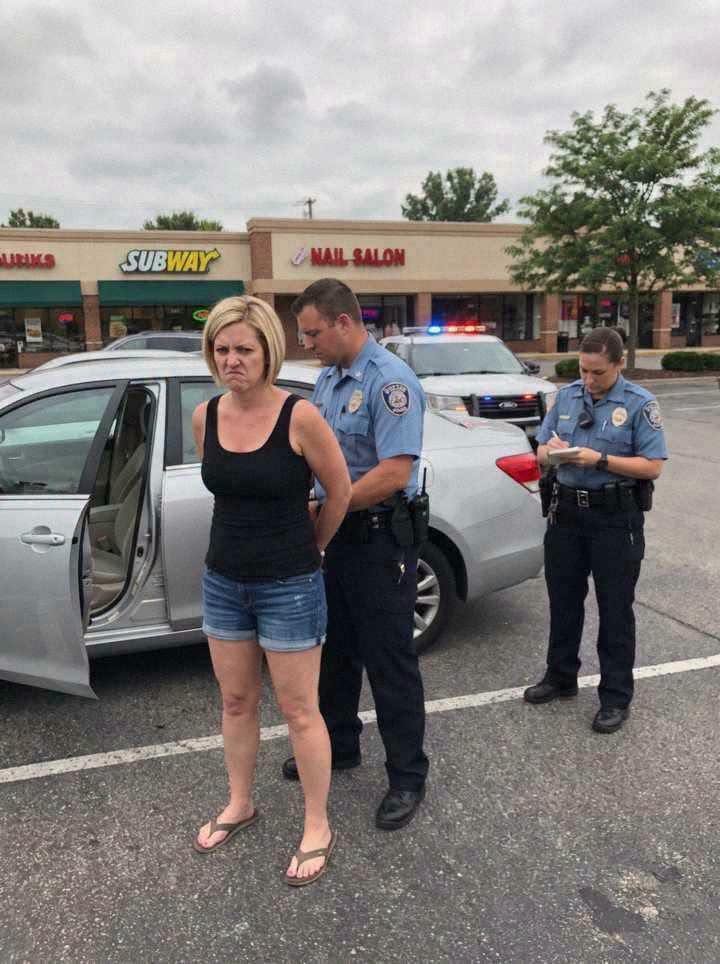
Instead, his face went completely pale.
The second officer stepped closer.
“What is it?”
The first officer didn’t answer.
He simply stared at the card inside the wallet.
Victoria watched them quietly.
“Go ahead,” she said. “Read it.”
The second officer took the wallet from his partner.
His eyes moved across the identification card once.
Then again.
His confidence disappeared.
“What the—?”
The first officer grabbed the wallet back.
“This can’t be real.”
Victoria remained pressed against the side of her car, her hands still cuffed behind her.
“You should probably check the number.”
The second officer looked at her suspiciously.
“Who are you?”
Victoria took a slow breath.
“I was hoping you would ask that before putting handcuffs on me.”
The card contained official credentials identifying Victoria as an investigator assigned to a state law-enforcement oversight unit.
But that wasn’t the only thing inside the wallet.
Behind the identification card was a second card.
And a small folded piece of paper.
The first officer unfolded it.
His eyes widened.
“What is that?”
Victoria answered calmly.
“The reason I asked you to look in my pocket.”
The paper contained the date, time, location and patrol-car identification number.
The second officer looked toward their vehicle.
Then toward Victoria.
“You knew we were going to stop you?”
“No.”
“Then why did you have this?”
“Because I wasn’t driving home from work.”
She paused.
“I was already conducting an investigation.”
Silence fell over the roadside.
The officers suddenly seemed very aware of the camera mounted on their patrol car.
The first officer looked at his partner.
“Turn it off.”
Victoria immediately spoke.
“Don’t.”
Both men froze.
“You don’t want to make this worse,” she continued.
The second officer swallowed.
“What exactly are you investigating?”
Victoria looked directly at him.
“Complaints about roadside stops involving intimidation, missing documentation and unnecessary use of force.”
Neither officer said anything.
She continued.
“And now I have two more names to add to the report.”
The first officer’s face hardened.
“You’re recording this?”
“I don’t need to explain every part of an investigation to you.”
He glanced at the patrol car again.
“Who authorized this?”
Victoria smiled faintly.
“You’ll find that out when your supervisor arrives.”
The atmosphere changed instantly.
Only a few minutes earlier, the officers had spoken as though they controlled the entire situation.
Now they were suddenly choosing every word carefully.
The second officer reached toward the handcuffs.
Victoria moved her shoulders slightly.
“Don’t remove them yet.”
He stopped.
“Why?”
“Because I want everything documented exactly as it happened.”
The first officer stared at her.
“You’re saying we shouldn’t uncuff you?”
“I’m saying you shouldn’t change the scene because you suddenly realize you’ve made a mistake.”
That sentence appeared to hit harder than anything else she had said.
The first officer stepped away.
He pulled his radio from his shoulder.
“Dispatch, I need a supervisor at my location.”
Victoria listened.
The dispatcher asked for the reason.
The officer hesitated.
“Possible administrative issue.”
Victoria almost laughed.
“That’s one way to describe it.”
The second officer looked embarrassed.
“You don’t understand what happened.”
“I understand exactly what happened.”
“You were stopped for a routine check.”
“And then?”
He said nothing.
Victoria continued.
“You couldn’t identify a legal reason for the stop. You ordered me out. You took my phone. You used force. You handcuffed me. And you told me I was being detained because I needed to ‘learn some manners.’”
The second officer looked down.
Victoria’s voice remained calm.
“I gave you several opportunities to slow this down.”
A few minutes later, another patrol vehicle arrived.
A senior officer stepped out and approached the scene.
He looked at Victoria.
Then at the handcuffs.
Then at the two officers.
“What happened?”
Neither answered immediately.
Finally, the first officer said, “We conducted a traffic stop.”
The supervisor looked at him.
“For what violation?”
Silence.
Victoria spoke.
“That is the question I’ve been asking since the beginning.”
The supervisor turned toward her.
“Ma’am, who are you?”
Victoria gave him her name and showed him the credential from her wallet.
His expression changed.
He recognized the agency.
He looked at the two officers.
“You knew who she was?”
“No,” one replied.
“That makes this worse, not better.”
The supervisor requested the body-camera footage and reviewed the initial recording.
The footage showed Victoria cooperating.
It showed her providing her documents.
It showed her repeatedly asking why she had been stopped.
It showed the officers ordering her out.
And it showed the moment she tried to use her phone.
Most importantly, it showed that the officers had no clear explanation for escalating the encounter.
The supervisor watched the recording without saying a word.
When it ended, he turned to the officers.
“Remove the handcuffs.”
One of them hesitated.
The supervisor’s voice became firm.
“Now.”
The cuffs came off.
Victoria rubbed her wrists but said nothing.
The supervisor apologized for what had happened.
“I understand,” she replied. “But an apology doesn’t replace documentation.”
He nodded.
“You’re right.”
She picked up her phone from the roof of the car.
Then she turned toward the two officers.
“You both made a choice today.”
Neither looked at her.
“You had multiple chances to stop.”
She put her phone into her pocket.
“You chose not to.”
The investigation that followed lasted several weeks.
The traffic stop was reviewed alongside earlier complaints involving the same officers. Supervisors examined body-camera footage, dispatch records and reports from previous encounters.
Some complaints were found to involve misunderstandings.
Others raised more serious questions about procedure.
The two officers were temporarily removed from roadside duty while the investigation continued.
Victoria’s own report became part of the review.
But there was one detail she later emphasized when asked about the incident.
It wasn’t the moment she was handcuffed that stayed with her.
It was the moment the officers realized that their actions were being examined just as closely as the actions of the people they stopped.
“I wasn’t trying to embarrass them,” she later explained.
“I wanted them to understand that authority comes with responsibility.”
As for the mysterious item in her pocket?
It wasn’t a weapon.
It wasn’t a secret recording device.
It was simply her official identification and the information she had been carrying for the investigation.
The officers had assumed that Victoria was powerless because she was alone on the roadside.
They were wrong.
And that mistake turned an ordinary traffic stop into an investigation neither of them expected.
Sometimes, the most important thing a person can carry isn’t something dangerous at all—it is proof that the truth can be checked.