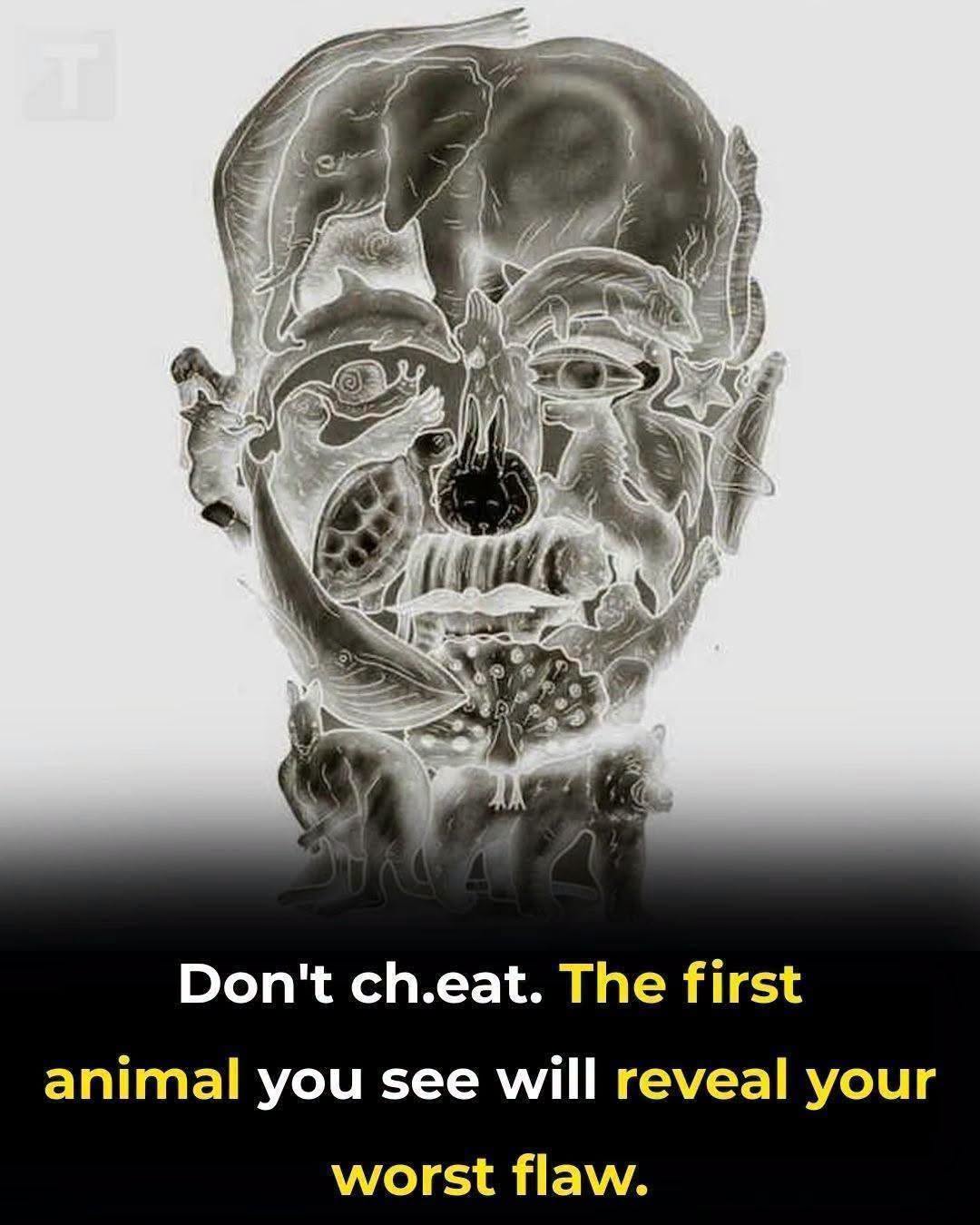
Of course, these interpretations are intended for entertainment and self-reflection rather than scientific assessment. There is no established psychological evidence that the first animal someone sees can accurately determine a personality trait.
Still, that hasn’t stopped people from comparing their answers with friends and family.
Which Animal Did You Notice First?
Take a quick look at the illustration before reading the interpretations below.
Try not to search for a particular animal. Simply notice which shape your eyes recognize first.
Once you’ve made your choice, see what the corresponding interpretation says.
Elephant — Stubbornness
If you noticed an elephant, the playful interpretation suggests that you may sometimes hold firmly to your opinions.
You might prefer to follow your own approach rather than change direction quickly when someone offers an alternative.
The positive side? Determination can also be a valuable quality when balanced with flexibility.
Iguana — Emotional Distance
Those who first notice an iguana are sometimes described as being reserved with their emotions.
You may prefer to process your feelings privately before discussing them with others.
That doesn’t necessarily mean you lack emotion. It could simply mean that you take your time before opening up.
Pig — Indulgence
A pig is associated with enjoying life’s comforts.
You may have a tendency to treat yourself, whether that means enjoying good food, relaxing when you have the opportunity, or occasionally putting pleasure ahead of practicality.
A little indulgence can certainly be part of a balanced life.
Cricket — Worrying
If a cricket stood out first, the playful interpretation points toward a tendency to overthink.
You may sometimes spend too much time considering possible outcomes or replaying situations in your mind.
On the other hand, thinking carefully can also help you prepare for challenges.
Horse — Pride
A horse is linked with confidence and pride.
You may place considerable importance on independence and personal achievement.
The challenge is knowing when confidence becomes unwillingness to accept help or admit a mistake.
Dolphin — Impulsiveness
If you spotted a dolphin, you may be someone who enjoys acting on instinct.
You might make decisions quickly, especially when something exciting catches your attention.
Spontaneity can make life interesting, although taking an extra moment to think things through can sometimes be helpful.
Bear — Rigidity
Seeing a bear is associated with being firm in your routines and opinions.
You may feel most comfortable when you know what to expect.
While consistency can be useful, being open to unexpected changes can sometimes create new opportunities.
Fox — Avoidance
A fox is playfully connected with avoiding uncomfortable situations.
You may prefer to step away from conflict rather than confront it immediately.
That approach can preserve peace, but difficult conversations occasionally become easier when addressed directly.
Rabbit — Insecurity
If the rabbit was the first animal you recognized, the interpretation suggests that you may sometimes doubt yourself.
You could be more critical of your own decisions than other people realize.
Remember that uncertainty is something many people experience from time to time.
Toucan — Seeking Attention
A toucan is associated with enjoying recognition.
You may appreciate compliments, attention, and opportunities to express yourself.
There’s nothing inherently wrong with enjoying the spotlight, especially when confidence is paired with consideration for others.
Kangaroo — Inconsistency
Those who see a kangaroo first are sometimes described as having difficulty sticking with one direction.
You may enjoy trying new ideas and changing plans when something more interesting appears.
Flexibility can be useful, although finishing what you start can be equally important.
Peacock — Vanity
A peacock is linked with appearance and self-presentation.
You may care about how others perceive you and enjoy looking your best.
Taking pride in your appearance is perfectly normal; the playful “flaw” comes into the picture only when appearances become more important than substance.
Turtle — Excessive Caution
If you noticed a turtle, the interpretation suggests that you tend to proceed carefully.
You may prefer to consider every possibility before making an important decision.
That caution can protect you from unnecessary mistakes, although it may occasionally keep you from taking worthwhile chances.
Whale — Emotional Isolation
A whale is sometimes associated with keeping emotions at a distance.
You may need plenty of personal space and prefer processing difficult experiences independently.
At times, however, sharing your thoughts with someone you trust can make challenges easier to manage.
Gorilla — Dominance
If the gorilla caught your eye first, the playful interpretation suggests a strong personality.
You may naturally take charge in group situations and feel comfortable making decisions.
Leadership can be a strength, provided there’s room for other people’s ideas as well.
Duck — Mood Changes
A duck is associated with changing moods.
You may experience shifts in enthusiasm depending on your surroundings or circumstances.
Everyone has emotional ups and downs, so this interpretation should be viewed as a fun observation rather than a serious personality assessment.
Starfish — Escapism
If you noticed a starfish, the interpretation suggests that you sometimes retreat into imagination or entertainment when reality becomes stressful.
Taking a break can be healthy. The important part is eventually returning to the things that need your attention.
Snake — Manipulation
A snake is given one of the more dramatic interpretations: a tendency toward manipulation.
But don’t take this label literally. Seeing a particular shape in an optical illusion does not demonstrate that someone is manipulative or dishonest.
At most, the interpretation can serve as a playful prompt to think about how you communicate with others.
Sloth Bear — Procrastination
If you noticed a sloth bear, you may occasionally put things off until later.
Many people procrastinate, particularly when a task feels boring, difficult, or overwhelming.
A useful response is to break large tasks into smaller steps and start with just one.
Bird — Instability
A bird is sometimes associated with having difficulty staying in one place or maintaining a single direction.
You may enjoy variety and become restless when life feels too predictable.
That can be both a challenge and a source of creativity.
Snail — Resistance to Change
Finally, if the snail was the first animal you noticed, the playful interpretation suggests that you may take longer than others to embrace change.
You might prefer familiar routines and carefully consider new situations before accepting them.
There’s nothing inherently negative about moving at your own pace.
Why Are These Visual Tests So Popular?
Part of the appeal is their simplicity.
You don’t need specialized knowledge or a lengthy questionnaire. You simply look at an image, make a quick observation, and compare your answer with a list of interpretations.
The results can also make for an easy conversation starter.
Two people can look at exactly the same picture and notice completely different things. That difference alone can be interesting to discuss.
However, it’s worth keeping expectations realistic.
A Fun Puzzle, Not a Psychological Diagnosis
There is no scientific basis for concluding that the first animal someone sees in an optical illusion reveals their “worst flaw.”
What a person notices first can be influenced by many factors, including the design of the image, visual attention, expectations, and individual perception.
Personality itself is considerably more complex than a single visual choice.
So if you saw a snake, don’t worry that the image has uncovered some hidden characteristic. And if you saw a peacock, it doesn’t mean you’re secretly obsessed with appearances.
Think of the exercise as what it is: a light-hearted optical illusion designed to encourage curiosity and conversation.
The most interesting part may not be what your animal supposedly says about you—but why you noticed that particular animal before everything else.