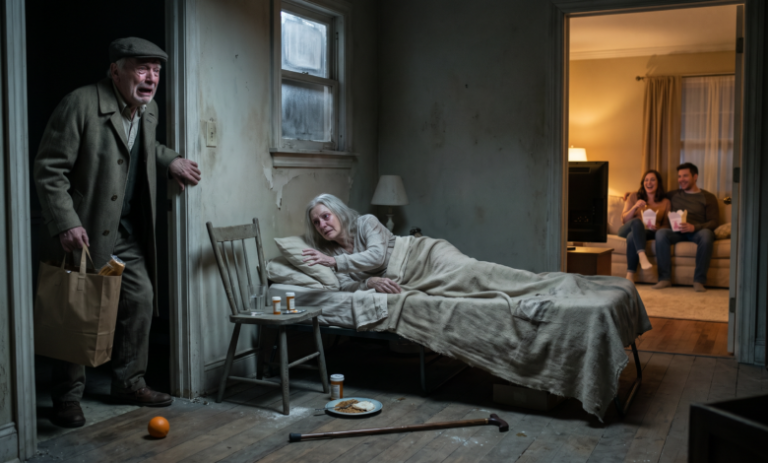
The doctor pulled me aside after about an hour.
“Mr. Callaway,” he said carefully, “your wife is severely dehydrated and malnourished. We’ve also found traces of a sedative in her system.”
For a moment, I didn’t understand the sentence.
Then one word stayed with me.
“Sedative?”
The doctor nodded.
“We’re still running tests. We don’t know the full history yet.”
“Could it have happened accidentally?”
He paused.
It was only a second.
But it was long enough.
“It’s possible,” he said. “However, the results suggest this may not have been an isolated incident.”
I stared at him.
Not an isolated incident.
The words seemed to rearrange everything I thought I knew.
By evening, Maggie was upstairs in intensive care.
Monitors surrounded her bed. Nurses came and went. The steady sounds of the machines filled the room.
I was told visiting hours were limited.
I stayed anyway.
Nobody asked me to leave.
After midnight, I finally went downstairs for coffee.
That was where I met Detective Harris.
He was waiting near the elevators in a dark suit, holding a small notebook.
“Mr. Callaway?”
“Yes.”
“I’m Detective Harris. The hospital contacted us after the initial findings. One of your neighbors also reached out.”
“Who?”
“Earl Hutchins.”
My stomach tightened.
Earl lived across the street from my son’s house.
I had met him only briefly.
But apparently, he had been watching something I had failed to see.
Detective Harris opened his notebook.
“I need to ask you about your son.”
I looked at him.
And suddenly, I understood that this was no longer simply a family emergency.
Someone was asking questions.
And those questions were beginning to point in one direction.
THE QUESTIONS I DIDN’T WANT TO ANSWER
Detective Harris asked me to step into a quieter corridor.
“This investigation is in its early stages,” he explained. “We don’t have conclusions yet. Only information we’re trying to understand.”
“I understand.”
He looked at his notes.
“Your wife’s condition suggests she may have been receiving medication that wasn’t properly documented.”
My hands tightened.
“Why would anyone do that?”
“That’s what we’re trying to determine.”
I already had a terrible thought.
Someone had needed Maggie tired.
Someone had needed her dependent.
Someone had needed her unable to question what was happening around her.
Then Harris told me what Earl had reported.
“He says he saw your wife collapse at least twice through the kitchen window.”
I stared at him.
“Collapse?”
“He said your son refused medical assistance both times.”
“Refused?”
Harris nodded.
“According to Earl, your son insisted she only needed rest.”
The room suddenly felt colder.
I remembered all the conversations I had with Kevin during the previous few months.
His questions about money.
His interest in his mother’s accounts.
The way he always changed the subject whenever I asked about her health.
The way he described Maggie as “confused” whenever she disagreed with him.
At the time, each detail had seemed harmless.
Together, they looked different.
Harris closed his notebook.
“Mr. Callaway, I need to ask you something directly.”
I waited.
“Do you believe your son is capable of putting your wife in danger?”
I thought about Kevin.
My son.
The child I had once carried on my shoulders.
The young man I had spent years defending.
Then I thought about Maggie lying upstairs.
Finally, I answered.
“I believe my son is capable of more than I wanted to believe.”
That night, I barely slept.
I sat beside Maggie’s hospital bed and watched her breathe.
At 3:14 in the morning, her fingers moved.
Then she squeezed my hand.
“Frank.”
I leaned forward.
“I’m here.”
Her eyes opened slowly.
She looked frightened.
“Don’t trust…”
Her voice faded.
I waited.
“Don’t trust him.”
Then she closed her eyes again.
I didn’t need to ask who she meant.
Kevin.
For months, I had been looking at my son through the eyes of a father.
That night, for the first time, I had to look at him through the eyes of a stranger.
And I didn’t like what I saw.
THE CALL FROM KEVIN
The next morning, Detective Harris returned with a search warrant.
Kevin called me before the investigators arrived.
“You’re making a mistake,” he said.
His voice was calm.
Almost too calm.
“Mom is sick. She’s been under a lot of stress. You’re overwhelmed.”
“I’m not overwhelmed.”
“Dad, think about what this looks like.”
That sentence stopped me.
Not because it sounded threatening.
Because it sounded calculated.
He wasn’t asking whether his mother was okay.
He was worried about appearances.
“I am thinking about what it looks like,” I said.
“What does that mean?”
“It means I’m asking questions I should have asked months ago.”
There was silence.
Then I hung up.
By afternoon, investigators were inside Kevin’s home.
I waited at the hospital.
Hours later, Detective Harris asked me to meet him in a small office.
He closed the door.
“We found something.”
I waited.
“Medication in the kitchen that doesn’t appear to belong to your wife. We’re checking the records now.”
My stomach tightened.
“There’s something else.”
He placed another folder on the table.
Financial documents.
Account information.
Drafts.
Transfers.
Questions about Maggie’s retirement benefits.
Requests concerning joint accounts.
Suddenly, this wasn’t just about a health crisis.
There was a financial pattern underneath it.
Harris looked at me.
“I think someone may have been trying to make your wife increasingly dependent on other people.”
I stared at the folder.
“Why?”
“That’s what we’re investigating.”
I stood.
“Where is Kevin?”
“We’re bringing him in for questioning.”
Before anything else, I went back to Maggie.
She was awake.
This time, her eyes were clearer.
“Frank,” she said, “something was wrong with me.”
I sat beside her.
“What do you remember?”
“Not everything.”
She looked down at her hands.
“I kept feeling like I couldn’t think properly. I would forget conversations. I’d lose track of things.”
“Why didn’t you call me?”
“I tried.”
Her voice became quieter.
“But my phone was always missing. Sometimes it was dead. Sometimes I couldn’t remember where I had left it.”
She looked at me.
“They kept telling me I was confused.”
I took her hand.
“But you weren’t?”
She shook her head.
“No. I was trying to understand what was happening.”
That was the moment my uncertainty disappeared.
Something had happened to my wife.
And someone had gone to considerable lengths to make sure nobody noticed.
THE INVESTIGATION
Two days later, Kevin was formally detained while investigators continued their work.
Brittany, his wife, gave a statement.
Then another.
Then changed important parts of the first.
Earl Hutchins spoke to investigators again.
The hospital provided its medical findings.
Financial records were examined.
Piece by piece, the situation became clearer.
Maggie had not simply been struggling.
She had been isolated from the people who might have recognized that something was wrong.
And that realization was harder for me to accept than anything else.
Because isolation can be disguised as care.
“Let her rest.”
“She’s under stress.”
“She needs someone to handle things for her.”
“They’ll be easier if we take care of the finances.”
Each sentence sounds harmless on its own.
Together, they can become something very different.
Three weeks later, Maggie finally walked out of the hospital.
She was still recovering.
But she was walking.
She held my hand in the parking lot and looked back at the hospital.
“Do you think he understands what he did?” she asked.
I started the car.
“I don’t know.”
She looked at me.
I paused.
“But I think the more important question is whether we understand what happens next.”
She nodded.
For the first time in weeks, I saw something in her expression that looked like hope.
I thought that was the end of the story.
I was wrong.
PART 4 — THE FILE THAT CHANGED EVERYTHING
Keep reading…