
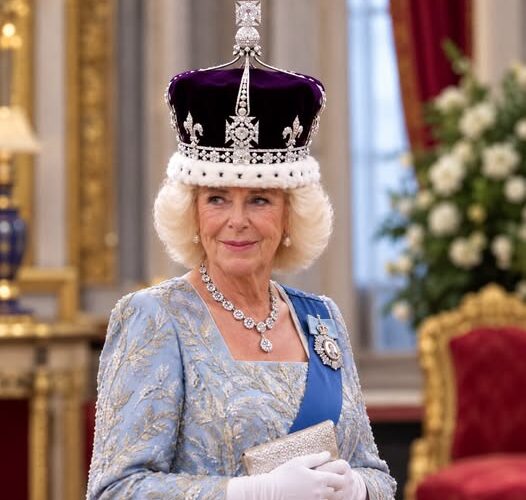

The image that drew so much attention carried none of the sensationalism that had surrounded her earlier years in the public eye. There were no dramatic gestures or confrontations. Instead, there was ceremony, restraint, and the quiet confidence of someone who had spent decades learning how to live under an extraordinary level of scrutiny.
Standing beside King Charles III, Queen Camilla appeared less like the controversial figure of old headlines and more like what she has gradually become within the modern monarchy: a working member of the Royal Family whose public role is defined by service, appearances, charitable causes, and support for the King.
That transformation did not happen overnight.
Camilla’s relationship with Charles was scrutinized for years, particularly because of Charles’s previous marriage to Diana, Princess of Wales. The story became one of the most intensely discussed chapters in British royal history, generating years of headlines, public debate, and deeply personal judgments about the people involved.
For Camilla, the attention came with a cost.
She became a familiar target of criticism and was frequently reduced to a single role in a complicated story. Newspaper coverage and popular narratives often focused on the most dramatic aspects of her relationship with Charles, leaving little room for the ordinary dimensions of her life or for the possibility that public perceptions might change over time.
Yet time did change the picture.
As the years passed, Camilla gradually became more visible in official royal duties. She accompanied Charles on engagements, supported charitable organizations, attended major state occasions, and developed causes of her own. Her public responsibilities increasingly placed her within the working structure of the monarchy rather than at its margins.
Then came the moment that permanently changed her constitutional and ceremonial position.
When Charles became King Charles III following the death of Queen Elizabeth II in September 2022, Camilla became Queen Consort. Her role was no longer simply that of the King’s longtime partner. She had become part of the formal institution of the Crown.
Months later, at the coronation, the symbolism became even more powerful.
The woman who had once been at the center of endless public argument was now standing alongside the King during one of Britain’s most important ceremonial occasions. Whatever opinions people held about her past, her position within the monarchy had become an established reality.
That does not mean the past disappeared.
History rarely works that way.
The controversies surrounding Charles, Diana, and Camilla remain part of the public record, and people continue to interpret those events differently. Some view Camilla’s journey as one of remarkable endurance and personal resilience. Others remain critical of the circumstances surrounding her relationship with Charles. Both the history and the public reaction to it have evolved over decades.
What changed most visibly was Camilla herself.
Rather than attempting to erase the past, she gradually built a public identity around the responsibilities she had been given. Her work has included advocacy relating to literacy, reading, domestic violence, osteoporosis, animal welfare, and other charitable causes.
Her approach has often been understated.
There has been no dramatic attempt to rewrite the story overnight. Instead, her position has been shaped through years of appearances, commitments, speeches, visits, and the repetitive work that defines much of royal service.
That may be why the photograph feels significant to so many observers.
The room may be filled with gold, velvet, uniforms, jewels, and centuries of ceremony, but the most striking element is the contrast between the woman people once thought they knew and the woman standing there now.
She is no longer simply a character in someone else’s story.
She has become part of the institution itself.
For a woman who spent much of her public life being discussed through the lens of other people, that represents a remarkable transformation.
The crown does not erase controversy. It does not rewrite history, and it cannot make decades of public fascination disappear. But it does mark a new chapter.
Camilla’s journey from private figure to Queen has been unusually complicated, shaped by love, loss, criticism, royal tradition, and the relentless attention of the media.
And perhaps that is what makes the image so compelling.
The significance is not simply that Camilla wears a crown.
It is that she arrived there after years in which many people believed she never would.
Now she stands beside the King not as a footnote to an old royal story, but as Queen Camilla — a figure whose place in Britain’s modern monarchy has been established through time, duty, and persistence.
The story is still complicated.
The history is still debated.
But the image remains unmistakable: a woman once defined almost entirely by controversy now standing at the heart of the institution she was once expected to remain outside of.
And beneath the glitter of the crown, perhaps the most remarkable part is not the ceremony at all.
It is the journey that made the moment possible.