
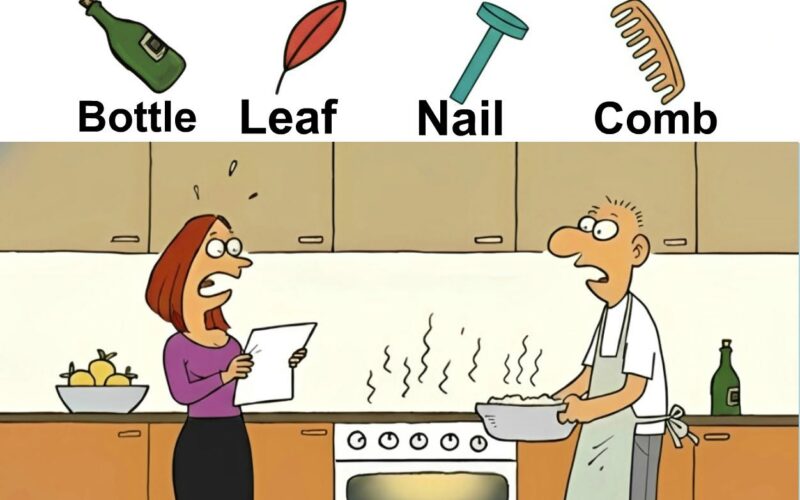

Start With the Bigger Picture
When people look at a detailed image, their eyes often focus first on the most obvious shapes, colors, or objects.
That can make smaller details surprisingly difficult to notice.
Instead of immediately searching one corner, try looking at the whole image first.
Notice the background.
Look around the edges.
Pay attention to areas where several shapes overlap.
Sometimes a hidden object blends into its surroundings so well that you may look directly at it without recognizing what you’re seeing.
Can You Spot the Bottle?
The bottle may not appear in the most obvious form.
Look for a shape with a narrow section and a wider body. It may be partially surrounded by other objects or positioned at an angle that makes it less recognizable.
Don’t worry if you don’t see it immediately.
Move your eyes slowly across the image and examine unusual outlines.
Now Look for the Leaf
Leaves can be particularly easy to hide in an illustration because their natural shapes can resemble other objects.
Look for a pointed or curved outline and check areas containing patterns that could disguise its shape.
Sometimes changing your viewing distance can also help.
If you’re looking closely at your phone, try holding it slightly farther away.
Where Is the Nail?
The nail is likely to be the smallest and easiest item to miss.
Instead of searching only for a complete nail shape, look for a thin, straight object or a small metallic-looking detail.
Small objects often disappear into busy backgrounds because our eyes naturally prioritize larger or more noticeable shapes.
And What About the Comb?
The comb may be easier to identify once you know what you’re looking for.
Look for a longer shape with repeated small lines or teeth.
It might be positioned among other objects whose outlines create visual confusion.
Take your time rather than trying to find everything at once.
Why Are These Puzzles So Easy to Miss?
Visual puzzles work because seeing something and recognizing something aren’t always exactly the same.
Your eyes can receive information from an image while your brain focuses attention on only certain parts of it.
Familiar objects can also become difficult to identify when they’re partially hidden, rotated, blended into a background, or surrounded by similar shapes.
That’s why someone can spend several minutes searching for an object and then suddenly say:
“How did I not see that?”
A Simple Challenge
Before checking the answer, give yourself another attempt.
Try these steps:
- Scan the entire image slowly.
- Check the corners and edges.
- Look for unusual outlines.
- Change the distance between your eyes and the screen.
- Focus on one object at a time.
- Then compare your findings with the answer.
And remember, these puzzles are designed for entertainment. Finding the objects—or missing them—doesn’t provide a reliable measure of intelligence, personality, age, or eyesight.
Sometimes the challenge is simply about attention, familiarity, and how the picture was designed.
Did You Find All Four?
If you spotted the bottle, leaf, nail, and comb without checking the answer, congratulations—you successfully completed the visual challenge.
If you missed one or more, don’t worry.
That’s exactly what makes hidden-object puzzles fun.
The most satisfying moment is often when the answer is revealed and the object suddenly becomes obvious.
So, which one did you find first?