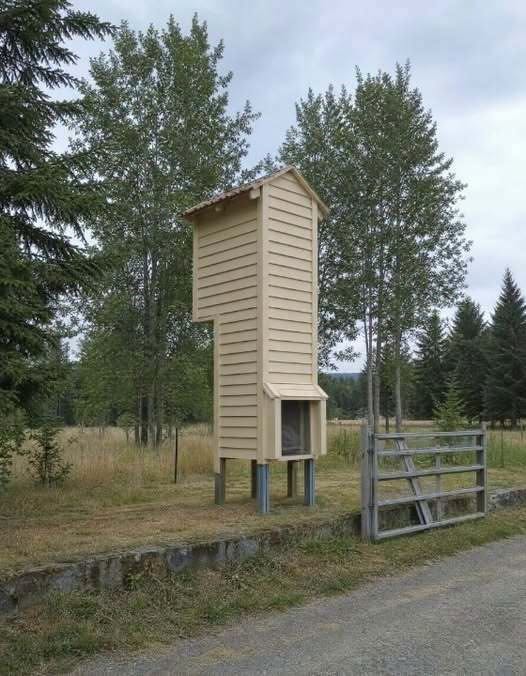
These devices are uncommon but not unique.
Similar systems have been installed on private property in several countries where driveways exit onto roads with poor sight lines. More commonly, highway authorities use large convex traffic mirrors at difficult intersections, although their use varies depending on local regulations because mirrors can distort distance and may not be appropriate in every situation.
Does it prevent accidents?
A mirror or periscope can improve visibility, but it is not a guarantee of safety.
Drivers must still:
- Stop completely before entering traffic.
- Check carefully in all available directions.
- Allow enough time to merge safely.
- Be aware that mirrors can make vehicles appear farther away than they actually are.
The structure is an aid—not a substitute for careful driving.
Why it attracts attention
Part of the appeal of these wooden towers is their ingenuity.
Rather than relying on electronics or expensive infrastructure, they use basic optical principles that have been understood for centuries. For locations where installing road improvements isn’t practical, a well-designed mirror system can offer a useful improvement in visibility.
A reminder that simple ideas can be effective
The roadside periscope demonstrates how straightforward engineering can sometimes solve everyday problems. While it won’t eliminate every hazard at a dangerous intersection or blind driveway, it shows that practical thinking and an understanding of basic physics can make roads safer in certain situations.
Sometimes the most interesting innovations aren’t high-tech at all—they’re clever applications of simple ideas that continue to work year after year.