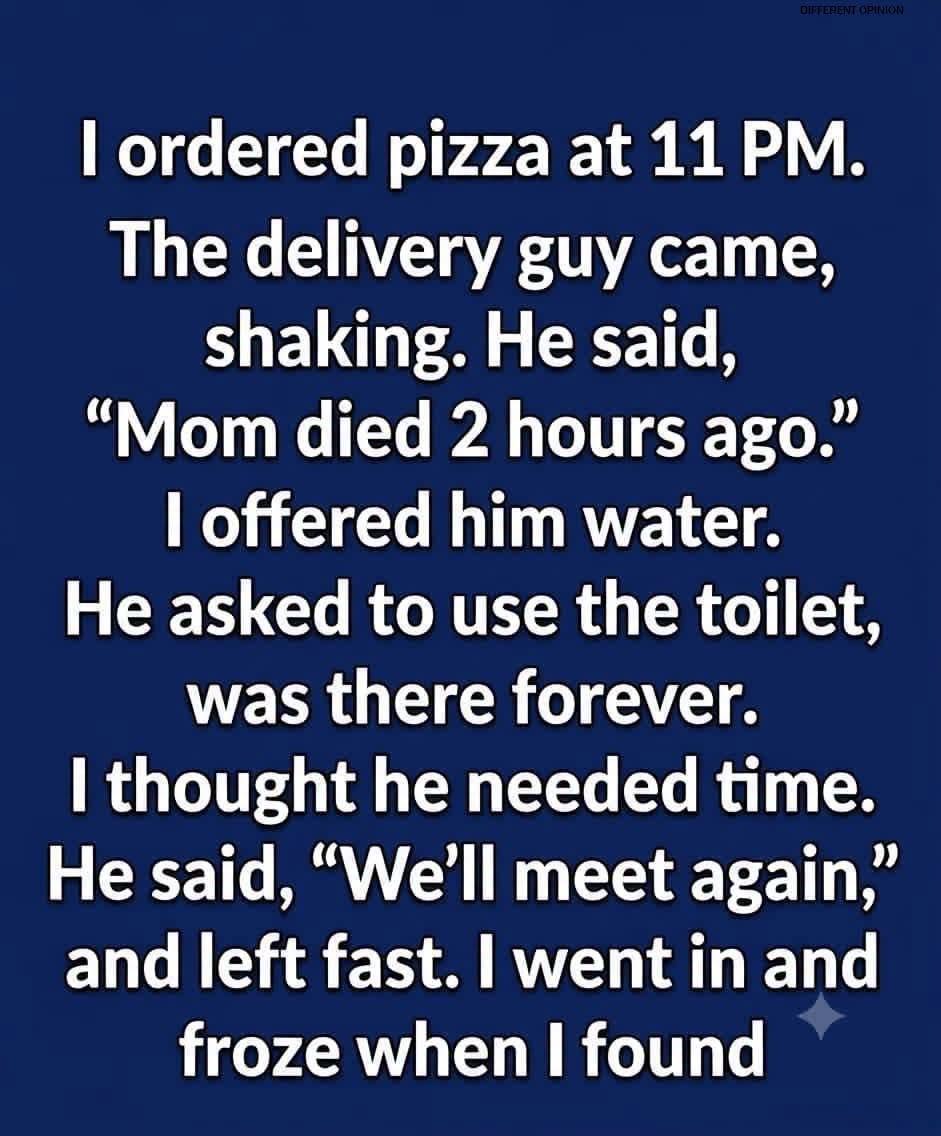
It was late when I ordered the pizza.
I wasn’t particularly hungry. It was more habit than anything else—the kind of late-night order you make when you’re tired, don’t feel like cooking, and want something easy before going to bed.
Outside, the city had become unusually quiet.
The traffic had thinned, most of the neighboring apartments were dark, and I expected the rest of my night to be completely uneventful.
Then the doorbell rang.
I opened the door expecting nothing more than a quick exchange with a delivery driver.
Instead, I met someone who clearly wasn’t having an ordinary night.
Something About Him Seemed Different
The driver looked young, perhaps in his early twenties.
He stood outside holding the pizza box with both hands and gave me the polite greeting you’d expect from someone finishing another delivery.
But something about his expression caught my attention.
He looked exhausted.
Not simply tired from working late.
There was a heaviness in his face that made me hesitate before closing the door.
“Long night?” I asked.
He looked down for a moment.
Then he quietly said something I wasn’t prepared to hear.
“My mother passed away a few hours ago.”
For a second, I didn’t know how to respond.
I Couldn’t Understand Why He Was Still Working
My first thought was obvious.
Why was he delivering pizzas?
Why wasn’t he with his family?
But I stopped myself from immediately asking.
People respond to grief differently.
Maybe he needed the money.
Maybe going home felt unbearable.
Maybe keeping himself occupied was the only thing helping him make it through those first few hours.
I didn’t know him well enough to assume.
So instead, I asked if he wanted some water.
He hesitated.
Then he nodded.
For a Few Minutes, He Wasn’t a Delivery Driver
I invited him inside and told him he could sit down for a moment.
The pizza stayed unopened on the kitchen counter.
I brought him a glass of water.
He sat quietly.
I kept trying to think of something meaningful to say, but every sentence sounded inadequate in my head.
Eventually, I realized I didn’t need to say much.
He hadn’t asked me for advice.
He hadn’t asked me to make him feel better.
Maybe he simply needed a few minutes where nobody expected anything from him.
So I let the silence stay.
Sometimes Silence Is Enough
After a while, he started talking a little.
Not about the details of what had happened.
Not about work.
Just a few scattered thoughts.
I listened.
There are moments when we feel pressured to find the perfect words for someone who’s grieving.
But there often aren’t any.
You can’t explain away someone’s loss.
You can’t turn grief into something reasonable with one comforting sentence.
Sometimes the kindest thing available is simply allowing another person to sit without having to pretend they’re okay.
That’s what I tried to do.
Then He Asked to Use My Bathroom
After several minutes, he stood.
“Could I use your restroom before I go?”
“Of course.”
I pointed him toward it.
“Take your time.”
He disappeared down the hallway and closed the door.
I returned to the kitchen.
The pizza was getting cold, but eating suddenly felt strangely unimportant.
I looked at the clock.
Only a short amount of time had passed since he’d arrived, yet the entire mood of the evening had changed.
A routine delivery had turned into an unexpectedly personal encounter between two strangers.
When He Returned, He Seemed Calmer
A few minutes later, the bathroom door opened.
The driver walked back toward me.
Something about him had changed.
He wasn’t suddenly cheerful.
Grief doesn’t disappear after a glass of water and a few quiet minutes in a stranger’s apartment.
But he seemed steadier.
More composed.
As though he’d given himself permission to stop for a moment before returning to whatever waited outside.
“Thank you,” he said.
I told him there was nothing to thank me for.
Then he headed toward the door.
His Final Words Caught Me Off Guard
Just before stepping into the hallway, he stopped.
He looked back at me.
“We’ll meet again,” he said quietly.
The sentence struck me as unusual.
Maybe it was simply his way of saying goodbye.
Maybe he believed our paths would cross again.
I didn’t ask.
I just nodded.
“Take care of yourself.”
He walked down the hallway.
A few seconds later, he was gone.
Then I Noticed Something in the Bathroom
I finally returned to the kitchen and opened the pizza box.
But before sitting down, I decided to check the bathroom.
That’s when I noticed something he’d apparently left behind.
It was a small personal item.
Nothing threatening.
Nothing that suggested an immediate danger.
Just something that clearly seemed to belong to him.
I picked it up and stood there for a moment.
Suddenly, his final words returned to me.
We’ll meet again.
Maybe he simply hadn’t realized he’d forgotten the item.
Perhaps he’d eventually notice it was missing and come back.
There didn’t need to be a mysterious explanation.
Still, the object made our brief encounter feel strangely unfinished.
I Kept Thinking About Him
Long after the pizza had gone cold, I found myself wondering about the driver.
Had he finished his shift?
Did he eventually go home?
Was somebody waiting for him?
Had he spent the entire evening telling customers he was fine while carrying something far heavier than any delivery bag?
I would probably never know.
But that uncertainty was part of what stayed with me.
We interact with strangers constantly without knowing what happened in their lives five minutes before we met them.
The cashier who seems distracted.
The driver who doesn’t smile.
The coworker who’s unusually quiet.
The person sitting alone on a bus staring through the window.
Most of the time, we see only a few seconds of somebody else’s day.
We rarely know what they’re carrying with them.
A Small Moment Can Mean More Than We Realize
I hadn’t done anything extraordinary that night.
I hadn’t solved his problems.
I hadn’t changed what had happened to his mother.
I gave a grieving stranger a glass of water, a chair and a few minutes where he didn’t have to be a delivery driver.
That was all.
But the encounter changed the way I thought about ordinary interactions.
We often imagine kindness as something dramatic—a major sacrifice or a grand gesture.
Sometimes it’s much smaller.
It’s noticing that someone isn’t okay.
It’s listening without demanding an explanation.
It’s giving someone a moment to collect themselves.
And occasionally, it’s simply treating a stranger as a person rather than the uniform they’re wearing or the service they’re providing.
I Never Looked at Late-Night Deliveries the Same Way
That evening began with something completely ordinary.
I ordered dinner.
Someone delivered it.
Under normal circumstances, we might have interacted for less than thirty seconds and never thought about each other again.
Instead, circumstances created a small connection between two people who knew almost nothing about one another.
I don’t know exactly what that moment meant to him.
I only know what it taught me.
Everyone we meet has a life continuing beyond the few seconds we happen to share with them.
Sometimes that life is joyful.
Sometimes it’s difficult.
And sometimes the person standing at your door carrying something as ordinary as a pizza may also be carrying a burden you could never have guessed.
The item he left behind eventually became a reminder of that night.
Not because there was anything mysterious about it.
But because it reminded me how quickly a stranger can become human to us once we stop long enough to actually see them.
Note: This story is presented as a narrative for entertainment and reflection. Names, dialogue, circumstances, and identifying details may be fictionalized or adapted.