Law enforcement and volunteers threw everything at it at first—search teams, dogs, helicopters, posters, interviews that repeated until my own answers sounded unreal. Then the urgency faded. The tips slowed. The case became a file. And I was left living in the space where a child should have been.
After the first year, I stopped driving Route 9 completely. I couldn’t stand the signs, the exits, the rest stops. My chest would lock up just seeing them.
A GPS Reroute I Didn’t Ask For
Last Tuesday, my navigation app rerouted me around an accident. I didn’t realize where it was taking me until I saw the sign.
Route 9.
My hands went damp on the steering wheel. My mind started shouting at my body to turn around, to get off the highway, to do anything except keep going.
Then the tire blew.
I managed to get onto the shoulder, but I didn’t move after that. I just sat there, gripping the wheel, crying so hard the road blurred. It wasn’t about the tire. It was about being pulled back onto the same stretch of asphalt where my son had vanished.
The Stranger Who Didn’t Ask Questions
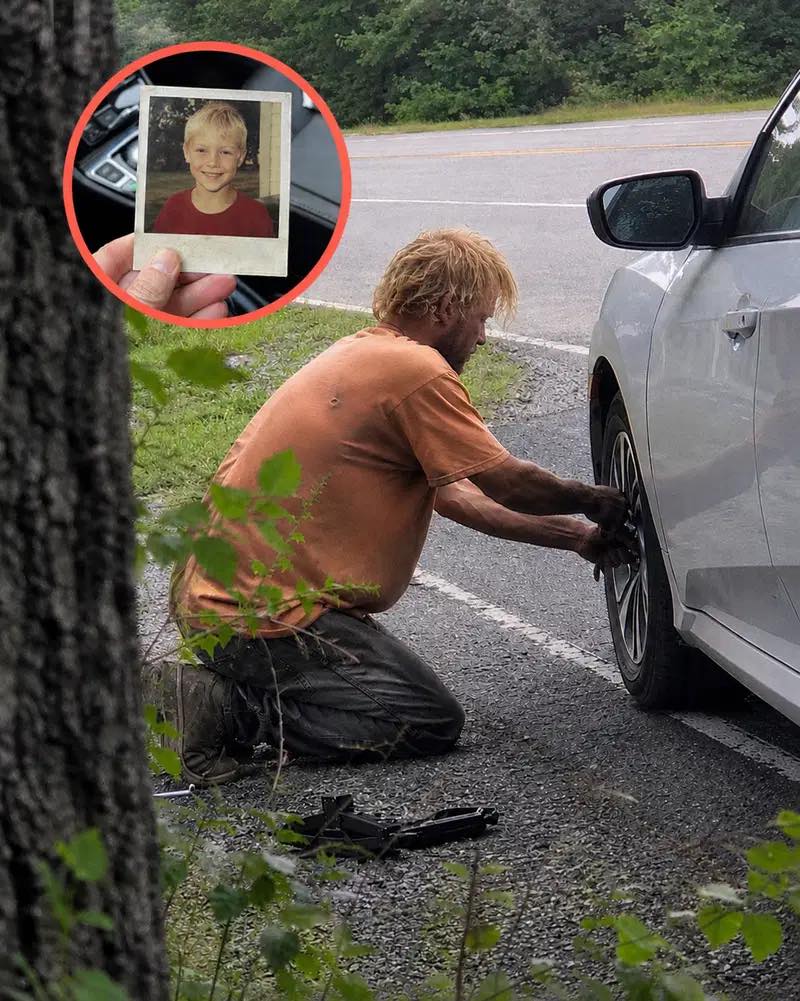
A man approached my car from behind—older, bundled in a worn coat, boots cracked from miles of hard living. His gray beard lifted in the wind. He looked like someone the road had chewed up and kept.
He glanced at my rear tire and said, “You got a spare?”
That was it. No lecture. No small talk. No judgment.
He worked quickly, like someone who’d done it a hundred times. I stood nearby with my arms wrapped around myself, watching his hands tighten the lug nuts with calm certainty.
When he finished, he wiped his hands on a rag and looked up at me.
His eyes held a kind of sadness I can’t explain.
Then, in a quiet voice, he said, “Take care now, Margaret.”
My stomach dropped. I hadn’t told him my name.
Before I could speak, he turned and walked toward the trees, disappearing like he’d never been there.
What He Left on My Passenger Seat
That’s when I saw it.
A Polaroid photo on the passenger seat.
It showed a little boy in a red shirt with hair falling into his eyes and a crooked front tooth—features so familiar my knees nearly gave out.
On the white border was shaky handwriting: an address.
And beneath it, my name.
A Call That Changed Everything
I called the man who had led the original investigation—now the mayor of our town. When I sent him a picture of the Polaroid, his reaction wasn’t relief.
It was fear.
“Margaret,” he said, voice tight, “do not go there.”
He explained why: the address likely belonged to a relative of a former Route 9 maintenance worker named Roy—someone they had questioned back when Daniel vanished. Roy claimed he’d seen nothing. If that photo came from him, and if the boy was Daniel, then a critical lead had been missed.
“Don’t do this alone,” the mayor said. “I’m coming.”
But after 20 years of empty bedrooms and unanswered birthdays, waiting wasn’t something I did well.
The House That Looked Too Normal
The place was small and ordinary—wind chimes on the porch, a truck in the driveway, toys scattered in the yard. Nothing about it looked like the ending to a missing persons nightmare.
I walked up holding the Polaroid so tightly it bent.
Inside the doorway stood a child holding a toy dinosaur. A woman rushed forward, pulling him back gently.
“Mason—come here,” she said, then looked at the photo.
Her face went pale.
“Oh God,” she whispered.
She stared at the Polaroid like she knew exactly what it was.
“That’s my husband,” she said.
“His Name Is Danny.”
I stepped inside before I could talk myself out of it.
The woman shut the door with shaking hands. “His name is Danny,” she said. “My name is Kate.”
In her kitchen, everything looked painfully normal—crayons on the table, a lunch box, a half-finished worksheet. The kind of life I’d imagined for my son, except it had happened without me.
Kate told me the truth in pieces.
Roy was her uncle. He had raised “Danny,” claiming the boy’s father was an old friend who abandoned him. Roy moved often, kept the child out of school, and eventually enrolled him under a different name with questionable paperwork and a story about missing records.
“I didn’t know,” Kate said, crying now. “But I started to feel like something wasn’t right.”
She explained that after Roy died, she found a photo with my name and an old address. Then she found newspaper clippings—missing child articles. My public pleas. Daniel’s picture.
She’d already tried to alert authorities. And the man who changed my tire? His name was Earl. He used to work with Roy. When Kate showed him the photo, he recognized me from old posters and told her if he ever saw me on Route 9, he’d put it in my hands.
He wasn’t chasing ghosts.
He was trying to do one good thing after a lifetime of looking the other way.
Meeting My Son as a Grown Man
I found him outside, stacking boards—late twenties, broad shoulders, sawdust on his sleeves. He turned when he noticed me staring.
For a heartbeat, I saw my little boy.
Then I saw a grown man looking at a stranger.
I stepped closer and said the only words that belonged to us.
“Your mom bought you a Sprite at a rest stop on Route 9. You went around the wrong side of the building and got lost.”
I drove to a gas station and came back with a cold Sprite, the same green label, water beading on the plastic.
He stared at it like it was a key unlocking something buried.
Then his voice cracked. “I remember my hands getting wet. I remember being mad you took too long.”
He swallowed hard, eyes wide with fear and recognition. “I went around the side. I thought I saw something in the trees. I couldn’t find the door again.”
The bottle slipped from his hand. I caught it before it hit the ground.
And in that moment, I knew.
The Truth in a Locked Cabinet
That evening, we opened a locked cabinet in a trailer behind the property.
Inside were boxes of clippings—every anniversary article, every appeal, every photo of me standing beside Daniel’s school picture. Roy had been watching my grief from a distance for 20 years.
There was also a note—messy, cowardly, and brutally simple.
He’d found a crying boy behind the rest stop. The child said his name was Daniel and his mom was Margaret. Roy claimed he panicked because of an old warrant and unpaid fines. He told himself he’d call in the morning.
But morning became “later.”
And “later” became a lifetime.
No elaborate criminal plot. No mastermind. Just one fearful decision repeated every day until it became someone else’s stolen childhood.
What You Can’t Get Back—and What You Can
My son didn’t get his childhood back. I didn’t get his first day of high school, his graduation, his first job, his wedding, or the day his own child was born.
Those losses don’t rewind.
But that night, I stood in his kitchen while his little boy—my grandson—wandered in and pressed a dinosaur sticker into my palm like it was the most ordinary thing in the world.
The Sprite bottle sat on the counter between us, cold and sweating under the kitchen light.
My son looked at me, exhausted and overwhelmed.
“I don’t know how to be your son,” he said quietly.
I didn’t have a perfect answer. After 20 years, there aren’t any perfect answers.
But Route 9—after taking everything from me—finally gave something back.
Closing CTA
If this story moved you, share your thoughts in the comments: What would you do first if you were given a single clue after years of unanswered questions? And if you know someone still searching for a loved one, consider sharing this—sometimes one conversation is where the truth begins.