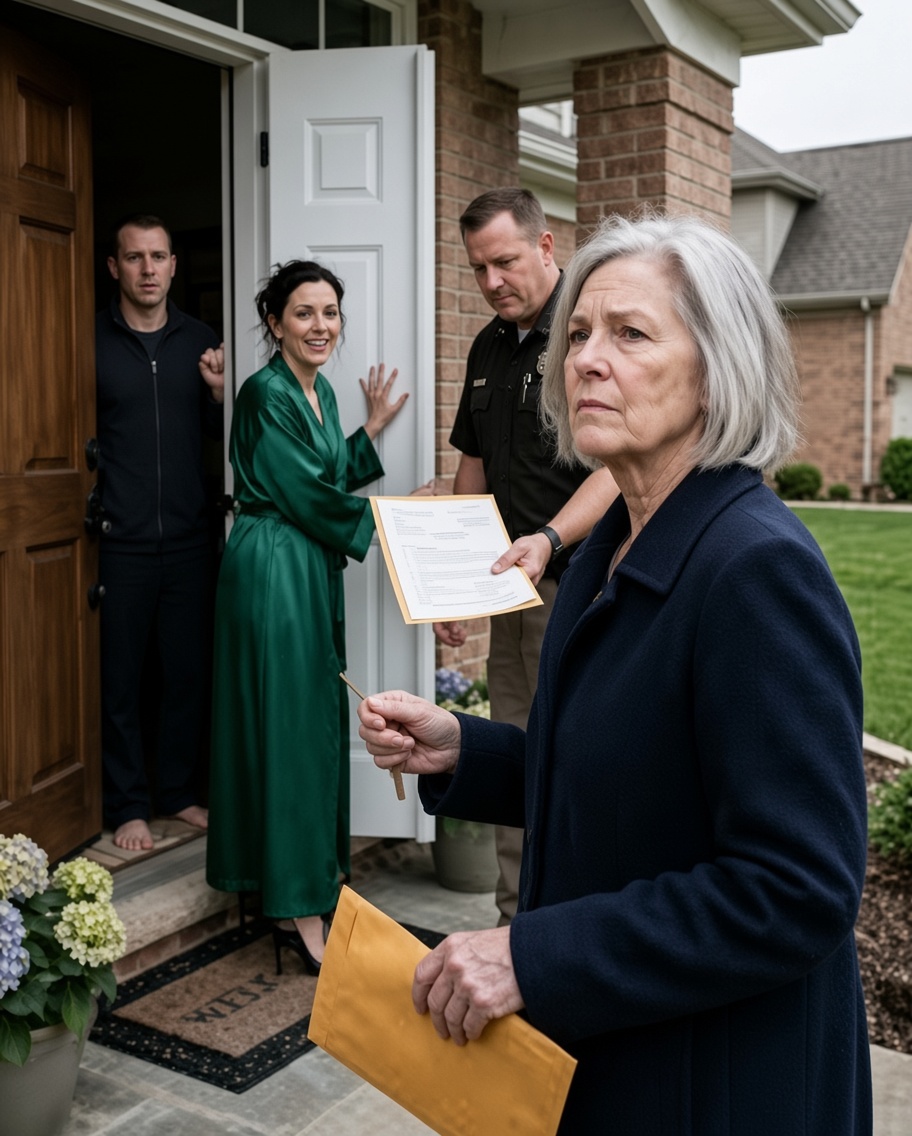
That was when I stopped feeling confused and started feeling very awake.
The Lunch That Was Never Really About Lunch
By the time my son Mark and his wife Alicia arrived, I had already called Thomas, the attorney who had helped my late husband Raymond and me with our estate planning. I asked him to come to the house. I also placed the folder Alicia expected me to sign beside the butter dish on the kitchen table.
Alicia looked surprised when she saw Thomas pull out a chair.
She smiled tightly and said she thought we were simply going to talk about what was best for me.
I told her that was exactly why I wanted someone present who understood the paperwork.
Mark barely looked at me. That hurt more than I expected. This was the same boy who used to call every Sunday at five, the child whose school meetings, doctor visits, birthdays, heartbreaks, and graduations were stitched into my life. Now he sat at my table while avoiding my eyes.
I decided there was no point pretending.
I told them I had heard the phone call.
The kitchen went silent.
I repeated what I had heard: that Alicia believed I would sign what they put in front of me, that someone could remove my glasses if I insisted on reading, that a cousin might help with a discount at Silver Meadows, and that my house might sell for about one hundred eighty thousand dollars.
I also told them I knew Bruce, the real estate contact, had already heard the property could be listed within thirty days.
Alicia’s face changed. She tried to explain that someone had to think about the future. Then, before she could stop herself, she asked if I knew how much money was tied up in that house.
That was the sentence that told me everything.
I reached beneath the table and pulled out a copy of a bank transfer from four years earlier. It showed the forty thousand dollars Raymond and I had given Mark and Alicia for housing expenses. It was clearly marked as a gift, with no repayment required.
They had been saying they had helped pay for my house. They had not. Their own household expenses were not my mortgage.
Thomas then explained what had already been put in place years before. My house could not be sold, transferred, mortgaged, or used as collateral by anyone else without my written authorization. Raymond and I had made sure of that.
Then came the detail Alicia and Mark did not know.
I also owned the house where they were living.
Four years earlier, when I gave them the forty thousand dollars, I had also purchased the remaining equity in the property they had been renting. Raymond and I kept the arrangement private because we wanted the home protected as part of our long-term financial plan. I had also been paying the property taxes and insurance.
Alicia looked stunned. Mark looked as if the floor had moved beneath him.
I was not trying to control their lives. I was trying to protect mine.
Raymond’s Letter Changed the Room
Thomas placed a photograph on the table. It showed Raymond standing near our lake property, a place we had loved for decades.
Mark asked what it had to do with anything.
Thomas explained that Raymond had bought land near the lake more than thirty years earlier. It was not purchased as a shortcut for Mark’s future. Raymond believed independence mattered more than waiting for an inheritance.
Then Thomas looked at me and said perhaps it was time for Mark to read what Raymond had left for him.
I opened the drawer and took out an envelope I had hoped never to use. Across the front, in Raymond’s handwriting, were the words: For Mark — only if he forgets who his mother is.
Mark stared at it for several seconds before opening it.
Raymond’s letter was firm, but not cruel. He wrote that if Mark ever found himself at my table discussing documents that affected my home or finances, he needed to stop and make sure I understood every choice being made. He reminded our son not to confuse my kindness with weakness. He reminded him that a house is not only wood and brick, but the place where a family’s history lives.
Mark could barely keep reading.
For the first time that day, he looked less defensive and more ashamed.
He admitted they should have talked to me honestly. Alicia then said something no one expected.
She had made poor investment decisions. The loss was about eighty-six thousand dollars.
She said she had tried to increase their savings, then used household money and borrowed more while attempting to cover the losses. Instead of telling Mark right away, she tried to fix the problem alone. Each choice made the next one harder. Eventually, my house had become, in her mind, a possible solution.
That was the moment the issue became bigger than one lunch or one folder of documents. This was about financial secrecy, pressure inside a marriage, and the danger of treating someone else’s property as an emergency fund.
I asked Thomas to take Mark outside for a few minutes so I could speak to Alicia privately.
When we were alone, I asked her how serious the situation was. I also made something clear: I would not give her access to my property or finances.
The documents she had brought concerned residential care and financial authority. Those were not choices she could make for me.
She said she thought she was solving a problem.
I told her the truth. She was trying to solve her problem with my life.
What Readers Should Know
Family pressure around aging, property, and money can become complicated quickly. In my case, Raymond and I had already taken steps that protected my home, the rental property, and the lake land. Those legal arrangements mattered because they prevented confusion from becoming a financial disaster.
Estate planning is not only for wealthy families. Clear documents can help protect a homeowner’s choices, clarify who has authority, and reduce the risk of relatives making assumptions about property, savings, taxes, insurance, or care decisions. When money is tight or a family member is in financial trouble, those boundaries become even more important.
After that morning, Thomas reviewed the paperwork Alicia had brought. Some of it required professional attention. Mark also learned that certain financial documents had been prepared without his full understanding, which became a serious matter for him to address with legal guidance.
I did not rescue them financially. I loved them, but I did not take responsibility for Alicia’s decisions.
Over the next several months, Alicia accepted responsibility for what she had done. She moved out for a time, and she and Mark tried to work through the damage with professional guidance. Eventually, they chose to separate. Alicia agreed to repay what she could, sold several expensive items, and changed her spending habits.
Mark began coming over every Wednesday. The old short Sunday calls turned into longer conversations. Sometimes he brought tools and tried to repair something around the house after watching videos. Sometimes he just sat at the kitchen table with me.
One day he asked if he would ever become the man his father wanted him to be.
I told him he was already working toward it.
That spring, a development company made an offer for part of my lake property. Mark reminded me I did not have to sell. That mattered. He was no longer pushing me toward a decision. He was respecting that it was mine to make.
I eventually sold part of it and used some of the proceeds to start the Raymond Bennett Scholarship Fund. In the first year, it helped six local students. Mark later told me he had finally understood that money matters most when it creates opportunity.
Christmas came eight months after the pocket dial. The house was warm, banana bread was in the oven, and my grandchildren were laughing in the next room. Mark gave me a framed photograph taken beside the lake thirty years earlier. On the back, he had written that home is not only a place, but somewhere people are respected and allowed to come back.
Every Sunday at five, my phone still rings.
Sometimes Mark has news. Sometimes he simply wants to talk. But now the calls are different, because they are no longer made out of habit. They are made with intention.
I learned that morning that a house can be protected with legal documents, insurance records, tax plans, and clear ownership papers. But a relationship needs something else: honesty, patience, boundaries, and the willingness to take responsibility.
The house was never the only thing I was protecting. I was protecting my right to choose — and, in the end, the possibility that my son might find his way back with respect.
Sometimes the hardest family conversations begin with the truth no one expected to hear.