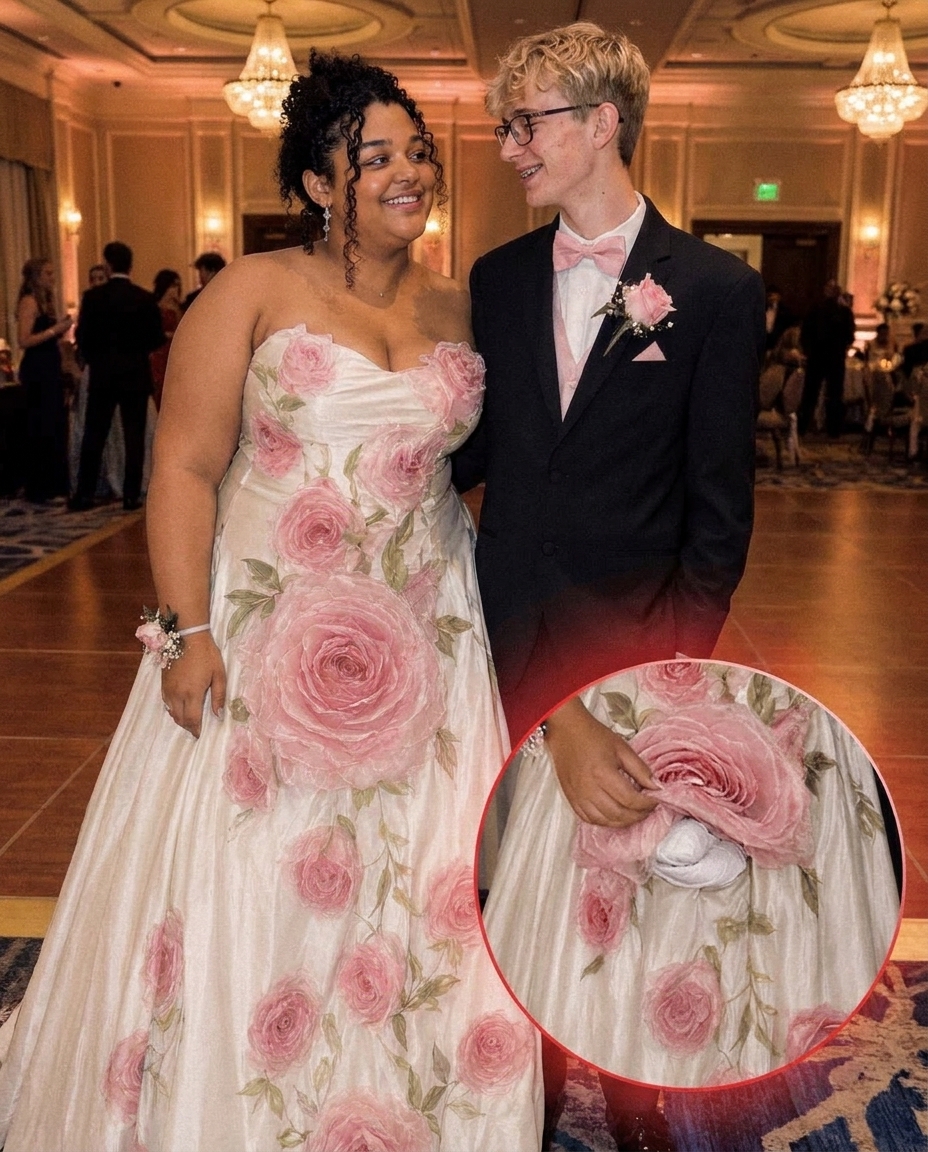
He missed chemistry tests while trying to finish the dress. The material was ivory silk, but the gown became more than fabric. It became a record of what Hazel had endured.
Each rose on the dress hid embroidered fragments of the words that had been used to shame her. Eli did not repeat those words to hurt her again. He transformed them, petal by petal, into something Hazel could wear with dignity.
On prom night, Eli brought the gown to Hazel’s room. He called her “Hazelnut,” the nickname Mason had once used for her. Mason had also made Eli promise that if Hazel ever became too quiet, Eli would be loud enough for both of them.
The Moment the Room Went Still
At the dance, Eli stepped up to the microphone only briefly. He did not give a long speech. He simply asked Hazel to look underneath the largest rose on her gown.
When she did, she found a folded strip of embroidered silk tucked inside. Eli explained that the dress had been made from every word that had tried to break her.
The gym fell silent.
Students began to understand what they were seeing. The comments they had dismissed as jokes or gossip had been preserved in thread. What once felt easy to say from a distance now sat in front of them as evidence of real harm.
Hazel cried, but not because she had been humiliated. She cried because, for once, someone had seen the pain without reducing her to it.
Then one girl came forward and whispered an apology. Another followed. Then a boy approached, struggling to speak through tears. The night shifted from a dance into an unexpected moment of accountability.
Why This Matters
Stories like Hazel’s resonate because they reflect something many teenagers understand: the pressure to fit in can become cruel quickly, especially around milestone events like prom. Clothing, body image, grief, and social belonging can all collide in ways adults do not always see until damage has already been done.
The dress did not erase Hazel’s grief over Mason. It did not fix everything in one evening. But it gave her a moment where pain was not the final word.
Mave watched from the parents’ section and realized prom had never truly been about a gown or a dance. It was about giving Hazel one night where she was not defined by loss, judgment, or the words others had thrown at her.
Later, Mave returned home alone and stood in Mason’s old room, her hand pressed against his dresser. She whispered that someone had kept his promise.
The next morning, Hazel came downstairs for breakfast. She was still tired. She was not suddenly healed, because grief does not work that way. But she sat at the table, and when Mave placed pancakes in front of her, Hazel took a bite.
Sometimes love does not force someone back into life all at once. Sometimes it waits nearby, patient and steady, holding out a hand until they are ready to step forward.