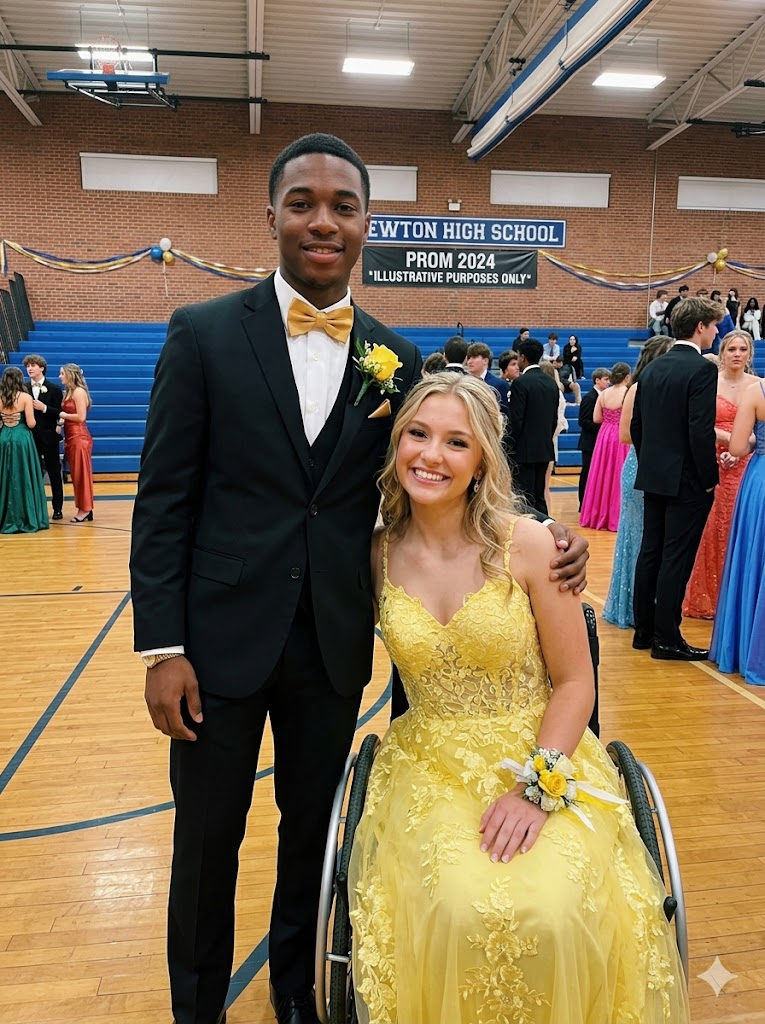
Prom Night: The One Moment She Didn’t Expect to Matter
By the time senior prom came around, she wasn’t expecting a miracle. She planned to show up, smile when needed, and stay on the edge of the room—present, but not fully included. That kind of distance had become familiar over the years.
Loneliness in a crowded gym or banquet hall can feel sharper than being alone at home. It’s not always about whether people are around you—it’s the feeling that everyone else belongs effortlessly, while you’re stuck watching life happen through glass.
Then Daniel walked up.
He didn’t approach her like she was fragile. He didn’t act nervous or overly careful. He spoke like it was the most normal thing in the world—like she was simply another person at prom who deserved to be included. No performance. No pity. Just straightforward kindness.
It wasn’t a movie moment with applause. But it mattered because it was real. For the first time in a long time, she felt seen in a way that didn’t make her feel “different.” Sometimes the biggest emotional shift comes from something small: being treated like you belong exactly where you are.
The Next Day, Daniel Admitted Something He’d Kept Buried for Years
What she didn’t know that night was that Daniel had been carrying a memory connected to her tragedy—one he never fully understood as a child.
Years earlier, when the crash happened, Daniel had been nearby. He was too young to make sense of what he saw, but children often absorb more than they can explain. The details didn’t form a clear story in his mind back then—only fragments, feelings, and a lingering sense that something was wrong.
As he grew older, those fragments didn’t fade. They sharpened.
What once felt like a confusing childhood snapshot slowly turned into a heavy question: Did I see something important? And if he did, what did it mean that he never said anything?
He tried to process it in the only ways he knew how at the time—through silence, avoidance, and even a drawing he’d made years earlier, an attempt to capture what words wouldn’t cooperate with. But silence has a cost. The longer he carried it, the heavier it became.
Eventually, Daniel reached a point where keeping it to himself felt worse than speaking up.
A Quiet Confession That Turned Into a Major Police Lead
When Daniel finally talked, it wasn’t dramatic. No big announcement. No heroic speech. Just a hesitant, human decision to tell the truth as clearly as he could.
And that truth mattered.
Because in cases like this—especially when time has passed—one credible detail can shift everything. A small memory can become a missing piece. A long-forgotten observation can help investigators re-check timelines, revisit evidence, and ask the questions that should have been asked years ago.
His statement didn’t undo the loss. Nothing could. But it replaced uncertainty with clarity, and confusion with something solid enough to face.
For her, it wasn’t about revenge. It was about recognition—about knowing her family’s story wasn’t going to remain a blur of unanswered questions. Even when justice can’t restore what was taken, truth can still bring a form of closure that helps a person breathe again.
Returning to the Road Where It All Changed
Going back to the place where her life broke apart wasn’t easy. Trauma clings to locations. A stretch of road can hold years of grief in a way that’s hard to describe until you’re standing there again.
For a long time, that spot represented only one thing: loss.
But now, it held something else too. Not forgiveness. Not a reset. Just a wider truth—one that included courage, compassion, and the strange way healing can begin when someone finally speaks.
Daniel being there added another layer to the memory. The past didn’t change, but it stopped being a single frozen moment. It became part of a longer story—one where she was no longer only the person the accident happened to, but also someone who survived it and kept going.
Healing didn’t mean forgetting. It meant the road was no longer the only chapter that defined her life.
Closing CTA
If this story moved you, share your thoughts in the comments: do you think speaking up years later can still make a difference—and what would you want someone to do if they remembered a key detail from a tragedy?