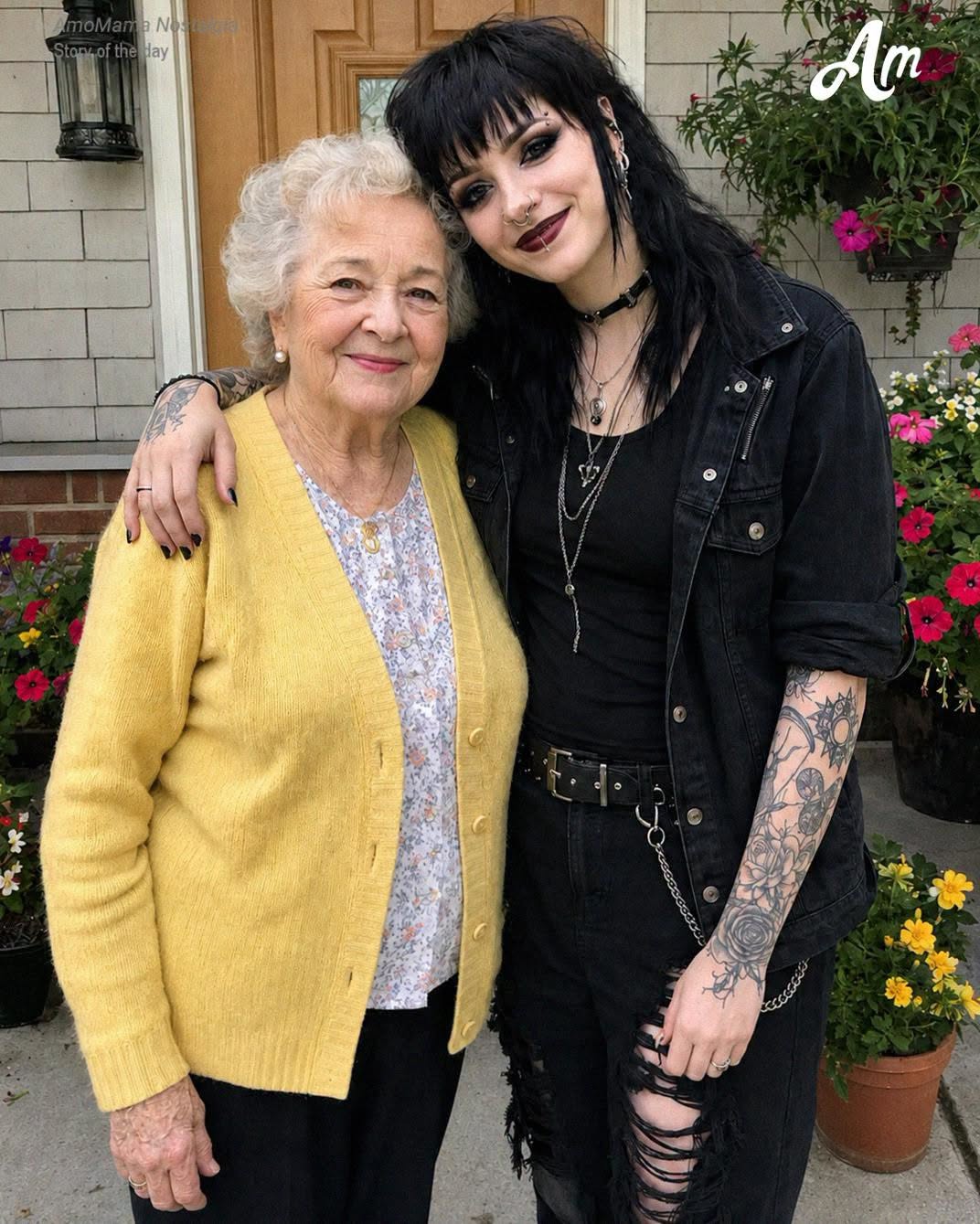
The Visitor Maeve Couldn’t Understand
Maeve’s concern was not only about Raven’s appearance. It was the feeling that her mother had made room for someone else in a place Maeve thought belonged to family.
Doris had always lived quietly. Her days were built around familiar routines, neighbors, books, and her garden. Raven did not fit the picture Maeve had of her mother’s world, and that made it easy for Maeve to assume there was something strange about the connection.
But Doris never acted frightened or pressured. She welcomed Raven. She laughed with her. She guarded their conversations. Over time, Maeve stopped challenging the visits, even though she never stopped wondering what was inside that box.
Then Doris suffered a stroke and died. The family was left grieving, sorting through the practical details of loss while carrying the emotional questions that had never been answered.
After the funeral, Raven approached Maeve. Her eyes were swollen from crying. Without making a scene, she placed a small brass key in Maeve’s hand.
Doris, she said, had told her to give it to Maeve only after she was gone.
Maeve asked what it opened. Raven would not explain everything. She only said she had known a part of Doris that Maeve had not, and she warned her not to put the key away and forget it.
What Was Hidden in the Wooden Box
The key opened the same wooden box Maeve had once seen on the kitchen table.
Inside were cards, letters, and years of words Doris had written but never sent. They were addressed to Elaine, Doris’s estranged sister. The messages were filled with regret, hesitation, and the kind of love that had survived a long silence but had never found its way into a mailbox.
Maeve began to understand why Doris and Raven had needed privacy.
Raven was also separated from her own mother. In their Saturday talks, she and Doris had spoken about the fear of reaching out, the embarrassment of waiting too long, and the pressure of trying to find the perfect words. Each had encouraged the other to make contact with the person she missed.
Raven had called her mother because Doris kept urging her to do it. Raven, in turn, had pushed Doris to call Elaine.
Their friendship was not a secret plot or an intrusion into the family. It was a safe place for two stubborn, frightened people to admit what they could not easily say to those closest to them.
Doris had found it easier to confess her fear to Raven because Raven had not spent years watching her avoid the call. There was no family history in the room, no old disappointments, no pressure to explain everything at once.
But the box also revealed something harder for Maeve to face.
At some point, Elaine had asked Maeve whether Doris ever spoke of her. Maeve, exhausted by being caught between the sisters, had chosen the simplest answer. She had allowed Elaine to believe Doris no longer cared.
It may have felt like avoiding conflict in the moment. But the result was serious. Maeve had helped preserve a silence that neither sister truly wanted.
The Bigger Picture
Family estrangement often survives because nobody wants to be the first to speak. People wait for the right apology, the right mood, the right timing, or the perfect sentence. In Doris’s case, waiting became its own decision.
After reading through the box, Maeve found one sealed envelope with Elaine’s name on it. She could have opened it. She could have decided she had a right to know what her mother wrote. Instead, she left it sealed.
Then she went to Elaine and told the truth without dressing it up. Doris had missed her. Doris had written to her. And Maeve had known more than she had admitted.
Maeve did not ask Elaine to forgive her. She did not tell her aunt what to do with the letter. She simply put the envelope where it should have been all along.
Three weeks later, Elaine returned to Doris’s kitchen.
The letter did not erase the years the sisters had lost. It did not give them a final conversation or a perfect ending. But it did correct the belief that had hurt Elaine most: the belief that Doris had stopped loving her.
In the letter, Doris had written that she spent years waiting until she knew exactly what to say, only to realize that waiting was the problem. She had missed her sister through all of it.
From there, Maeve and Elaine began to rebuild slowly. Not dramatically, and not without pain, but honestly.
Raven remained part of the story, though not in the way Maeve first imagined. She was not an outsider taking Maeve’s place. She was the person who had given Doris room to say the truth before she had the courage to send it.
The brass key opened a box, but it also opened a family history Maeve had helped keep closed. It showed how easy it is to mistake avoidance for protection, and how a convenient answer can shape years of someone else’s grief.
Doris never got to speak directly to Elaine before she died. Still, her final letter forced the living to stop managing one another’s choices and start telling the truth.
For Maeve, the hardest lesson was that love cannot repair what silence keeps hidden. Sometimes the most meaningful thing a person can do is hand over the message, step back, and let someone else decide what happens next.