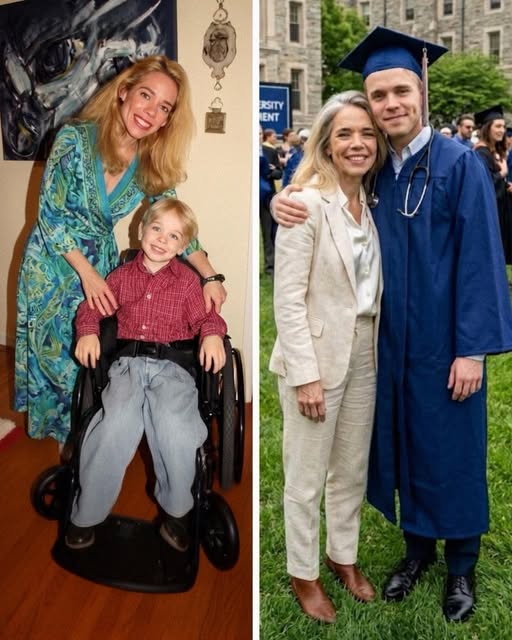
He said he had imagined that day for years. As a child, he had pictured his father in the front row as someone who had helped him reach the stage. He imagined a father who knew about the surgeries he had endured, the foods he disliked, the books he loved, his favorite color, and the reason he had chosen to become a doctor.
Then he made clear why that dream had never matched reality.
His father, he said, had left before he had a chance to know him. Not because of anything the child had done, but because of what Warren feared his son might never be able to do.
The auditorium grew quiet as the graduate described the difference between the person who saw a diagnosis and walked away, and the person who stayed and built a life around helping him move forward.
That person was his mother.
She had worked two jobs while learning medical language she had never expected to need. She celebrated tiny milestones that others might not have noticed. When he managed a step with a walker, she cried. When he wanted to stop trying, she reminded him that progress was not always measured in miles.
The Person He Chose to Honor
The graduate told the crowd that people kept congratulating him for becoming a doctor. But in his view, the praise belonged somewhere else.
He said he would not have been standing there if his mother had not carried him first.
Then he revealed something no one expected. He had received a call from his father the week before graduation and had spent time deciding whether to answer. He had wondered whether people could truly change.
He spoke about forgiveness carefully. It did not erase what had happened, he said. It simply refused to let the past decide the future.
Then he pulled a folded envelope from his graduation gown. Inside was the first letter he had ever written to his father, a letter he said he had carried since he was sixteen. But instead of reading it aloud or asking why Warren had left, he chose to turn toward the person who had remained.
He walked down from the stage and embraced his mother in front of hundreds of graduates and their families.
“You graduated too, Mom,” he whispered.
The applause returned even louder. Professors wiped their eyes. Families stood in silence for a moment before the celebration resumed.
The Bigger Picture
After the ceremony, as graduates posed for photos and families gathered outside, Warren approached his son. He admitted he did not deserve anything, but asked whether they could have dinner sometime.
The graduate did not pretend one meal could restore twenty-five years. He understood that some memories could never be recreated. But he also carried a lesson from his mother: healing does not always mean rebuilding what broke. Sometimes it means putting down the weight that has been carried for too long.
A month later, father and son met for dinner. It was not a perfect ending. It was simply a beginning that should have happened decades earlier.
As they left the restaurant, Warren quietly admitted that he had once believed having a disabled son would ruin his life. Looking across the parking lot at the young doctor laughing with friends, he finally understood what fear had cost him.
Some lessons come early enough to change a person’s future. Others arrive only after years of consequences. His son had already become the man Warren once failed to believe he could be.
And for the mother who stayed, the graduation stage was proof that every difficult step had mattered.