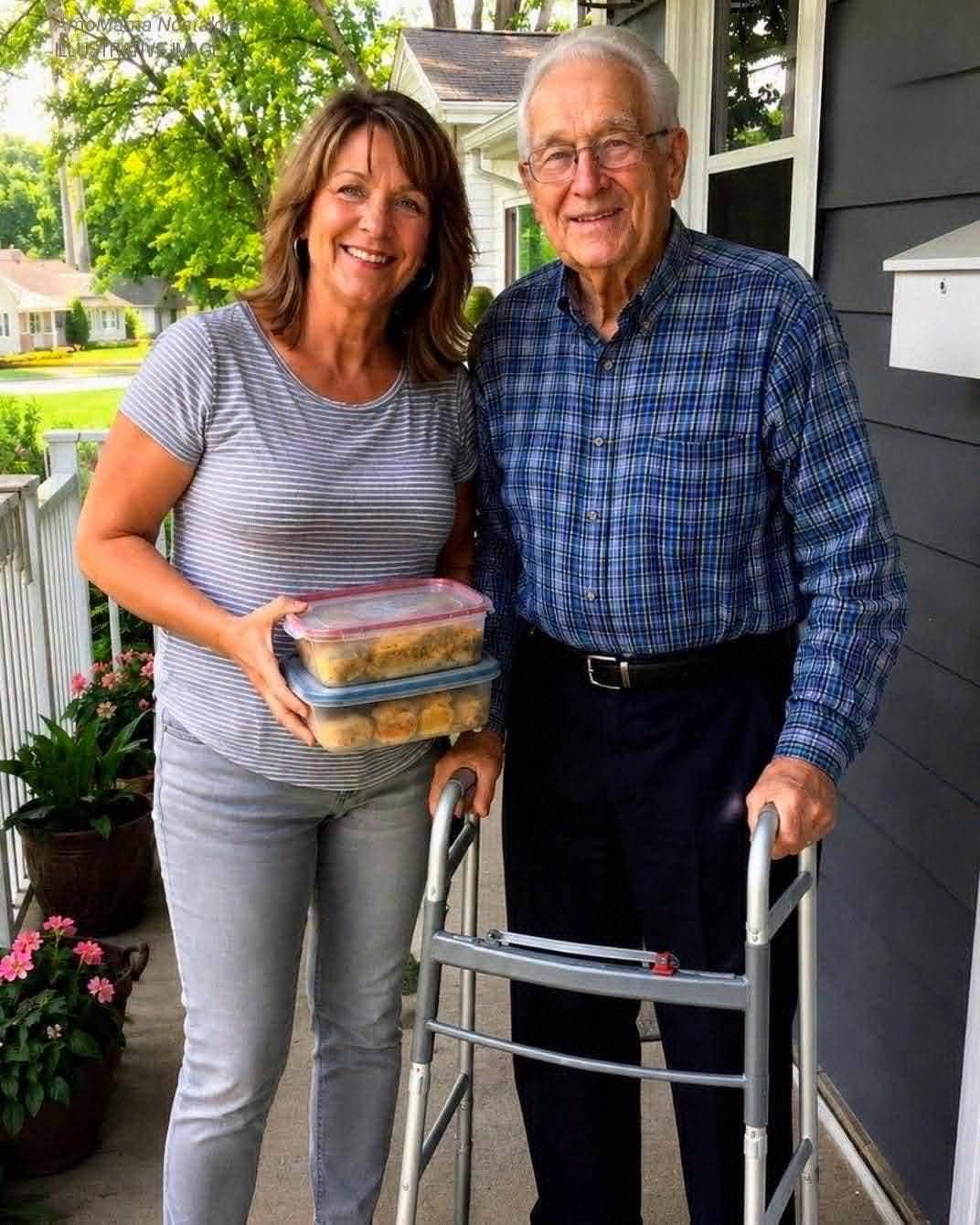
Then came the line that stayed with me: the freezer held the answer to a question I had never thought to ask.
The Freezer I Had Never Noticed
I called my child and asked if they remembered an old freezer in the basement. The question sounded strange even as I said it. After the call ended, I sat at the kitchen table with Lawrence’s letter in my hands, wondering whether this was grief, confusion, or some final request I was meant to honor.
Eventually, curiosity won.
The basement was cold and dim when I switched on the light. I moved boxes, shifted an old blanket, and there it was: a large white appliance tucked behind stacks of storage. On the front was a small padlock.
The key was taped beneath a nearby wooden shelf.
That was when I understood this had not happened by accident.
Inside the freezer, there were no frozen meals or forgotten groceries. It was empty except for a large metal box at the bottom. My name was written across the front, followed by a message: For the woman who never asked for anything in return.
For a while, I simply stared at it. Then I opened the box.
Inside was another letter, much longer than the first. This time, Lawrence explained the story he had never told me.
Lawrence’s Hidden Past
Years before I moved into the neighborhood, Lawrence had owned a successful construction company. He had worked hard, made a comfortable living, and carried regrets that he rarely spoke about.
The deepest one involved his only son.
After Lawrence’s wife died, father and son had argued. The distance between them grew into years of silence. Lawrence admitted in the letter that he had spent a long time telling himself his son did not care, even though he knew he had played a part in the separation.
Then the letter revealed something I had never known. His son had come back to town years earlier but did not know how to approach the father he had not spoken to in so long.
Instead, he watched from a distance.
He saw me picking up Lawrence’s prescriptions. He saw me clearing snow from the walkway. He saw me bringing meals and sitting beside Lawrence on warm evenings. Over time, he began asking his father about me.
Lawrence wrote that my visits had done more than help him get through the day. They had softened something in him. They had reminded him that he could still open the door to another person.
Eventually, his son started visiting again.
Lawrence had never told me because he did not want me to feel watched, measured, or obligated. He simply let the relationship rebuild quietly. In his words, I had unknowingly become part of the reason father and son found their way back to each other.
The box also held photographs.
Some showed Lawrence as a young man. Others showed his son as a child. Then there were pictures of me: standing on Lawrence’s porch with a dish in my hands, laughing beside him at a neighborhood barbecue, sitting with him in moments I had thought were ordinary.
At the bottom was one final photo. Lawrence sat at his kitchen table with his son. Between them was a plate of food.
It had been taken years earlier, during the time I thought I was simply dropping off dinner.
The Bigger Picture
There was still one question left: why had Lawrence hidden everything in my basement?
The answer was in the final paragraph of his letter. The freezer had once belonged to him. He had owned the house years before I moved in, before selling it to the family who later sold it to me. When the previous owner offered to leave the freezer behind, Lawrence asked that it stay.
He knew, he wrote, that one day he would need to tell me the truth.
His last words in the letter were not about money, possessions, or repayment. They were about what he believed my kindness had given him. I had always said I was only bringing dinner. Lawrence said I was bringing him reasons to keep going. Because of that, he found the courage to reconnect with his son.
The next morning, there was a knock at my door.
A man I had never met stood on the porch with tears in his eyes. I knew before he said a word that he was Lawrence’s son.
We sat at my kitchen table for nearly three hours. He told me Lawrence had spoken about me often, not because of the food itself, but because of how my visits made him feel less alone.
Then he shared something Lawrence had not included in either letter.
Every time he visited his father, Lawrence asked him the same question: had he thanked me yet?
The man reached into his coat pocket and placed a small photograph on the table. It showed Lawrence and me sitting on his porch. Lawrence had once insisted I stay for coffee because he did not want me walking home in a storm.
His son said he believed Lawrence wanted me to have it.
Before he left, he said his father had spent years believing he had lost his family. But I had shown him that family is not always only the people who share your blood. Sometimes it is the person who notices a light on next door and knocks.
After he was gone, I went back down to the basement. The freezer no longer felt strange or forgotten. It felt like a reminder of everything people overlook: small errands, warm meals, brief visits, and quiet acts of care that seem insignificant at the time.
For nine years, I thought I was helping Lawrence. I never realized he was leaving something for me, too.
Sometimes kindness returns years later, not as a grand reward, but as a simple thank-you from someone who finally understands what it meant.