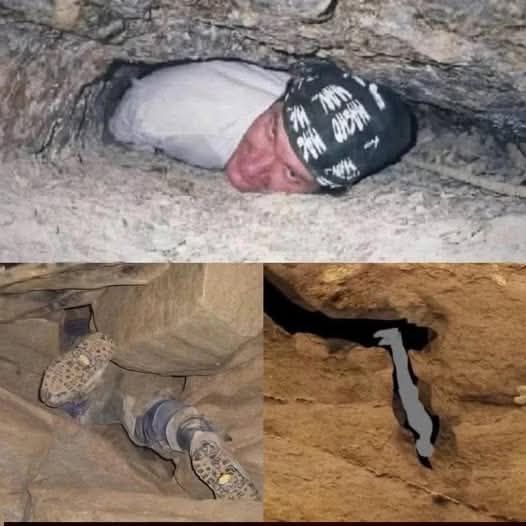
Why Tight Passages Don’t Look Dangerous—Until They Are
Caves, tunnels, and underground systems pull people in for a reason. They promise mystery, discovery, and the adrenaline rush of going where most people never will. To an explorer, a narrow opening doesn’t always look like a threat—it looks like a route.
At first, it feels manageable. You crawl forward carefully, convinced there’s room to adjust if needed. Then the rock subtly changes shape. The passage narrows. Your shoulders compress. Your torso aligns with the stone in a way that makes reversing direction far harder than you expected.
And suddenly, you learn the most brutal rule of tight spaces:
If you can’t reposition, you can’t escape.
When Breathing Becomes Part of the Emergency
In extremely confined spaces, the problem isn’t always oxygen—it’s mechanics. If your chest can’t expand normally, each breath becomes smaller and more stressful. The body interprets that restriction as immediate danger.
That’s when the survival response kicks in:
- Heart rate spikes
- Breathing speeds up (even though faster breathing can make it worse)
- Thoughts race, often jumping straight to worst-case scenarios
The instinct is to fight—push harder, pull harder, force your way out.
But in a crevice that rigid, force usually backfires. The more you strain, the more your body expands against the rock. Muscles tense. Shoulders flare. Your position locks in.
Trying harder can literally make you more stuck.
The Hidden Threat: Claustrophobia You Didn’t Know You Had
Not everyone thinks they’re claustrophobic—until stone is touching both sides of their body and time starts bending in their head.
In tight cave squeezes, the mind plays tricks:
- The walls feel like they’re “closing,” even if they aren’t
- Seconds feel stretched into minutes
- Panic makes problem-solving harder, not easier
That mental spiral can be as dangerous as the physical trap, because panic leads to rushed movement—and rushed movement leads to worse positioning.
How Experienced Cave Explorers Get Out (Without “Muscling” It)
Seasoned cavers train for squeezes because they know the goal isn’t strength. It’s control.
In a tight passage, escape often depends on small, deliberate actions:
- Stop and reset breathing to reduce chest expansion and calm the nervous system
- Relax shoulders and hips to lower body width by millimeters that matter
- Move in micro-adjustments, inch by inch, instead of big pushes
- Shift angles—sometimes a slight rotation creates the only workable exit line
It sounds almost too simple—until you realize that in a crack barely wider than a human body, a fraction of an inch can be the difference between freedom and a full rescue operation.
And one of the most important skills is the hardest one to use when you’re scared:
Knowing when to stop moving.
Why Proper Cave Safety Planning Isn’t Optional
Caves are unpredictable. A passage that looks passable can tighten abruptly. A stable surface can shift. Visibility can be misleading, especially when you’re crawling forward and can’t see the shape of what’s ahead.
That’s why responsible exploration includes real safety basics:
- Helmet and reliable lighting (plus backups)
- Communication plan and someone who knows your location
- Understanding the route and avoiding unknown squeezes without support
- Never going alone in technical or tight systems
In a space this narrow, even a small advantage—an informed partner, a calm voice, a better angle—can change everything.
The Lesson That Sticks With You
Scenes like this hit hard because they reflect something deeply human: the urge to see what’s hidden. That same curiosity fuels exploration, innovation, and discovery.
But underground, curiosity without caution can turn into an emergency fast.
If the person in that crevice made it out, it likely wasn’t through brute force. It would have been through patience—controlled breathing, careful repositioning, and slow, intentional movement. Maybe even guidance from someone outside who could see what the trapped person couldn’t.
Because tight stone doesn’t negotiate. It doesn’t “give.”
And sometimes the way out isn’t pushing harder—it’s thinking clearer.
Want more real-world survival stories and safety breakdowns like this? Share your thoughts in the comments—would you ever try cave exploring, or is this your worst nightmare? And if you found this useful, pass it along to someone who loves adventure.