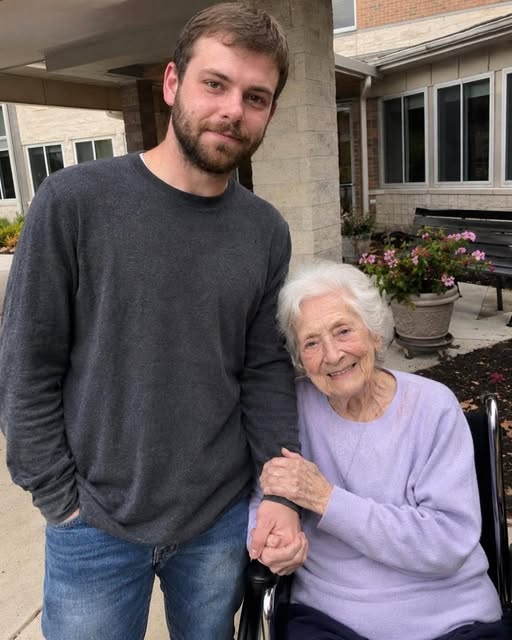
The First Visit to Room 214
The nursing home room was quiet when he arrived. An old television hummed softly in the background, and sunlight fell across a shelf lined with carefully placed photographs.
Rosie was sitting near the window. She looked frail, smaller than he had imagined, but when she saw him, her expression changed. Her face warmed. She reached for his hand as if she had been waiting for that moment all day.
He had expected guilt. He had expected awkward silence. Instead, he felt something loosen in him.
The visits continued. Sometimes he came during lunch breaks. Sometimes he stayed longer than he planned. Rosie did not want expensive presents or dramatic stories. She wanted ordinary company. She wanted someone to listen.
Over time, their conversations stopped feeling like an act. They watched birds outside the window. They talked about small things. She asked him questions that no one had asked in years.
His own life had not left much room for being cared for. His father had been absent for a long time, and his mother’s health struggles had pushed him into the role of caretaker. Somewhere along the way, he had become the person everyone needed, with little space to need anyone back.
Rosie changed that. What began as a paid arrangement slowly became a relationship he did not know he had been missing.
A Letter She Left Behind
Then the nursing home director called.
Rosie had passed away peacefully in her sleep.
For several seconds, he could not speak. Part of him tried to remind himself that she was not really his mother. But grief does not always follow paperwork, biology, or the rules people expect it to follow.
A few days later, he returned to the nursing home to collect something Rosie had left for him. The director handed him a sealed envelope and then told him what Rosie had known all along.
From the first day, Rosie had understood he was not her son.
Her memory was not always perfect, the director explained, but she had recognized the truth. Still, she had welcomed him because he kept coming back.
Inside the envelope was a handwritten letter. The writing was shaky but readable, and before he reached the end of the first paragraph, he was in tears.
Rosie wrote that she had known almost immediately he was not the child she had raised. But while her biological son stayed away, he had sat beside her, listened to her memories, and made time for her when she needed someone most.
To Rosie, that mattered more than blood.
At the bottom of the letter was a small brass key. It belonged to a safety deposit box. Rosie’s instructions were clear: what was inside should be shared. Part of it was meant for him. The rest was to help improve life for residents in the nursing home, especially those who spent too many days waiting for visitors who never came.
The Bigger Picture
Before he could fully process Rosie’s final gift, her biological son, Tim, appeared.
Tim accused him of manipulating his mother and argued that everything should belong to him. What followed was months of difficult legal proceedings, with records reviewed and testimony heard.
As the case unfolded, a clearer picture emerged. Tim had kept his distance for years. When asked about his relationship with Rosie, he admitted that watching her decline had been too painful.
That pain may have explained his absence, but it did not erase it.
One of Rosie’s closest friends at the nursing home described him simply as “the boy who chose to stay.”
In the end, Rosie’s wishes were honored.
When the safety deposit box was finally opened, it contained savings bonds, family keepsakes, and photographs from across Rosie’s life. Among them was an image of a young Rosie holding her infant son, a reminder that families often begin with love, even when time, fear, or distance later pull people apart.
He followed Rosie’s instructions exactly. The funds helped create activities, outings, and improvements for nursing home residents who often felt forgotten.
He still visits almost every Saturday. Sometimes it is just coffee and conversation. Sometimes it is sitting with someone who needs a patient listener.
The chair by Rosie’s window remains empty, but her presence still feels close.
He took the job because he needed money. He walked into Room 214 expecting to play a role. Instead, he found a bond that changed how he understood family.
Rosie’s greatest gift was not the safety deposit box. It was the lesson that family can be built by consistency, kindness, and the simple decision to keep showing up.
Sometimes the people who become family are not the ones who share your name, but the ones who choose to stay.