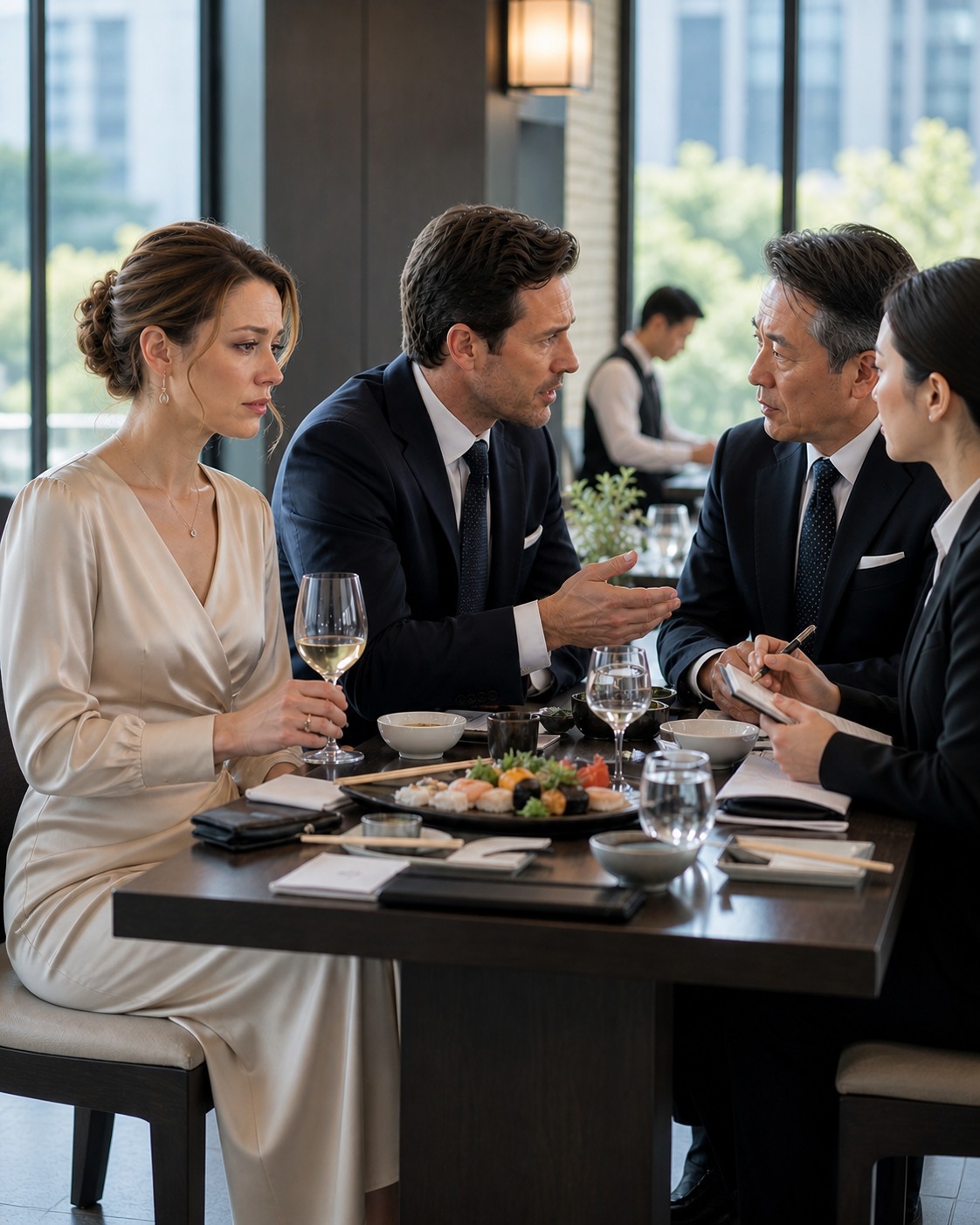
Adrian’s jaw tightened. He hated when my world didn’t immediately orbit his. “Big doesn’t cover it,” he snapped. “This could bring in millions in revenue. It could put me in an entirely different league.”
“Then I hope it goes well,” I replied, turning the page like my heartbeat hadn’t just picked up.
He took a slow drink and studied me over the rim of his glass. “I need you at dinner Friday. We’re hosting Takamura at Kiyomi House downtown. I want the night to feel polished, not like a negotiation.”
“Of course,” I said, calm on the outside.
“Wear the dark green dress,” he added, waving a hand as if he were choosing table linens. “The simple one. Japanese executives respect understated elegance. They like refinement in a woman.”
I gave him a small, obedient smile—the kind that keeps peace when peace is cheaper than a fight. “Noted.”
Then he leaned back, satisfied. “Most of the conversation will be in Japanese,” he said. “The interpreter will handle it, or I might speak a little myself. You’ll probably be bored, but your job is easy: smile, be gracious, and don’t offer opinions. This isn’t the night for that.”
My pulse hit once, hard, then steadied.
For a year and a half, Adrian had mistaken my quiet for cluelessness. He’d treated my patience like surrender. He never questioned my late-night reading, my online classes, or the fact that I’d built a life of learning while he was busy building an ego.
He didn’t know I spoke Japanese—fluently.
He didn’t know I understood the language and the culture well enough to catch what people really say when they assume you can’t.
And he definitely didn’t know that the illusion he lived inside was about to collapse in public.
A High-End Dinner, a High-Stakes Deal, and a Husband Who Got Too Comfortable
Friday night, I wore the dark green dress—not because Adrian ordered it, but because I liked the way it reminded me of my own dignity. Kiyomi House was the kind of upscale restaurant executives choose when they want to signal power without saying it out loud: warm amber lighting, dark wood, minimalist floral arrangements, and glass that reflected the city like a polished mirror.
Mr. Hiroshi Takamura arrived with quiet authority. Late fifties, composed, not flashy—yet everyone at the table could feel that he didn’t need to perform importance. His interpreter sat beside him, but it became obvious within minutes that Adrian wanted to show off the few Japanese phrases he’d memorized for business leverage.
Adrian’s Japanese was stiff, overly formal, and rushed—like someone reading lines they didn’t fully understand. He bowed too deeply, smiled too widely, and talked too much.
I offered a proper greeting, kept my words minimal, and watched Takamura’s eyes flick toward me with brief curiosity—like he sensed there was more to me than I was letting on.
Course after course arrived: delicate sashimi, a rich broth, then beautifully plated entrées. The conversation stayed polite, professional, and distant—until the moment Adrian got comfortable.
When the discussion shifted fully into Japanese, Adrian relaxed into the smug confidence of a man who believed he was the only one in the room who could understand what was being said.
That’s when he showed everyone who he really was.
The Insult He Thought Was “Safe” to Say
In casual Japanese, Adrian tilted his head toward me like I wasn’t even a person at the table.
“My wife works in marketing for a small ceramics studio,” he said, dismissive. “Nothing serious. It just keeps her busy. Mostly she takes care of the house, shops, and goes to little events. You know how it is—American women with comfortable lives can get idle. She’s here tonight because she makes the table look softer. More welcoming.”
I kept my hand steady on my wineglass. I didn’t flinch. I didn’t react.
But the humiliation still hit—cold and sharp, like ice water under the skin.
It wasn’t just that he was disrespectful. It was the precision of it: he had reduced me to décor. A “nice touch.” A background detail meant to improve the atmosphere while he handled the “real work.”
Across the table, Mr. Takamura’s expression barely changed, but his fingers paused near his cup. His eyes tightened for a fraction of a second—disapproval, controlled and unmistakable.
Adrian, blind to everything but his own ego, mistook the silence for approval.
Then He Said Something Far Worse
As the evening went on and the drinks loosened his judgment, Adrian leaned in slightly. He lowered his voice, forgetting that arrogance has a way of carrying.
Still in Japanese, he continued—calmly, confidently—like he was discussing the weather.
“There’s also a way to structure part of the project funds through offshore trusts before internal review catches up,” he said, smiling. “If your side agrees to the supplemental wording, no one at my firm will look too closely. There are always ways around bureaucracy.”
Then, as if that weren’t enough, he added the final blade:
“Besides, I have distractions at home. A junior associate—Sabrina—understands my real life better than the quiet little wife waiting in Boston.”
The restaurant noise faded into a dull hum, like my mind refused to process it at full volume.
Offshore trusts. Bypassing internal review. A named coworker. An affair spoken about like a punchline.
Twelve years of marriage—years of shared sacrifices, compromises, and trust—reduced to a brag in front of an international business partner.
I looked at Mr. Takamura.
He looked uneasy, trapped between manners and morality. But when his gaze met mine, something passed between us—recognition. Understanding. The moment he realized I wasn’t confused, wasn’t naïve, and wasn’t just “the wife.”
I understood every word.
And for the first time that night, I wasn’t sitting there as someone being humiliated.
I was sitting there as someone collecting evidence.
If you’ve ever been underestimated—or watched someone reveal their true character when they think you can’t understand—share your thoughts in the comments. What do you think happens next?