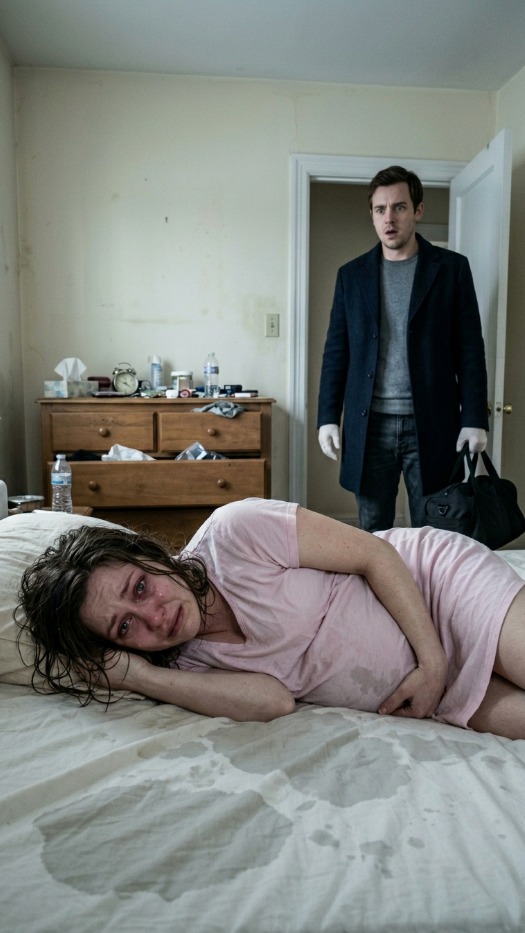
I walked down the hall and stopped cold in the doorway.
Clara was on the edge of the bed, hunched forward like she was trying to protect herself from something invisible. One hand was pressed hard against her belly. Her nightgown was on backward—seams showing, collar twisted. A glass of water lay shattered on the floor beside a wet towel, and there was a dark stain on the wood that made my stomach drop.
I should have moved immediately. I should have called an ambulance without thinking. I should have gone into “husband mode” and done the only thing that mattered: help her.
But my brain did something uglier first.
It listened to my mother.
The Poisoned Thought I Wish I Could Take Back
Three weeks earlier, over coffee, my mom had leaned in like she was sharing “woman-to-man truth” and said Clara had been distant. Secretive. That women hide things. That I should make sure I wasn’t being played.
And standing there in that bedroom—seeing the chaos, the backward nightgown, the panic—I didn’t see an emergency right away.
I looked for evidence of betrayal.
It’s hard to admit that. Harder to forgive myself for it.
Clara’s phone was face down on the bed, charger ripped halfway out of the wall. My voice came out rough, wrong.
“How long?” I asked.
She blinked at me, drenched in sweat, trying to speak through pain. “Since ten… maybe earlier. I thought it was cramps. I tried calling you.”
I picked up her phone and the screen lit up like a verdict.
My name—over and over. Missed calls stacked like a staircase. Twenty attempts while I was unreachable on a plane, smiling to myself about my “surprise.”
Then I saw the part that broke me.
Two calls to 911.
Both ended within seconds.
Clara swallowed hard. “I couldn’t talk. I panicked. It stopped for a minute and I hung up. I thought I was exaggerating.”
That sentence hit me like a punch. While she was terrified she might be losing our baby, she was also afraid of being “dramatic.” And I—standing right there—had been busy suspecting her of the worst.
“Did You Think I Was With Someone Else?”
I rushed to help her sit up and she cried out, fingers digging into my arm. I grabbed a blanket, then her coat, trying to get us out the door fast.
She pointed weakly toward the dresser. “The medical folder. Bottom drawer.”
I yanked it open too hard and spilled receipts and vitamins onto the floor before I found the blue folder with her name written neatly on the front.
When I turned back, Clara wasn’t just in pain—she looked awake in a different way. Like something inside her had clicked into place.
“Ethan,” she whispered, quiet but sharp. “Did you think I was with someone else?”
I couldn’t lie without humiliating both of us. I couldn’t deny what she’d already seen on my face.
She looked away, arms wrapping protectively over her belly. “I saw your expression,” she said. “When you looked at the room… and my nightgown. I saw exactly what you thought.”
The backward nightgown suddenly felt like the cruelest detail. Not scandal—just proof she’d been dizzy, alone, and struggling to function.
“I put it on after the shower,” she said, voice flat. “The pain hit so hard I couldn’t even tell front from back.”
I knelt to tie her shoes because she couldn’t bend over. She didn’t say anything, but the silence was loud—filled with every minute she waited for me to pick up, every time fear told her she might be losing the baby, and every time she still hoped I’d show up.
The Question That Exposed My Priorities
In the lobby, the cold air made her knees buckle. I caught her and half-carried her to the car.
Before she got in, she turned to me under the streetlamp and asked something I’ll remember for the rest of my life.
“Were you afraid for me first,” she said softly, “or were you angry first?”
I could have taken the easy way out. I could have said fear, love, confusion—anything that sounded noble.
But she deserved the truth.
“I was angry first,” I admitted.
She nodded once, like a private suspicion had just been confirmed. Then she got in the car and shut the door.
My Mother’s Texts Arrived at the Worst Moment
I drove fast—too fast—watching Clara grip her stomach and breathe through wave after wave of pain.
My phone buzzed. I ignored it. Then it buzzed again.
At a red light, I checked.
It was my mother.
Are you home yet?
Call me before you speak to Clara.
Please, Ethan. There are things you need to know about her.
I dropped the phone into the cup holder and accelerated the second the light changed. Clara saw the screen glow.
“Who is it?” she asked.
“My mother,” I said.
Something in Clara’s face shifted—not surprise. Recognition.
“She called me tonight,” Clara said quietly. “Around nine. Right before it got unbearable.”
My grip tightened on the steering wheel. “What did she say?”
Clara stared straight ahead. “She told me not to trap you with a pregnancy if I wasn’t sure I wanted to be in this marriage.”
I felt sick.
Then Clara added, voice steady but empty: “She said men sometimes need scientific proof before they believe they’re fathers.”
My chest went cold because I recognized it. My mom had planted the same idea in my head weeks earlier—paternity tests, “peace of mind,” little comments disguised as concern.
And I’d never told Clara.
I’d called it “family drama.” I’d convinced myself silence was the same as protection.
It wasn’t protection. It was permission.
The ER, the Question, and the Pause That Cut Deep
We reached the emergency room and nurses rushed out with a wheelchair. Questions flew—weeks along, bleeding, prior complications—while I stood there holding the blue folder like it could make me useful.
Then the intake nurse asked, routine as breathing, “And you are the father?”
Clara hesitated.
Only for a fraction of a second.
But it was long enough to hurt in a way I didn’t know was possible.
“Yes,” she said.
The hesitation wasn’t doubt about our baby.
It was her realizing my doubt had become visible.
They wheeled her away. I followed until a nurse stopped me at the curtain. “One minute, sir. We need to stabilize her.”
I paced outside the trauma bay with bleach in my nose and guilt in my throat.
The Call I Finally Refused to Answer
When I got back into the room, Clara looked exhausted and far away. The doctor ordered bloodwork and an emergency ultrasound.
Clara turned her head toward me. “Don’t call your mother,” she said.
It wasn’t a suggestion. It was a boundary. The first real one she’d ever had to draw because I hadn’t drawn it myself.
I nodded. “I won’t. I promise.”
Then my phone vibrated again—loud in that small room.
Incoming Call: Mom
I stared at the screen. For most of my life, I’d answered immediately—especially after my father died, when my mom used grief like a lever to move everyone around her. She had opinions about everything: our apartment, our finances, Clara’s job, even the baby’s name.
I told myself I was “managing” her so Clara didn’t have to deal with it.
But standing there, watching my wife fight through pain, I finally saw the truth.
I wasn’t protecting Clara.
I was protecting myself from the discomfort of choosing sides.
I rejected the call and powered the phone off completely.
The Ultrasound and the Flicker That Saved Us for One More Day
The gel made Clara flinch—it was ice cold. The room went quiet except for the machine’s hum.
I didn’t understand the screen. Clara didn’t even look at it—she watched the doctor’s face, hunting for a clue.
I placed my hand over hers. She didn’t hold on at first.
That small refusal hurt more than any shouting ever could.
Then another wave of pain hit, and her fingers clamped around mine like instinct had overridden disappointment.
The doctor adjusted a dial.
A grainy shape appeared.
Then a tiny flicker—fast, unsteady, alive.
“There is cardiac activity,” the doctor said carefully. “The baby’s heart is beating.”
Clara made a sound that was half sob, half breath. My legs went weak with relief, but I didn’t feel entitled to it.
The doctor didn’t celebrate. He explained risks, observation, strict bedrest—words like threatened miscarriage and hematoma that made the future feel fragile and uncertain.
And I kept staring at Clara’s backward nightgown peeking from beneath her coat, thinking about how close I came to breaking my family—not with an affair, not with money, not with addiction, but with something quieter and just as destructive:
unchecked suspicion fed by someone who should have wanted peace.
The Morning After: The Question I Couldn’t Dodge
They moved Clara to an observation room as dawn turned the sky gray-purple outside the window. A nurse suggested I get coffee, sit down, breathe.
I couldn’t leave her side.
When Clara finally opened her eyes, she looked young and distant at the same time—like she’d aged overnight.
“Ethan,” she said, voice rough. “I need you to tell me something.”
I leaned in. “Anything.”
She studied my face like she was searching for the last remaining truth in our marriage.
“If your mother demands scientific proof,” she asked slowly, “will you ask for it with her?”
The question hung in the room, sharp and clean—like it could cut away whatever we were pretending not to see.
Because the real emergency wasn’t only the bleeding or the pain.
It was whether I would finally protect my wife and child from the person who kept trying to poison our home… and whether Clara could ever feel safe with me again.
If you’ve ever dealt with a controlling in-law, trust issues in marriage, or family pressure during pregnancy, share your thoughts below—what boundaries do you think are non-negotiable?