The Night Shift Teaches You Who’s Really Struggling
Working nights is like watching the world in fragments. Truckers passing through for coffee. Teens killing time. People who look fine on the outside but carry stress like a second job.
Ross got used to the rhythm: the buzz of fluorescent lights, the roller grill humming, the same radio songs on repeat. He kept his head down and did his job. He understood budgets because he was living one—tight, exact, and unforgiving.
Then one night, around 11:30 p.m., the door chimed.
A Tired Mom Walked In Carrying a Sleeping Child
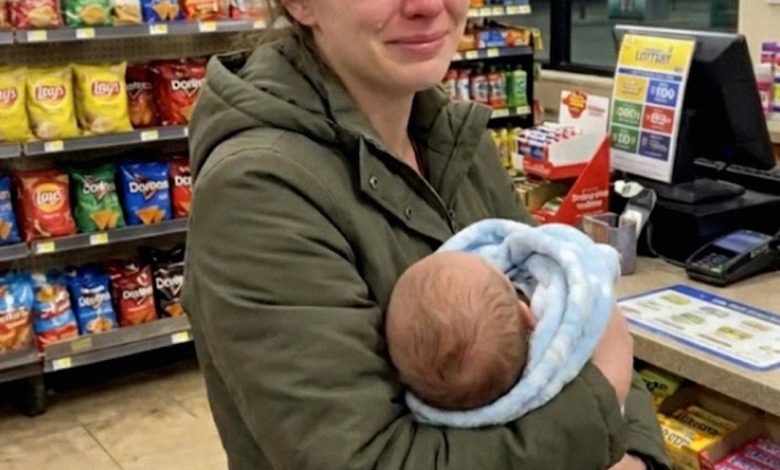
A woman stepped inside holding a little boy who was completely asleep, arms limp over her shoulder. She looked exhausted in a way that sleep alone doesn’t fix—like she’d been running on stress for too long.
She didn’t browse. She didn’t linger. She moved aisle to aisle with one goal: get the basics and get out.
She grabbed milk, bread, and diapers. Nothing extra. No snacks, no treats, no comfort purchases—just survival.
At the counter, Ross rang it up.
$14.72.
She shifted the child on her hip and started digging through her purse. Crumpled bills. Loose change. A few lonely coins that clinked too loud in the quiet store.
Her face tightened as she counted again.
“I’m short by four dollars,” she said, barely above a whisper. “Can I put the diapers back?”
Four dollars isn’t much—until it’s the difference between getting through the night and falling apart.
Ross Reached Into His Wallet Without Thinking
Ross didn’t give a speech. He didn’t make it a big moment. He just pulled out his wallet and slid cash across the counter—enough to cover what she was missing.
“It’s fine,” he told her quietly. “Just get home safe.”
For a second, she just stared. Her eyes filled with something between shock and relief, like she had been bracing for the world to be cruel and didn’t know what to do when it wasn’t.
She took the bag, adjusted the sleeping boy, and hurried out into the dark parking lot. Ross watched her taillights disappear down the highway and went back to work, figuring it was just a small kindness in a long night.
A Week Later, an Envelope Changed Ross’s Own Life
Seven days later, Ross’s manager called him into the back office and handed him a plain white envelope with Ross’s name written neatly on the front.
No company logo. No return address. Just weight—like whatever was inside mattered.
Ross opened it and froze.
Inside was a check for $5,000 and a letter.
The letter was from the woman’s parents.
That $4 Wasn’t About Diapers—It Was About Escape
Her name was Emily. According to her parents, she’d been stuck for years in an abusive relationship—isolated, controlled, cut off from the people who loved her. That night at the gas station wasn’t a regular errand run.
It was the night she finally left.
She had been driving toward her parents’ home—hundreds of miles away—on a thin tank of gas and whatever cash she could scrape together. The diapers weren’t a convenience. They were a necessity. And being short by four dollars wasn’t just embarrassing—it was the kind of final obstacle that can break someone down.
Her parents wrote that when Emily realized she couldn’t afford the diapers, she almost turned back. Not because she wanted to—but because she felt trapped, like the world was confirming what she’d been told for years: that she didn’t deserve help.
Then a stranger behind a counter covered the difference and treated her like she mattered.
That moment—small on paper—helped her keep going.
“You Gave Her Dignity When She Needed It Most”
Ross showed the letter to his wife, Lydia, and the reality hit him in a way it hadn’t before. The $5,000 would help—no question. It could catch up bills, reduce debt, and finally give them breathing room in a high-cost world.
But the real impact wasn’t financial.
It was the reminder that kindness can be practical. It can be the thing that keeps someone moving forward when they’re one step from giving up.
Ross tried to refuse the check. He didn’t want his gesture turned into a transaction. But Emily’s parents insisted. They told him it wasn’t a “payment.” It was their way of honoring the kind of person who still helps strangers, even when he’s struggling too.
That Sunday, Ross met them. He saw Emily safe, supported, and slowly rebuilding her life. Her father looked him in the eye and said, “You gave her dignity when she needed it most.”
Why This Story Still Matters (Especially Right Now)
Ross still works nights off Highway 52. The lights still flicker. The radio still loops the same songs. The job is still the job.
But he sees it differently now.
He doesn’t look at his position as a dead end anymore. He sees it as a place where life passes through—where people show up carrying more than a soda and a receipt. Some carry fear. Some carry grief. Some carry the weight of trying to start over.
And he knows something most people forget:
Sometimes the smallest amount of money can make the biggest difference—because it’s not just money. It’s hope.
Closing CTA: Have you ever been helped by a stranger—or been the one who stepped in at the right moment? Share your story in the comments, and if this moved you, pass it along to someone who could use a reminder that small kindness still matters.