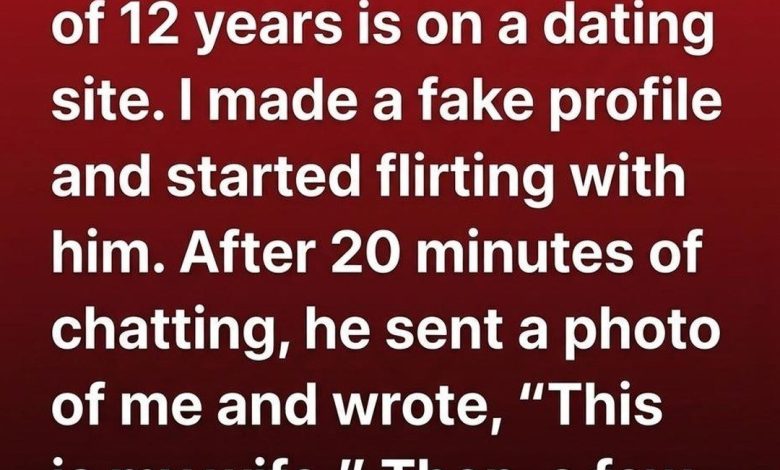
My stomach dropped so fast it felt like gravity doubled. In the dark, your mind doesn’t gently ask questions—it launches accusations. A double life. A hidden relationship. A backup plan. I could practically hear my insecurities lining up like witnesses: You’re too sick. Too tired. Too much. He’s looking elsewhere.
I stared, hoping it was fake—some weird copy, some coincidence, anything. But the bio had his exact brand of self-deprecating humor. There were references to tiny moments that belonged only to our marriage. This wasn’t a stranger wearing his face. This was my husband.
My hands shook as I made a blank account—no photo, no name, no history. Just a shadow. I sent a simple message, bracing myself for the kind of reply that changes a life in the worst way.
His response came quickly.
And it wasn’t flirtatious. It wasn’t secretive. It was… kind. Measured. Respectful.
It sounded like the same man who had held my hand through appointments, surgeries, and setbacks. The same man who never raised his voice when I cried in frustration or apologized for being “difficult” when my body wouldn’t cooperate.
I kept waiting for the moment the mask slipped. It didn’t.
Then he sent an attachment.
I watched it load, my mind racing through every possible nightmare. But when the image appeared, the air left my lungs.
It was me.
Not the version of me curled under blankets with aching joints and a bruised spirit. It was a photo from five years earlier—sunlit beach, wind in my hair, joy in my eyes, the kind of smile that came easily back when pain wasn’t a daily negotiation.
Before I could even process it, a message followed. He told this “stranger” that the woman in the photo was his wife. Then he shared a link to a private digital journal he’d been keeping—quietly, consistently, in secret.
I clicked.
And I started to read.
The words didn’t reveal an affair. They revealed a man trying to survive helplessness.
He wrote about watching me hurt—not only physically, but emotionally. He described noticing the way my confidence had been worn down little by little, how I’d started to speak about myself like I was a problem to manage instead of a person to love. He admitted the “empty look” he sometimes saw in my eyes and how it haunted him, because he couldn’t fix it with effort or logic or determination.
Mark is the kind of person who repairs things. He’s practical. He believes there’s a solution if you work hard enough. And in his journal, he confessed what he rarely said out loud: that he felt powerless in the face of my pain.
But the most devastating truth was also the most beautiful one.
That secret profile wasn’t a doorway out of our marriage. It was a searchlight aimed back toward me.
He had been reaching out to support communities, trauma-informed counselors, and people who had lived through long recoveries—asking one question over and over:
“How do I help the person I love see their value when they feel like a burden?”
There were hundreds of replies. Practical strategies. Mental health resources. Advice on supporting a partner with chronic illness. Messages from strangers who had been in our shoes—people who understood caregiver fatigue, medical trauma, depression, and the complicated grief of losing your old life while still being alive.
He saved everything. Organized it. Archived it like a lifeline.
While I lay in bed convinced I was weighing him down, he was out there collecting hope—piece by piece—waiting for the moment I could accept it.
The realization hit so hard I had to put the phone down.
I’d been mourning the “old me,” convinced that was the only version worth loving. Meanwhile, my husband wasn’t trying to resurrect the woman from the beach photo. He was loving the woman in front of him—right now—aching, changed, still here.
When I finally got up, my body protested like it always did. The hallway felt long. My joints screamed. But my chest felt lighter than it had in years.
Mark was in the living room, half-watching TV, looking exactly the same as he always did—steady, familiar, unaware that I’d just stumbled into the deepest part of his heart.
I didn’t confront him. I didn’t confess my late-night panic or the anonymous message. I just sat beside him and leaned into his shoulder.
He didn’t interrogate me. He didn’t demand an explanation.
He simply wrapped an arm around me and held me like he’d been holding our life together all along.
In that ordinary moment, something in me finally unclenched. I understood that love isn’t only staying during the hard parts. Sometimes love is staying awake in the dark, searching for a way to bring someone back to themselves.
I wasn’t a burden he tolerated.
I was someone he refused to give up on.
If this story resonated with you, share it with someone who needs hope tonight—and tell me in the comments: have you ever misunderstood someone’s silence, only to learn it was love in disguise?