The officer’s expression softened immediately. “No, buddy. I don’t think you did.”
But he looked deeply unsettled.
The second officer was already opening another piggy bank with the handle of his flashlight. More keys spilled out. More notes. More addresses.
One of the slips read:
FOR THE THOMAS FAMILY — WINTER OF ’98
Another:
BACK DOOR. THEY NEVER CHANGED THE LOCK.
Another simply said:
In case she comes home.
I felt a chill crawl up my spine.
“What is this?” I whispered.
The older officer stood and glanced toward Mrs. Adele’s house across the street. Her curtains were closed tight.
“You said your son helped your neighbor yesterday?”
I nodded.
He exhaled slowly. “Then I think you need to hear who your neighbor really is.”
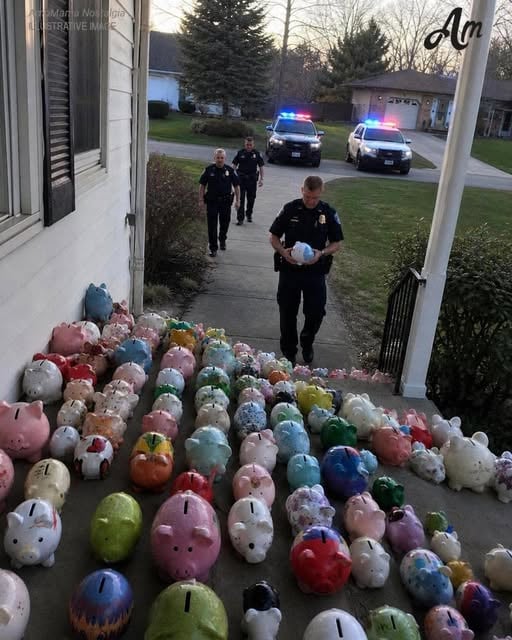
By noon, our tiny street looked like the center of a crime documentary. More patrol cars arrived. Detectives knocked on doors. Neighbors stood in clusters on sidewalks pretending not to stare.
And still, piggy banks kept appearing.
People were leaving them quietly at the edge of our yard.
An elderly man in suspenders arrived carrying one wrapped in a grocery bag. A woman dropped another off and drove away crying before anyone could stop her. By lunchtime there were nearly a hundred.
Every single one contained keys.
And every key, according to the police, belonged to a house once helped by Mrs. Adele.
Not robbed.
Helped.
For nearly forty years, Adele Mercer had apparently been the silent guardian of half the neighborhood.
After her husband died in the late 1980s, she began secretly keeping spare keys for struggling families—single mothers, elderly widowers, people escaping abusive homes, addicts trying to get sober, parents working three jobs at once. Anyone who might someday need someone to check on them.
Back before security cameras and smartphones, people trusted each other differently.
And they trusted Adele most of all.
“She was basically this neighborhood’s emergency contact,” one detective explained. “People gave her keys because she was the one person who always answered the phone at three in the morning.”
But the notes told a larger story.
Mrs. Adele hadn’t just held onto keys.
She had held onto people’s lives.
One note described sneaking food into a family’s kitchen after the father lost his job. Another detailed medication schedules for a dying neighbor. One piggy bank contained a hospital bracelet alongside a key and a note that read:
She was scared to die alone.
I had to sit down after reading that one.
The officers weren’t investigating a crime.
They were trying to understand why all these piggy banks had suddenly appeared overnight.
And why every person dropping them off kept saying the same thing.
“She told us to bring them when the boy helped her.”
The boy.
Oliver.
Apparently after he gave Mrs. Adele his savings, she started making phone calls.
Dozens of them.
Maybe more.
Calls to people nobody even realized she still spoke to.
By evening, our yard was crowded with strangers carrying memories.
A firefighter said Adele once paid his heating bill anonymously when he was a rookie with twins at home. A nurse cried while describing how Adele sat with her mother during chemotherapy treatments because she couldn’t get time off work. One man admitted Adele secretly kept him fed for six months after he lost custody of his daughter and fell into depression.
“She made me promise,” he said, voice cracking, “that if I ever got back on my feet, I’d help someone else before I paid her back.”
Nobody had known the full extent of it.
Not until Oliver.
Not until a six-year-old walked across the street with his piggy bank and reminded an old woman that kindness still existed.
Then came the moment that changed everything.
Just after sunset, the older officer approached me again holding one final envelope.
“This one was inside a blue piggy bank,” he said quietly. “It has your son’s name on it.”
Inside was a letter written in shaky cursive.
To Oliver,
There is a secret about kindness grown-ups forget.
Money is not what saves people.
It is being seen.
Years ago, when my husband died, I thought I disappeared too. Then neighbors carried me through my grief one small kindness at a time. A casserole. A ride to church. Someone fixing a broken pipe for free.
So I started keeping keys.
Not to houses.
To people.
Every key here belongs to someone who once needed help and found it.
Yesterday, you reminded me that goodness still lives here. I wanted everyone else to remember too.
Thank you for turning the lights back on in more ways than one.
Love,
Mrs. Adele
By the time I finished reading, I was crying too hard to speak.
Oliver looked up at me, confused.
“Why’s everybody sad?”
I pulled him into my arms.
“They’re not sad, baby,” I whispered. “They’re remembering.”
He thought about that seriously.
Then he asked the question none of us were prepared for.
“Can we help her more tomorrow too?”
And standing there surrounded by police cars, broken piggy banks, old keys, and strangers wiping tears from their faces, I realized something extraordinary had happened overnight.
One small act of kindness from a child had uncovered an entire hidden history of people quietly saving one another.
And for the first time in years, the whole neighborhood felt like a family again.