A Dark Porch and a Question I Didn’t Want to Answer
It started with her porch light. For a few evenings in a row, her front window stayed dark. No warm glow. No TV flicker. Just stillness.
Oliver tugged my sleeve one night as we walked past. “Why is Ms. Adele’s house so dark?”
I gave the easy answer first—the one adults use when they don’t want to investigate. “Maybe she went to bed early.”
But Oliver didn’t accept that. He looked up at me and asked the question that forced me to stop hiding behind convenience.
“What if she needs help?”
So we walked up to her porch.
What We Found Wasn’t Just a Bill—It Was a Warning Sign
Ms. Adele opened the door slowly, wrapped in a sweater even though the air wasn’t cold. Her smile was there, but it didn’t reach her eyes. She tried to reassure us with the same words so many older people use when they’re struggling.
“I’m fine, honey. I’m just… managing.”
Inside, the house felt different—too quiet, too dim. And on a small table near the entryway, I saw it: a shut-off notice and a stack of unopened mail. Not dramatic, not cinematic—just the ordinary paperwork that can quietly unravel someone’s life when fixed income, rising utility costs, and unexpected expenses collide.
She noticed me looking and gently moved the papers aside, embarrassed.
“It’s nothing,” she said.
But it wasn’t nothing. It was the kind of “nothing” that turns into missed meals, skipped prescriptions, and dangerous nights without heat or light.
Oliver Didn’t Hesitate—He Just Decided
On the walk home, I was already thinking like an adult: calling the utility company, checking community assistance programs, figuring out what we could do without overstepping or embarrassing her.
Oliver was thinking like a human being.
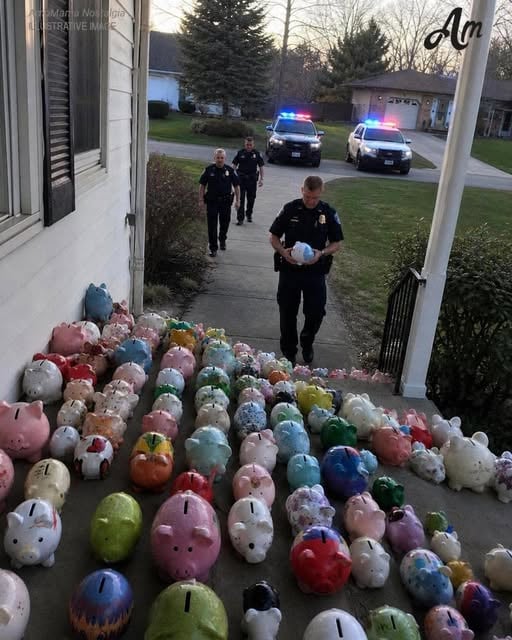
He went straight to his room, dragged out his piggy bank, and started twisting the cap with both hands. Then he remembered the second one. Then the little tin where he kept “special money” from birthdays. He even brought out a gift card he’d been saving for a toy store trip.
He laid it all out like an offering.
“She can have it,” he said. “She’s old. And she’s alone. And it’s dark.”
I tried to explain that adults handle these things, that we’d find a way, that his savings were for him. But my words sounded thin in the face of his certainty.
To Oliver, this wasn’t charity. It was responsibility.
Every Dollar Felt Like a Message
The next morning, we went back. I brought groceries and offered to help make some calls. Oliver carried a small envelope stuffed with his carefully counted bills and coins.
Ms. Adele tried to refuse at first. Pride and dignity can be heavy things, especially for someone who has spent a lifetime being the helper, not the one who needs help.
Then Oliver reached out and pressed the envelope into her hand.
“So your lights can come back,” he said quietly.
She looked at him, and her expression changed—the way people look when they realize they’ve been seen. Not glanced at. Not pitied. Seen.
In that moment, Oliver’s money wasn’t just money. It was a message: You matter. You’re not invisible. We didn’t forget you.
The Real Problem Wasn’t the Shut-Off Notice
What shook me most wasn’t the bill itself. Bills happen. Systems fail. Prices rise. Life gets complicated.
What scared me was how easily the rest of us had let our “busy” become an excuse to stop noticing the people who once held our community together. Ms. Adele had fed kids after school. She’d watched for packages on porches. She’d asked about sick relatives and meant it.
And somehow, when she needed a hand, the street got quiet.
That day, we didn’t just help get her utilities back on. We flipped a switch in ourselves.
How One Child Sparked a Chain Reaction
Word travels fast in a neighborhood once someone breaks the silence. A few neighbors offered to rotate check-ins. Someone else brought over extra meals. Another person helped sort mail and set up automatic payments. We found local senior support resources and made sure Ms. Adele had the numbers saved.
It wasn’t grand. It was practical. It was sustainable. And it started because a child refused to walk past a dark porch and pretend it wasn’t his concern.
Kindness spreads like that—quietly at first, then all at once.
What Oliver Taught Me About Real Wealth
Watching my son give away everything he’d saved wasn’t just emotional—it was clarifying. He reminded me that generosity isn’t about having extra. It’s about deciding someone else’s dignity is worth your inconvenience.
And he reminded me of something I’d forgotten: communities don’t stay strong by accident. They stay strong because people choose to show up.
Have you ever seen a small act of kindness change an entire situation? Share your story in the comments—and if this moved you, pass it along to someone who could use a reminder to check on a neighbor today.