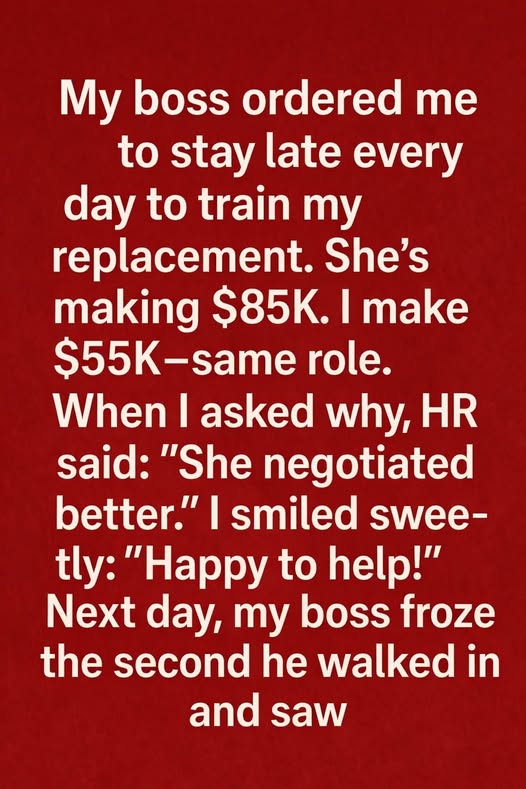
No discussion about performance. No mention of the years I had carried difficult projects or fixed critical problems behind the scenes. Just a simple explanation that made me feel invisible.
Still, I continued training her.
Every evening, we stayed late reviewing systems, client histories, workflow strategies, and the countless shortcuts I had developed through experience. I showed her how to spot risks before they became disasters and how to handle the pressure no manual could prepare someone for.
To be clear, none of this was her fault.
She was intelligent, respectful, and eager to learn.
But while teaching her, something unexpected happened.
For the first time, I truly saw the depth of my own expertise.
As I explained process maps, reporting structures, emergency procedures, and performance strategies, I realized how much knowledge I had quietly accumulated over the years. Things I had treated as “just part of the job” were actually highly valuable skills that kept the entire operation running smoothly.
I had spent so long minimizing my own contribution that I forgot how difficult my role actually was.
One morning, my manager walked by while we were reviewing a workflow chart I had created. The whiteboard was packed with systems, timelines, escalation plans, and efficiency improvements I had personally designed over time.
He stopped and stared.
Before I could answer his question about how training was going, the new hire spoke up.
She explained how complex the role really was and how much strategic knowledge I brought into every part of the process. She even admitted she was shocked by how much responsibility I had been managing alone.
For the first time, I saw my manager’s expression change.
It was subtle, but unmistakable.
He finally understood the scope of what I had been carrying.
That same week, I requested a formal compensation review.
This time, I didn’t walk in emotionally frustrated or uncertain. I walked in prepared. I brought documented achievements, measurable outcomes, successful project data, and salary comparisons from the current market.
I explained something many companies fail to recognize:
Negotiation only works when employees feel empowered to advocate for themselves in the first place. Quiet consistency and long-term performance deserve recognition too.
Whether my salary changes immediately or not, something inside me already has.
I no longer see myself as replaceable.
Training someone else didn’t diminish my worth.
It revealed it.
And for the first time in years, I stopped waiting for someone else to acknowledge my value before believing in it myself.
What Do You Think?
Have you ever discovered a major pay gap at work or realized you were being undervalued? Share your experience in the comments and join the conversation. Your story might encourage someone else to finally recognize their own worth too.