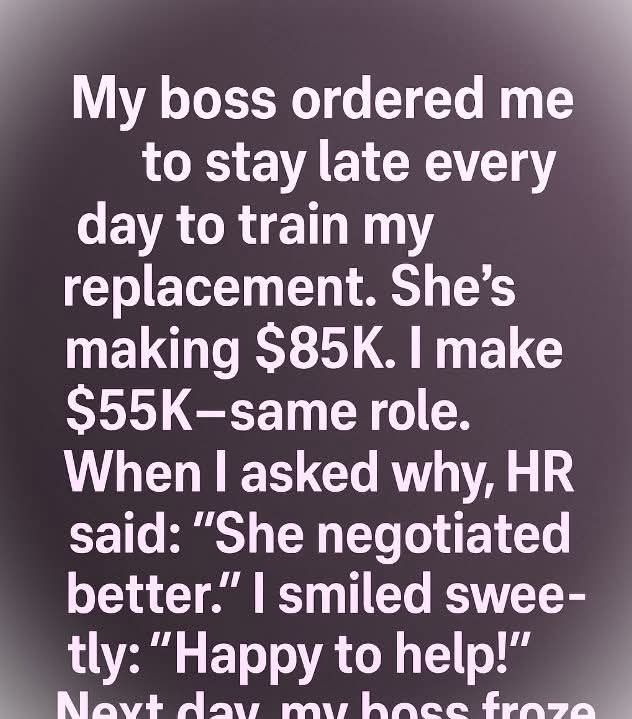
He said the company was “going in a different direction.” They’d hired someone new to “take over the department.” Then he added the part that was clearly meant to sting: he expected me to stay late all week to train my replacement.
He was waiting for the reaction—shock, pleading, embarrassment. Instead, I kept my face neutral, nodded, and said I’d do what I could.
Not because I was okay with it. Because I needed a minute to think.
HR Accidentally Revealed the Real Insult
Later that day, I went to HR to start the exit process. While paperwork was being pulled up, a hiring authorization document was left visible long enough for me to catch one detail that made my stomach drop.
My replacement’s starting salary: $85,000.
Same role. Same department. Thirty thousand dollars more.
I asked about the gap. The response was a shrug and a casual line that landed like a slap: “She negotiated better.”
That’s when the disappointment turned into something sharper—clarity. Not loud anger. Not a scene. Just a calm decision: I was done donating free labor to people who didn’t respect it.
I Pulled My Contract and Compared It to What I’d Actually Been Doing
Back at my desk, I opened my employment contract and the official job description. Then I started listing everything I’d been handling for years that wasn’t included—technical fixes, vendor management, crisis response, escalations, process improvements, and the invisible “keep-this-place-running” work that had become my normal.
Gregory had leaned on my reliability and made it seem like those extra responsibilities were just “part of being a team player.” But they were never formally assigned, never reflected in my title, and definitely never compensated.
I organized everything into a training plan—one that would be accurate, professional, and impossible to argue with.
Training Day: Two Stacks of Reality
Tuesday morning, Gregory introduced Sarah as the new lead. She seemed capable—also understandably nervous. When she sat down with me, I greeted her kindly, then set two labeled stacks of paper on the desk.
- Stack #1 (thin): “Official Contractual Job Duties”
- Stack #2 (massive): “Additional Tasks Performed Outside Scope”
Sarah stared at the second pile like it might tip over.
I explained, calmly and without drama: the thin stack was what I was hired to do for $55,000. The large stack was everything I’d been doing beyond my role—unpaid, unofficial, and expected anyway.
Then I told her the truth that mattered most: I would train her thoroughly on the duties in the first stack. But I would not be teaching the second stack—because those responsibilities were never part of my job, and I wasn’t going to keep normalizing them on my way out.
It wasn’t personal. It was boundaries.
What Happened When I Stopped Covering for Management
For the rest of the week, I trained Sarah on the actual role: standard reporting, routine invoices, documented procedures, and daily customer logs.
When she asked about handling server failures, complex vendor negotiations, or high-priority escalations, I kept my tone polite and consistent:
“That isn’t listed in my job description, and I was never officially assigned ownership of it. Gregory would be the best person to walk you through that.”
By Wednesday, the department started to wobble—because the “extra” work I’d been quietly doing wasn’t extra at all. It was critical. And without me absorbing it, it went exactly where it should have gone all along: to the person who had been taking credit while avoiding responsibility.
Gregory’s phone wouldn’t stop ringing. Vendors wanted answers. Errors piled up. Client issues escalated. He rushed out of his office multiple times demanding to know why things weren’t handled.
Each time, I pointed to the contract and repeated the same simple truth: those tasks were outside my role.
Sarah Understood the Trap—And I Refused to Help Set It
As the week went on, Sarah’s anxiety shifted into something else: relief. She admitted she’d assumed she was walking into an impossible workload and would be expected to “figure it out” alone.
She also realized something important: if I had quietly trained her on everything I’d been doing, Gregory would have simply transferred the same unpaid workload onto her and called it “leadership.”
Instead, she now had a clear map of what the job actually was—and what needed to be formally defined, staffed, or compensated if the company expected it to continue.
My Exit Was Quiet. The Impact Was Not.
On Friday, I completed the final item in the official duties stack. Then I walked into Gregory’s office, placed my resignation letter on his desk, and left without an argument, without a speech, and without looking back.
Two weeks later, I accepted a senior management role at a competing company for $95,000—proof that my skills had market value, even if my old workplace refused to admit it.
Gregory tried to use my exit as a power move. Instead, it exposed how much of the operation had been held together by one underpaid person doing work far above their pay grade.
Knowing your worth isn’t an attitude—it’s a strategy. And once you see the difference between loyalty and exploitation, it becomes a lot harder for anyone to take advantage of your work ethic again.
CTA: Have you ever been asked to train a replacement, take on “temporary” responsibilities, or do work outside your job description without fair pay? Share your experience in the comments—and if you want more real-world career lessons on salary negotiation, workplace boundaries, and professional growth, bookmark this page and check back for the next story.