Then I saw Warren reach for his keys.
At first, I assumed he just needed air. That was always his pattern—step away before feelings got heavy. But when I asked him for something small, a glass of water, he didn’t even move.
He stared at Henry the way someone inspects a cracked screen—quietly calculating the cost, the inconvenience, what it would take to replace it.
No tears. No panic. Just rejection.
He walked out like he was leaving an appointment that ran longer than expected. And in that moment, my life split cleanly into two parts: before and after.
I looked down at my son—so new, so unaware—and whispered the only promise I could make.
“I’m here,” I told him. “I’m not going anywhere.”
Even then, it felt like he understood.
The Years No One Turns Into a Pretty Quote
The years that came next weren’t cinematic. They weren’t “inspirational” in the way people like to package struggle into a neat social media caption. They were chaotic, expensive, exhausting.
I learned how to do stretches and exercises with hands that shook from sleep deprivation. I learned how to fight insurance denials, how to fill out paperwork that treated my child like a case number, and how to keep my voice steady when I wanted to scream.
I learned the special kind of loneliness that comes when people talk to you in hushed tones, like hardship is a virus they might catch if they get too close.
At church, people offered sympathy with lowered voices and sad eyes.
At school, there were “suggestions”—the kind that sound polite but land like a door closing. Maybe Henry would be “more comfortable” somewhere else. Somewhere “less demanding.”
Henry didn’t let anyone speak over him for long.
One day, sitting across from an administrator who thought she was being compassionate, he asked calmly, “Do you mean physically… or because you think I’m not smart?”
I had to press my lips together to keep from smiling.
He had my stubbornness. My refusal to shrink. And over time, that stubbornness turned into something powerful: self-respect.
He Didn’t Just Adapt—He Studied the System
By the time Henry was a teenager, he didn’t only understand his diagnosis—he understood the world around it. He read medical journals at our kitchen table. He asked better questions than some professionals. He corrected doctors who spoke about him like he wasn’t sitting right there.
One night, he said something that stopped me in my tracks.
“I want to be the person who talks to the patient,” he told me. “Not about them.”
That’s when I knew he wasn’t going to spend his life apologizing for taking up space. He was going to build something bigger than the limits people tried to assign him.
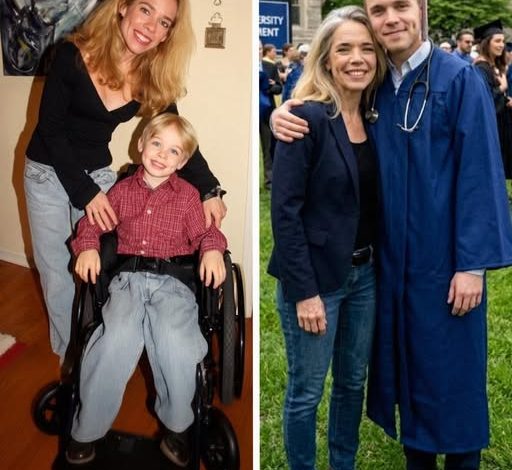
When he got accepted into medical school, I cried so hard I couldn’t breathe. I truly believed the hardest chapter was finally behind us.
I didn’t realize success has a way of attracting people who disappeared when the work was ugly.
His Father Came Back—But Only When It Looked Impressive
Twenty-five years after Warren walked out, he reached out.
Not when Henry needed procedures.
Not when pain stole his sleep.
Not when bills stacked up and I had to choose what could wait until next payday.
Only now—when the story looked polished from the outside. Only now, when there were accomplishments people could clap for.
I didn’t understand why he’d show up until the night it became painfully clear.
The room was full of proud families—flowers, cameras, speeches, the bright shine of achievement. I kept smoothing my dress, trying to calm nerves I couldn’t explain.
Then I saw him.
Older. Heavier. Well-dressed. But unmistakably the same man who left a hospital room without looking back.
He approached like we were old friends.
“You’ve done well,” he said, eyes scanning Henry. “No wheelchair. No cane.”
I felt something cold settle in my stomach. He wasn’t here to reconnect. He was here to collect.
To borrow credit for a life he didn’t help build.
The Speech That Changed Everything
When Henry stepped up to speak, the room quieted. He looked composed—steady in a way that made my chest ache.
Then he said words I will carry for the rest of my life.
“People like stories like this,” Henry began. “They see the white coat and assume it’s about perseverance. Mine.”
He paused, eyes scanning the crowd.
“But if I’m standing here tonight, it’s not because I was born unusually strong. It’s because my mother was.”
The air in the room shifted.
Henry continued, voice clear. “When I was born, a doctor told my parents my life would be harder than expected. My father left that day.”
I stopped breathing.
“My mom carried me into every room my father was too weak to enter. So no—this isn’t a proud moment for both my parents. It belongs to the woman who never missed a hard day.”
He looked toward me then, and I felt twenty-five years of struggle tighten in my throat.
“Everything good in me learned her name first.”
For decades, I carried the weight of being the only one who stayed.
In one honest moment—surrounded by strangers—my son gave that truth a voice I never dared to demand.
After the Applause
Later, Warren cornered Henry, his face tight with indignation.
“You brought me here for that?” he asked.
Henry didn’t flinch. “I didn’t embarrass you,” he said. “I told the truth.”
On the drive home, the city lights blurred past the windows, and something inside me finally settled.
I used to think I raised my son alone.
But the truth is, every therapy session, every late-night worry, every battle I fought when I wanted to collapse—those weren’t just survival.
They were instruction.
And in the end, Henry didn’t only become a doctor.
He became the kind of man his father never had the courage to be.
If this story moved you, share your thoughts in the comments—have you ever had to rebuild your life after someone walked away? And if you’d like more real-life stories about resilience, parenting challenges, and starting over, subscribe or follow so you don’t miss the next one.