“Why does he just sit there?” he asked.
I didn’t have a good answer. So we did the simplest thing: we went to ask.
The Real Issue: No Ramp, No Independence
Caleb’s mom, Renee, opened the door. She looked exhausted in a way that went beyond being busy—like someone who’s been carrying too much for too long.
When we asked about Caleb, she gave a small, apologetic smile.
“He wants to go out more than anything,” she admitted. “But we don’t have a ramp. If he needs to leave the porch, I have to lift him every time. And I can’t always do that.”
They’d been trying to save for a ramp for more than a year. Insurance wouldn’t cover it. Contractors were expensive. Everything kept getting delayed.
And that’s when Ethan did something I didn’t expect.
Grief, Purpose, and a Blueprint on the Kitchen Table
That night, Ethan skipped the usual distractions. No games. No phone. He sat at the kitchen table with paper and a pencil, sketching and erasing until the lines finally started to look like a plan.
“I think I can build a ramp,” he said.
His dad—my husband—had taught him basic carpentry before he passed away three months earlier. Small projects at first, then bigger ones. Building things was one of the few ways Ethan still felt connected to him.
The next day, Ethan poured out his savings jar onto the table.
“That was for your new bike,” I reminded him gently.
He nodded without hesitating. “I know. But he can’t even get off his porch.”
He Bought the Materials Like a Pro
We went to the hardware store together. Ethan didn’t guess—he measured, asked questions, checked angles, and chose materials carefully. He treated it like a real job, not a kid’s project.
After school, he dropped his backpack and got to work: measuring, cutting, sanding, adjusting. His hands got scraped up, but he didn’t complain once.
I helped where I could, but Ethan led the build from start to finish.
By the third evening, he stepped back and studied the ramp.
“It’s not perfect,” he said. “But it’ll work.”
Caleb Rolled Down the Ramp—and Everything Changed
We carried it across the street and installed it with Renee. At first she looked confused, then stunned as she realized what Ethan had made.
When the ramp was secure, Renee turned to her son.
Caleb placed his hands on the wheels and rolled forward. The moment he moved down the ramp and onto the sidewalk by himself, his face transformed—like someone had just handed him freedom.
Within minutes, other kids gathered around him. Someone asked if he wanted to race. Caleb laughed—an honest, full laugh—and joined in.
For the first time, he wasn’t just watching life from the porch.
Ethan stood beside me, quiet, but glowing.
The Next Morning: An Entitled Neighbor Destroyed It
The next day I woke up to shouting. I ran outside barefoot and stopped cold.
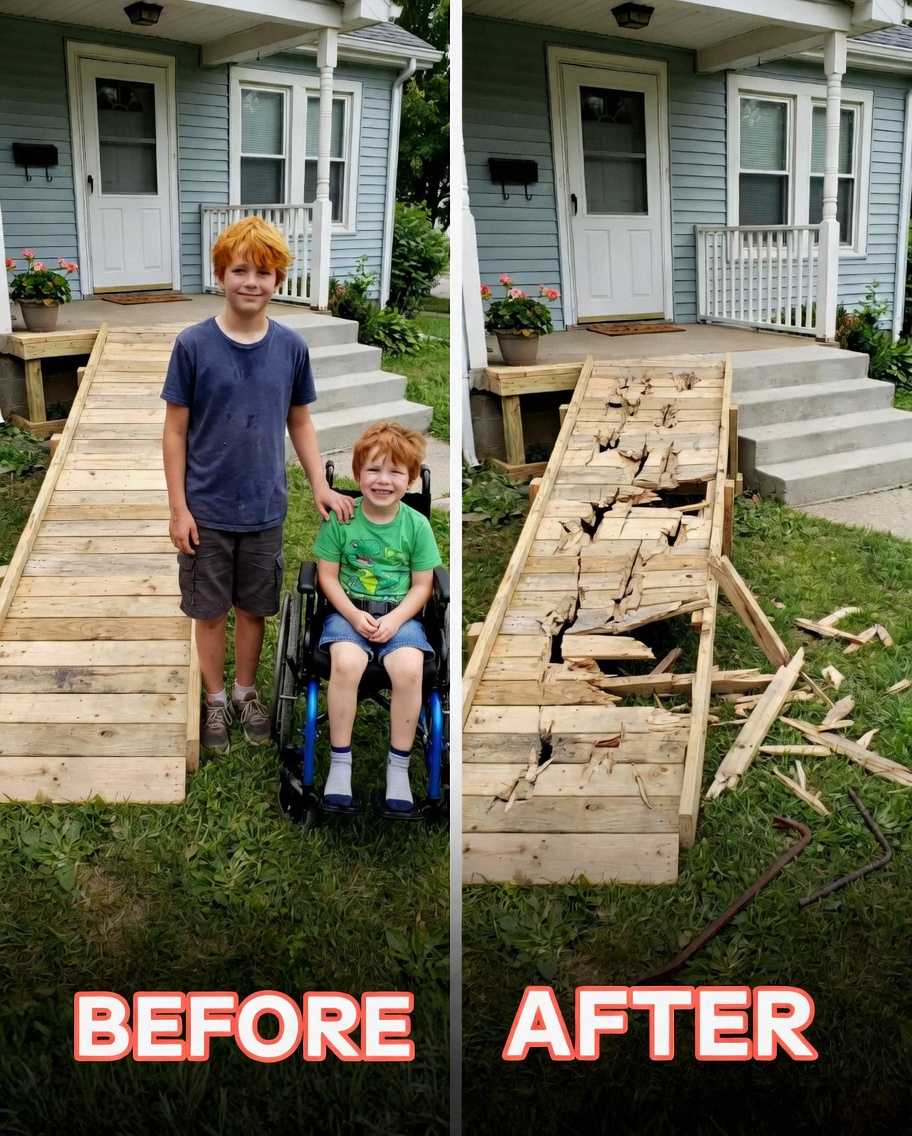
Mrs. Harlow—our neighbor—stood in front of Caleb’s house, furious. Before anyone could stop her, she grabbed a metal bar and slammed it into the ramp.
Again. And again.
Wood splintered. Screws popped loose. The ramp collapsed into broken pieces.
She tossed the bar aside like it was nothing and snapped, “Fix your mess.”
Later, I found Ethan sitting on his bed, staring down at his hands.
“I should’ve built it stronger,” he whispered.
“No,” I told him. “You built something kind. The problem isn’t your ramp. The problem is someone who thinks accessibility is optional.”
Then the Black SUVs Arrived
The following morning, black SUVs pulled up in front of Mrs. Harlow’s house.
Not police. Not neighbors.
Men in suits stepped out and walked to her door. Mrs. Harlow answered with a bright smile—until the conversation shifted. From where I stood, I couldn’t hear every word, but I watched the confidence drain from her face.
Here’s what we learned soon after:
Mrs. Harlow had been interviewing for a high-level leadership position at a national organization that promotes kindness, community support, and inclusive programs for people with disabilities.
And someone had seen what she did.
When she tried to explain it away—“It’s not what it looks like…”—one of the men cut in calmly:
“It’s exactly what it looks like.”
A Community Investment She Didn’t See Coming
They also announced something no one expected: the foundation planned to purchase the empty lot behind her home.
Not to build something private.
To build something public—something meaningful:
- Accessible pathways designed for wheelchairs and mobility devices
- Adaptive playground equipment so kids of all abilities could play together
- Permanent ramps and inclusive community features
And Caleb would get a professionally built wheelchair ramp—safe, durable, and up to code.
A Tribute That Brought Us to Tears
Then they said something that hit me right in the chest.
In honor of Ethan’s father—who had served as a firefighter—they would dedicate part of the new accessible space to his memory. A permanent installation that would carry his name and service forward.
Mrs. Harlow sank to the ground, speechless, watching everything unravel in real time.
And our street felt different after that—like the neighborhood itself had chosen a side.
What This Taught Our Whole Neighborhood
One child saw a barrier and decided to solve it.
One adult saw the same thing and decided to tear it down.
In the end, the choices people make when no one “important” is watching say more than any speech, sign, or social media post ever could.
If this story moved you, share your thoughts in the comments: What’s one small act of kindness you’ve seen—or done—that made a real difference? And if you want more real-life stories about community, parenting, and doing the right thing, stick around and read the next one.